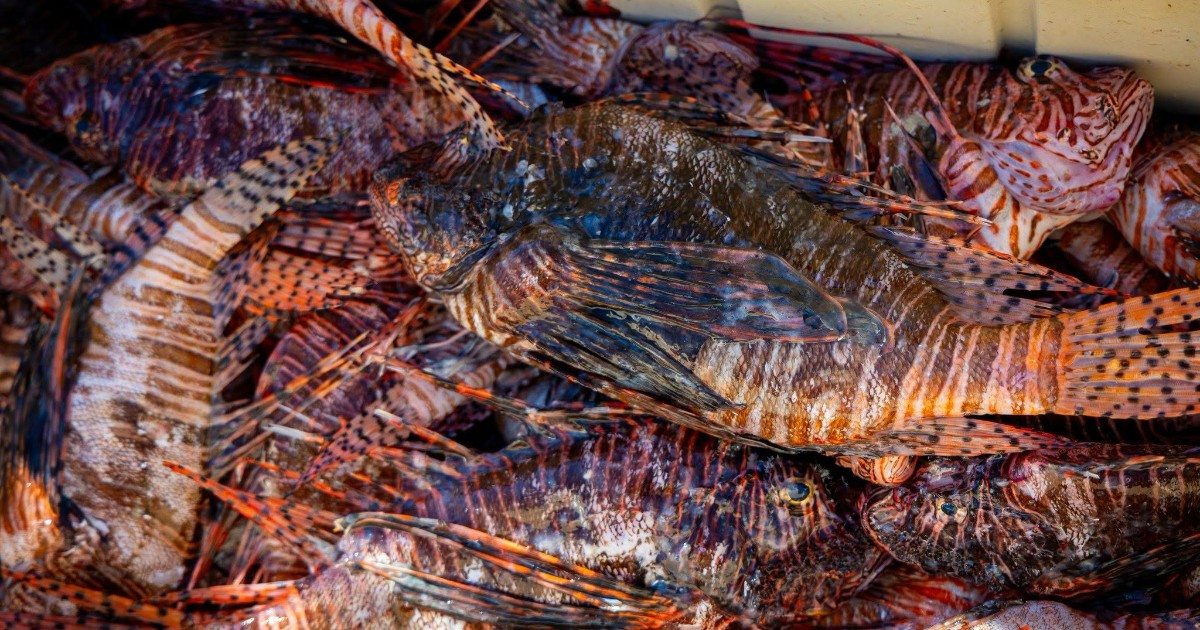
Florida set a new record in the fight against the lionfish, an invasive species that threatens reefs and marine biodiversity.
During the 2026 edition of the Lionfish Challenge, 533 participants removed 36,187 specimens from the waters of the state, a record number since the program's inception and exceeding last year's results by more than 5,000 captures.
The Florida Fish and Wildlife Conservation Commission (FWC) reported this Monday that participants conducted 1,468 dive sessions during the competition, organized to reduce the presence of this predator in marine ecosystems.
The organization emphasized that the results set a record in both participation and the removal of lionfish, reflecting the growing interest of recreational divers and commercial fishermen in contributing to the management of the species.
"The record success of the Lionfish Challenge demonstrates the powerful impact that collective action can have on conservation," stated Rodney Barreto, president of the FWC.
The official explained that removing thousands of specimens from Florida's waters helps reduce pressure on native species and protect underwater ecosystems.
The competition took place over the summer, from May 22 to September 14, and allowed divers from various areas of Florida to participate.
In this year's edition, the FWC expanded the award categories to recognize six winners, including recreational divers, commercial fishers, young people, and military veterans.
Hunter Ledbetter, from Monroe County, earned the title of Lionfish King after removing 1,541 specimens during the competition.
The same participant, a veteran of the United States Marine Corps, also won the category reserved for military personnel and veterans.
For her part, Helen Rodney from Broward County was recognized as Lionfish Queen after capturing 1,488 fish.
The difference between the two participants was just 53 specimens, which highlights the high number of catches achieved individually during the competition.
In the commercial category, David Garrett from Volusia County won after removing 1,136 pounds of lionfish, approximately equivalent to 515 kilograms.
The youth category was won by Meagan Huffman from Texas, who caught 185 specimens.
The establishment Dive Pros, located in Pensacola, received recognition as the main checkpoint of the competition, after logging over 5,000 lionfish tails submitted by participants.
These queues are used in the verification process for catches of the program, while commercial fishermen must present the relevant documentation for their operations.
Jessica McCawley, director of Marine Fisheries Management at FWC, thanked the participation of divers, collaborating companies, and the communities involved.
"We are extremely grateful for the support of our staff, sponsors, and the community that contributed to this achievement," he expressed.
The official emphasized that the 2026 edition demonstrated the importance of collaboration between those who engage in recreational diving and those involved in the commercial extraction of marine species.
The Lionfish Challenge is an annual program in which participants receive prizes and recognition based on the number of lionfish they capture and the categories they compete in.
Unlike other invasive species control contests in Florida, registration for the Lionfish Challenge is free, according to the FWC.
The competition is open to participants who meet the program's conditions and take their catches in Florida waters.
Interested parties can check the requirements and conservation activities through the official Lionfish Challenge website.
The effort to control this species has a history of several years in the state.
In May 2019, Florida held a new edition of the Lionfish Challenge to encourage the capture of lionfish, offering prizes for participants who reached specific extraction volumes.
That initiative was already aimed at drawing attention to the damage caused by this fish and encouraging collaboration between divers and environmental authorities.
The problem also affects Cuba and other territories in the Caribbean.
In September 2022, Cuban authorities announced a campaign to encourage the capture of lionfish, featuring fishing activities and cooking contests aimed at promoting its use.
The presence of this invasive species on both sides of the Florida Strait reflects the regional dimension of an environmental issue that is not confined to U.S. waters.
The lionfish, native to the Indian and Pacific Oceans, has become an environmental problem in the waters of the western Atlantic, the Gulf of Mexico, and the Caribbean.
Its expansion is particularly concerning because it feeds on numerous small fish and crustaceans, including juvenile specimens of species that play important roles in coral reefs.
Additionally, it has venomous spines that can cause painful injuries and make handling difficult, although this does not prevent trained specialists and fishermen from capturing it.
One of the reasons for its rapid expansion is its reproductive capacity, combined with the scarcity of predators capable of keeping its populations under control in the invaded areas.
The abundant presence of lionfish can disrupt underwater food chains and increase pressure on local species that are already facing threats related to reef degradation.
Therefore, the authorities in Florida maintain extraction programs aimed at reducing their abundance, although the removal of thousands of individuals does not mean that the species has been eradicated.
Related videos:
Filed under: