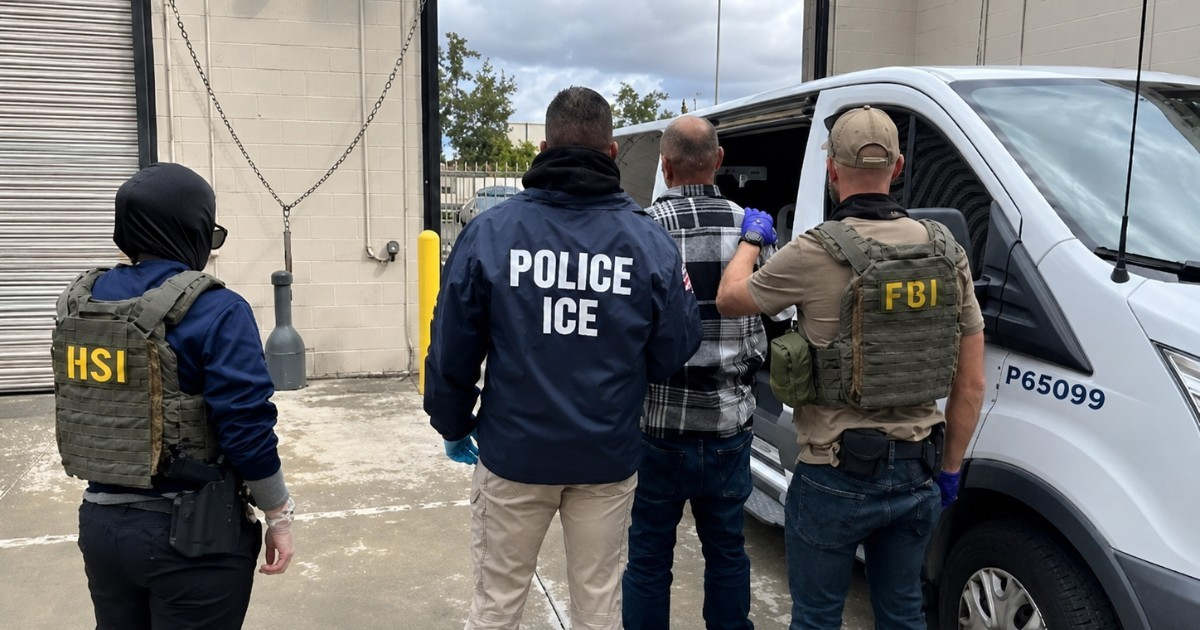
The U.S. Immigration and Customs Enforcement (ICE) launched a nationwide operation against immigrants accused of fraudulently obtaining benefits from the Supplemental Nutrition Assistance Program (SNAP), commonly known as food stamps, and among the first detainees is a Cuban citizen.
The woman has been identified as EPR, who, according to federal authorities, is in the United States illegally and was arrested as part of this new offensive.
The operation was confirmed by ICE to the media Fox News, which reported this Tuesday that the authorities described the initial arrests as the beginning of a sustained campaign to identify foreigners who allegedly received food assistance without meeting the legal requirements.
Who is the Cuban woman detained by ICE?
EPR is identified among the first individuals arrested in the national operation. The Department of Homeland Security of the United States (DHS) described her as a Cuban citizen without legal immigration status in the United States.
According to the information provided by the department to Fox News, the Cuban woman had previously been convicted of disorderly conduct and also had arrests for charges of assault and domestic violence.
Regarding the alleged food fraud, authorities did not disclose what documents may have been used, how much money was received, over what period, or whether specific criminal charges related to SNAP were filed.
There has also been no public report of a conviction for this alleged fraud. Therefore, the arrest alone does not prove that a crime has been committed.
Four other Haitian immigrants among those arrested
In addition to the Cuban, authorities identified four Haitian citizens: Rubstony Junior Theodore, Wilbert Jean Baptiste, Louis Jean, and Jhensly Charles.
According to the DHS, Theodore had a history of arrests for theft, obstruction of law enforcement officers, and illegal entry onto someone else's property. Regarding the other three detainees, the information released did not provide equivalent details about their backgrounds.
The authorities state that the five foreigners were arrested as part of actions against the alleged fraudulent access to benefits funded by federal funds.
It was not specified whether their cases are related to each other or if they pertain to independent investigations conducted in different states.
"A drop in the ocean": DHS announces more operations
The Secretary of Homeland Security, Markwayne Mullin, defended the operation and stated that unauthorized immigrants in the United States should not use federal programs for which they do not qualify.
«These programs are for Americans only», declared the official, although federal legislation also allows certain categories of foreigners who meet the required conditions to access SNAP.
Mullin described the initial results of the federal actions as "a drop in the ocean," referring to the scope that the Government aims to give to its investigations.
For its part, the DHS characterized the initial arrests as the beginning of a large-scale and sustained operation against the alleged fraudulent use of food stamps.
The announcement comes in the context of the Donald Trump administration's initiatives to investigate fraud in public programs and strengthen the enforcement of immigration laws.
Can Cubans continue to receive food stamps in the United States?
Yes. Certain Cuban citizens can continue to legally receive SNAP, as long as they meet both the applicable immigration requirements and the economic and administrative conditions of the program.
The rules changed following the approval of the federal law known as One Big Beautiful Bill Act in 2025, which restricted the categories of eligible foreigners.
According to the official guidance from the United States Department of Agriculture (USDA), the currently included categories encompass legal permanent residents who meet the waiting periods or their exceptions, individuals classified as Cuban/Haitian Entrants, and certain citizens from countries with special agreements with the United States.
Cubans and Haitians with the special classification of "entrant"
One of the most significant exceptions is the so-called Cuban/Haitian Entrant, established in federal legislation for certain individuals coming from Cuba and Haiti.
This classification has a particular feature: it is used to determine eligibility for certain benefits and does not necessarily correspond to an independent category of immigration status.
Individuals recognized within this classification may be eligible for SNAP without having to fulfill the general five-year waiting period that applies to many permanent residents.
The USDA maintains specific guidelines on the verification of Cubans and Haitians through the federal SAVE system, which is used by agencies to verify documentation and immigration classifications.
What happens to Cubans who have an I-220A?
The I-220A form, known as the order of release on recognizance or appearance bond, has raised numerous immigration questions among Cubans who entered the United States through the border.
Possessing an I-220A does not automatically equate to having permanent residency nor does it guarantee the right to receive SNAP.
However, that does not necessarily mean the person is excluded. Certain Cubans with that document may qualify for the special classification of Cuban/Haitian Entrant, depending on their immigration status and the corresponding verification.
An official SNAP eligibility guide for North Carolina, updated in February 2026, expressly includes the I-220A among the documents that can be used to assess that classification for Cuban or Haitian citizens.
It also includes certain documents related to pending asylum applications and ongoing immigration proceedings.
This documentary criterion does not mean that all individuals with an I-220A are automatically eligible, nor does it replace the verifications that the agency in charge of the program in Florida must carry out.
And what about asylum seekers, parole beneficiaries, and permanent residents?
The new federal provisions also introduced important changes for other immigration categories.
- Asylum seekers and refugees: these classifications alone no longer confer independent eligibility for SNAP under the new rules. However, a Cuban or Haitian may retain the right if they also meet another qualifying classification, such as Cuban/Haitian Entrant.
- Parole beneficiaries: parole alone no longer guarantees eligibility. Certain Cubans and Haitians may still qualify through the specific exception for both nationalities.
- Permanent residents: may be eligible based on the five-year waiting period and applicable exceptions. Obtaining residency under the Cuban Adjustment Act does not eliminate the need to verify the relevant rules.
- Individuals without a qualifying immigration category: do not have the right to receive SNAP for themselves, although other eligible members of their family may still receive benefits.
The official explanation of the eligibility changes published by North Carolina outlines how the reform restricted benefits for certain foreigners while maintaining the exemption for Cubans and Haitians included in the special classification.
What should Cubans in Florida do if they receive a letter about their benefits?
Families currently receiving food stamps should pay attention to official notifications, especially if they are asked to update their immigration, economic, or family information.
The Florida Department of Children and Families (DCF) stipulates that applicants must meet the conditions of state residency, income, identity, immigration status, and other program requirements.
If you receive a review request, it is advisable to ensure that it comes from an official channel, carefully read the deadlines, submit true and up-to-date documentation, and keep copies of the responses sent.
Those who have documents such as I-220A, I-94, work permits, or asylum application receipts may need an individual assessment to determine if they meet any eligibility classification.
The procedures and communications can be accessed through the official portal MyACCESS Florida.
An administrative review, a change in eligibility, or a request for documentation does not automatically indicate that a criminal investigation for fraud is underway. If an individual receives a formal accusation or communication from immigration authorities, it is particularly important to seek specialized legal advice.
Este operativo de ICE forma parte de una campaña más amplia que podría afectar a miles de inmigrantes en todo el país. Sigue todos los detalles y novedades en nuestra sección de
Related videos:
Filed under: