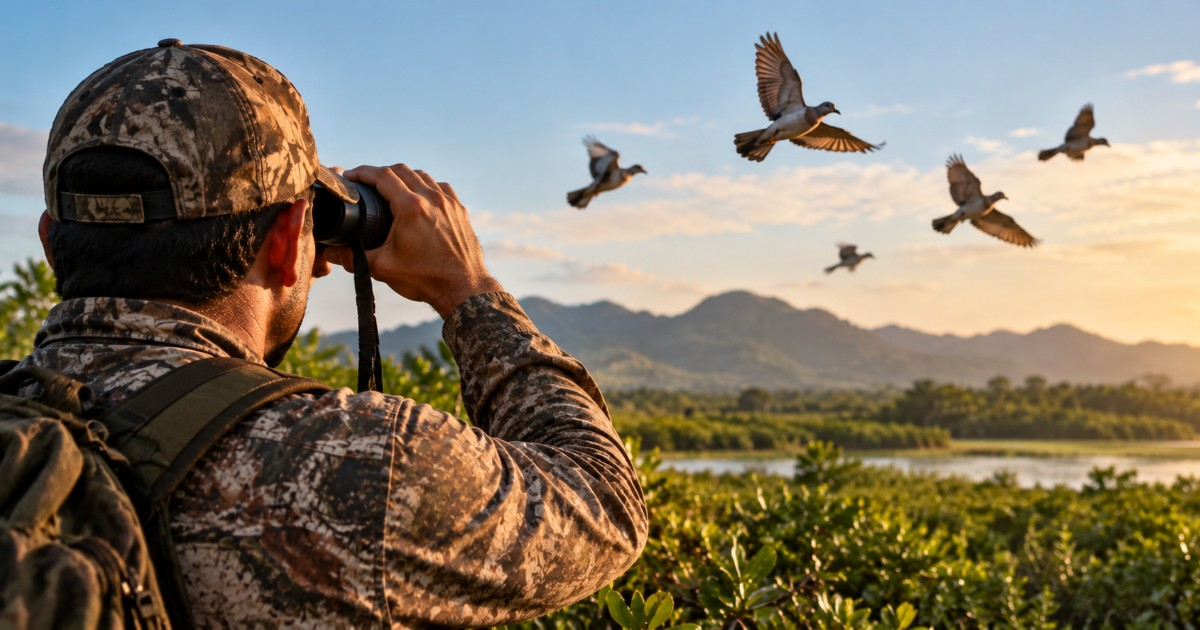
The Ministry of Agriculture of Cuba has established regulations for the 2026-2027 hunting season, through a resolution that determines the authorized species, the areas where this activity may take place, and the restrictions that hunters must comply with throughout the national territory.
The measure is included in the , published this Wednesday in the Official Gazette of the Republic of Cuba No. 93 Extraordinary of 2026.
The document establishes the hunting calendar from September 5, 2026, to March 28, 2027, meaning that the season had already begun when the regulation was published.
The regulation, signed on August 31 by the Minister of Agriculture, Ydael Jesús Pérez Brito, aims to regulate the use of wildlife and protect species whose capture is prohibited.
Among its main provisions is the exclusion of two species of doves from the list of animals that can be hunted during the season: the white-tipped dove (Patagioena leucocephala) and the purple-collared dove (Patagioena squamosa).
In the case of the white-crowned pigeon, the Ministry states that it is listed in the Red Book of Vertebrates of Cuba, which makes its protection through a legal ban necessary.
The crowned pigeon, for its part, is listed as a species of special significance, whose hunting requires a specific environmental license.
The resolution states that all species not listed in the official list of authorized animals are excluded from hunting. Their capture is considered illegal and may result in the penalties outlined in current legislation.
Annex I of the regulations contains the list of authorized game species and the maximum quantities that can be captured per session and per hunter, while Annex II identifies the areas and approved hunting grounds for the season.
These provisions apply to Cuban hunters, foreign residents in the country, and, under the appropriate conditions, to foreigners participating in international hunting activities.
For national and foreign hunters residing in Cuba who are members of the Cuban Federation of Sporting Hunting, the activity may only take place on Saturdays, Sundays, and public holidays, within the authorized areas and with permits issued by the Municipal State Forestry Service.
The permitted hours extend from sunrise to sunset. Additionally, hunting can only be carried out on authorized species when they move through their natural habitat, either during the flight of birds or in designated areas for hunting mammals.
It is expressly forbidden to shoot from moving land or water vehicles.
The resolution also establishes the obligation to use dogs to retrieve downed pieces and sets rules for their identification.
In the case of birds, the head and one wing with feathers must be preserved, while mammals should be transported eviscerated.
Another important restriction is related to the capture methods. The Ministry of Agriculture prohibits the use of lures, sticks, hooks, nets, traps, explosives, poisons, and poisoned baits, as well as other procedures that do not correspond to the authorized weapons.
It also does not allow the use of live birds as decoys, including those that have been blinded or mutilated, nor the use of tape recorders, artificial lighting sources, dazzling objects, or devices intended to illuminate the targets.
The provision also establishes that animals caught in hunting areas may be used for the consumption of the hunter themselves, but not for commercialization.
Regarding the permits, the regulation states that individual documents will be valid exclusively during the corresponding season. Until further provisions are established, they may be used in any of the authorized hunting areas of the national territory.
The State Forestry Service will be responsible for issuing the permits, while the Cuban Federation of Sport Hunting will participate in their distribution and in supervising the activities.
The resolution also includes exceptional authorizations for the capture of certain species not listed in the calendar, provided that the relevant legal and environmental requirements are met.
In the case of species of special significance, an environmental license issued by the Office of Environmental Regulation and Safety will be required.
The regulation specifies that international sporting hunting activities are not permitted during the 2026-2027 season, although they may be exceptionally authorized through special permits granted by the Directorate of the State Forest Service.
For these authorizations, interested entities must submit their applications at least 15 business days in advance and demonstrate the safety, organization, and availability of the relevant areas.
The new provisions replace the regulations from the previous season, approved by the , which established the hunting calendar from September 2025 to March 2026.
Related videos:
Filed under: