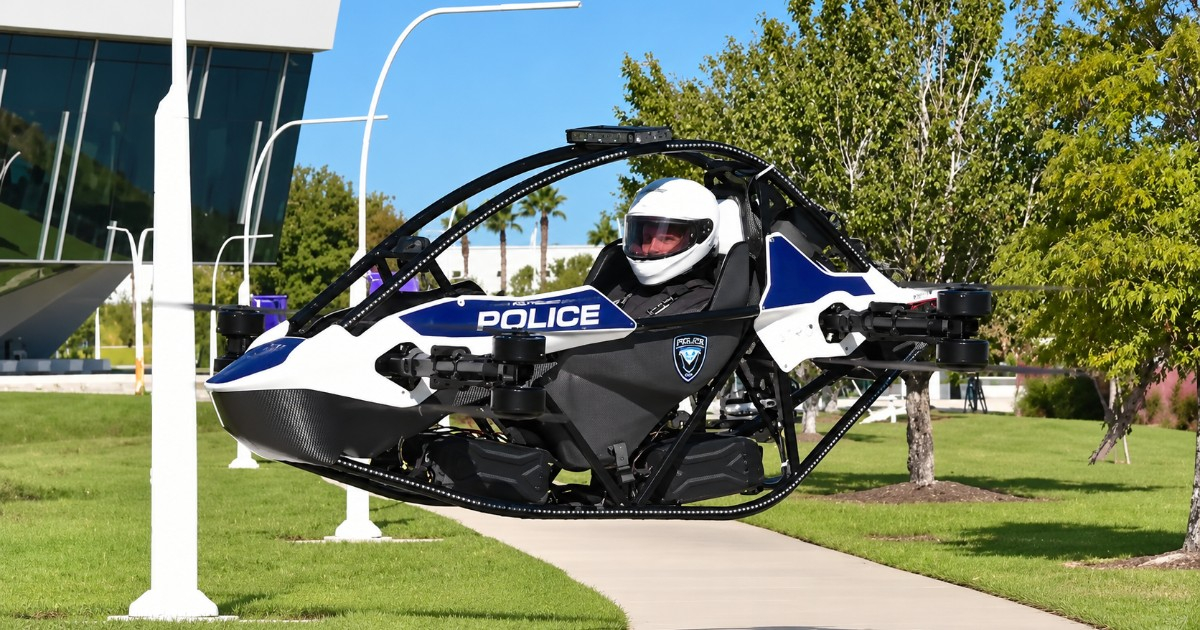
A university in Florida has unveiled what it describes as the first electric flying police vehicle in the United States, a manned aircraft that costs nearly 150,000 dollars and is designed to assist with patrols, search operations, and emergency response.
The vehicle, named «Astro», was presented on Tuesday by the Police Department of Florida Polytechnic University (Florida Poly), located in Lakeland, in the central part of the state.
According to the university's official report, it is the first police agency in the country to incorporate a crewed electric aircraft with vertical takeoff and landing, known by the acronym eVTOL, into its operational project.
Although it seems like a vehicle from a science fiction movie, Astro is still not conducting regular police patrols.
The institution is in the final phase of the procedures to obtain the corresponding authorization from the Federal Aviation Administration (FAA).
The device operates with electric motors and can take off vertically without needing a runway.
Unlike the drones typically used by police forces, it features a seat for an officer to pilot it directly.
According to a report by FOX 13 Tampa Bay, the university paid nearly $150,000 for the aircraft, which weighs approximately 154 pounds without its battery and can stay in the air for about 20 minutes.
The vehicle is a Jetson ONE model, developed by the company Jetson, and is designed to carry a single person.
According to reported by Spectrum News, it has a payload capacity of up to 210 pounds and can reach an altitude of 400 feet (almost 122 meters).
Its relatively limited autonomy means that it is not designed to replace police cars or helicopters used in prolonged operations.
The university aims to assess its usefulness in interventions that require quick movement to hard-to-reach locations.
Among the potential applications are the search for missing persons, monitoring the university campus and its surrounding areas, as well as responding to emergencies in regions where terrestrial vehicles cannot easily access.
The institution also plans to use it to support recovery efforts after hurricanes and other storms, especially when flooding, debris, or damage to roads hinder access to certain areas.
Another possibility is to transport emergency supplies to isolated locations, always within the technical and operational limitations of the aircraft.
The head of the university police, Aaron Murray, explained that the incorporation of this technology aims to anticipate the changes that public safety may experience with the development of new forms of aerial mobility.
"Advanced air mobility is an emerging technology, and we can choose to be proactive or reactive as it develops," stated Murray in the university press release.
The official noted that the intention is to understand how these aircraft can contribute to enhancing public safety and airspace management.
The Florida Poly Police also plans to collaborate with other security agencies in the region to explore the use of Astro during emergencies and joint operations.
However, there is still no confirmed date for the start of their official police flights.
FOX 13 reported that the project leaders hope to receive FAA authorization between November and the end of December, although that timeline is not guaranteed.
The name of the aircraft also has a unique story. “Astro” is a reference to the dog from the animated series The Jetsons, which since the 1960s envisioned a futuristic society where flying vehicles are part of everyday life.
The manufacturing company, Jetson, decided to prioritize the order from Florida Polytechnic University despite the fact that its model Jetson ONE has a waiting list of approximately three years.
According to Stéphan D'haene, the company's CEO, the decision was driven by the interest in utilizing this technology in applications that extend beyond entertainment and recreational flights.
The manufacturer believes that the university project will allow for the exploration of new possibilities for light electric aircraft in activities related to public safety.
In addition to its potential police functions, Astro will have a second use: it will serve as a tool for research and training for students of engineering and computer sciences.
The university began offering a new Aerospace Engineering program this fall and believes that the aircraft will provide opportunities to analyze emerging technologies through hands-on experiences.
A group of students is already collaborating with the team to study its characteristics and develop academic projects based on operational information.
According to FOX 13, university researchers are also studying the creation of a "digital twin," which is a virtual representation of the vehicle and its operational environment, that could be used to design training scenarios through virtual reality.
The professor Matt Bohm, in charge of the Mechanical, Industrial, and Aerospace Engineering department, explained to the television station that these tools would allow operators to prepare for different situations before facing them in real conditions.
The presentation of Astro comes at a time when Florida is promoting the development of advanced air mobility, a technology that includes electric aircraft capable of taking off and landing vertically.
In April, Florida approved legislation to facilitate the future operation of electric flying taxis by creating a legal framework for the development of vertiports and charging infrastructure.
The law HB 1093, signed by Governor Ron DeSantis, established provisions to incorporate those facilities into the state transportation system and allow financing mechanisms for their construction.
Related videos:
Filed under: