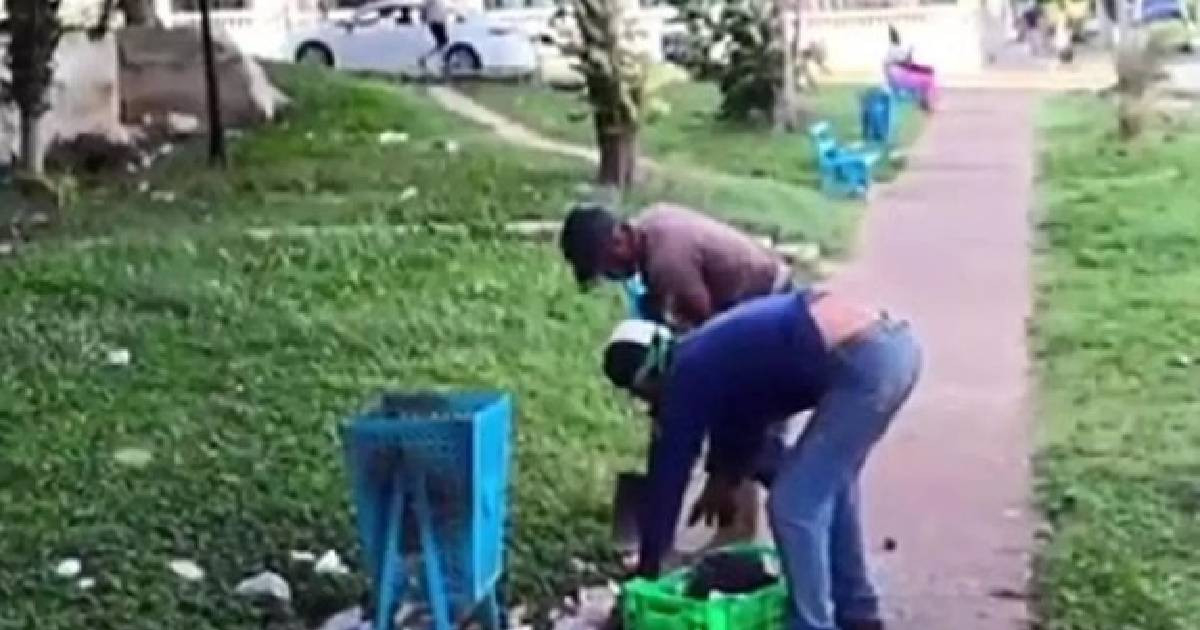
Two workers from the local development project (PDL) El Rampeño collected waste in the park at 19 and M, in El Vedado, without hand protection or basic tools, a scene documented this Friday by the independent newspaper 14ymedio, which contrasts with the promise to modernize waste collection in Havana through electric tricycles.
One of the workers was holding a small plastic box while the other was picking up papers and containers directly from the ground, with no brooms or dustpans in sight.
When they both returned to the cargo vehicle parked next to the sidewalk, there were still remnants among the grass and around the trees. “Look at the collectors, how they work, with their hands!” commented a neighbor.
The scene contrasts with the image shared on the same day by the EFE agency, which highlighted the work of around 15 electric tricycles providing service to restaurants, stores, markets, homes, and tourist establishments, including the Hotel Nacional de Cuba.
The entrepreneur Yasier Hernández, 35 years old, explained to the agency that the project combines private capital and sustainable technology to address fuel shortages and the decline of community services.
The PDL El Rampeño was launched in June with the promise of incorporating 30 electric tricycles, providing door-to-door pickup in 14 districts of the Rampa Popular Council, and installing a solar charging station at the corner of 23 and J.
However, the service started on July 1 with just five vehicles, and the fleet still does not reach half of the announced quantity.
The limitations are not just about the number of tricycles. According to observations by 14ymedio, some of the waste remains in the area after cleaning efforts. The vehicles make two rounds daily, at 8:00 AM and 8:00 PM, while the PDL employs 40 workers and charges 100 pesos per month per household.
In August, Pedro Garcés, president of the Rampa Popular Council, acknowledged that the project had not achieved its initial goal. "Unfortunately, the initial idea and the objective for the solid waste collection using electric tricycles has not been realized," he stated. He also pointed out that the solar station at 23 and J remained unfinished and criticized the delay in seeking charging alternatives during power outages.
Despite these difficulties, the conditions on the streets served by El Rampeño are better than in other parts of the capital. At the corner of Villanueva and Melones in Luyanó, a front loader had to clear a mountain of trash accumulated near the Miguel Enríquez hospital, known as La Benéfica. "They had that mountain of trash there for quite a few days," a neighbor told 14ymedio.
The crisis of communal services in Havana predates these private initiatives. At the beginning of the year, only 44 out of the 106 collection trucks in the capital were operational due to a lack of fuel and deterioration.
The private management model with charges to residents is also applied in other territories. In August, the mipyme Belmary started charging 100 pesos per month per household in the Isle of Youth as a fixed fee for waste collection.
In September, it was announced that the mipyme Almaley S.R.L. formally began the hiring process to collect and manage solid waste in the Historic Center of Camagüey, due to the challenges faced by state communal services.
Due to the inability to collect waste with trucks because of a lack of fuel, neighbors and delegates from the Casino Deportivo neighborhood, in the Cerro municipality of the capital, have organized their own community waste collection alternative.
Related videos:
Filed under: