On June 8, 1978, 48 years ago, the Russian writer Aleksandr Solzhenitsyn delivered one of the most extraordinary and prophetic speeches of the 20th century at Harvard University. That man, awarded the Nobel Prize in Literature in 1970, a survivor of the Soviet concentration camp system and expelled from his homeland in 1974, had personally witnessed the horrors of communism.
The West was expecting to hear a new condemnation of Soviet totalitarianism. But Solzhenitsyn surprised his hosts with a stern warning directed at the Western democracies themselves.
His speech, titled "A Divided World," denounced the loss of civic courage, the worship of material well-being, spiritual decay, and the dangerous tendency of political and intellectual elites to justify weakness in the face of aggressors.
Solzhenitsyn saw a civilization that had reached extraordinary levels of prosperity, scientific development, and individual freedoms, but which risked losing the moral convictions necessary to defend its achievements.
The Russian writer warned that those who had turned comfort and the fulfillment of material desires into ultimate goals could end up viewing any sacrifice for freedom as an unbearable burden.
Forty-eight years later, his words carry a chilling relevance. Let us look at Europe, and also at the Cubans who leave Cuba and only think about material things, showing no concern whatsoever for the struggle for freedom of their enslaved homeland.
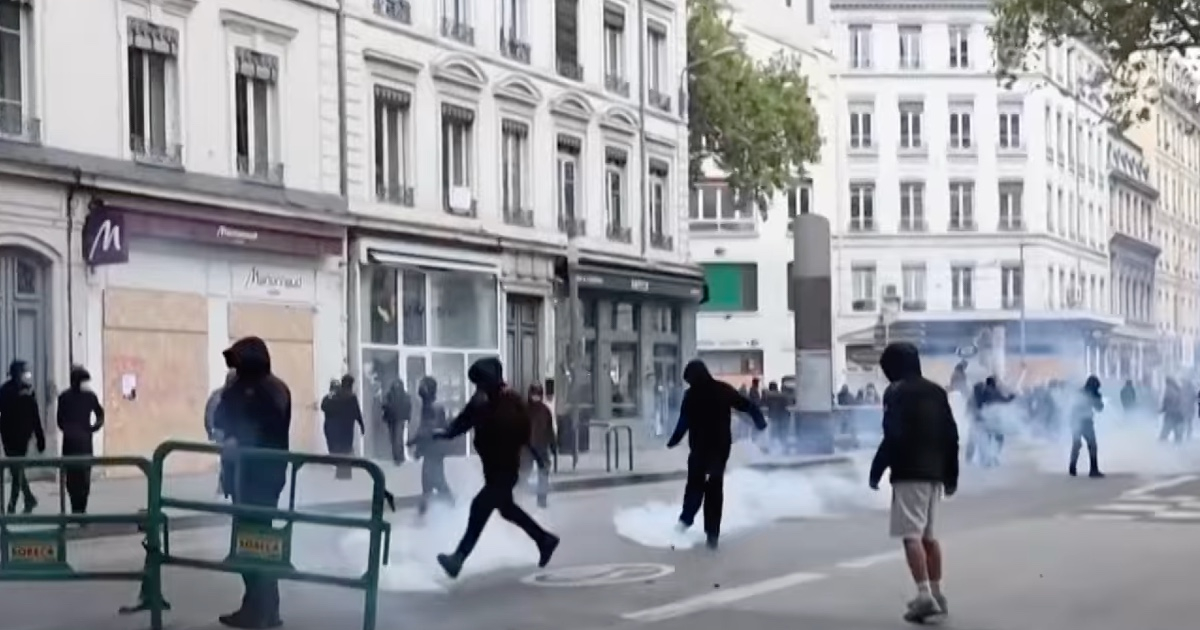
Paris, one of the great capitals of Western civilization, is experiencing new days of social tension. During October 2026, protests over the cost of living, educational shortcomings, and economic discontent have led to violent clashes, fires, looting, and attacks on public buildings. The far left and Islamic radicalism pose an increasingly dangerous threat.
In Milan, a symbol of prosperity, culture, and economic development, the unrest has led to clashes with law enforcement, property destruction, and the deployment of 500 additional military personnel to bolster security.
In Brussels, the political capital of the European Union, violent incidents and arrests have also been reported. In Madrid and Lisbon, thousands of citizens are demanding solutions to economic and housing issues. In Albania and Serbia, mobilization against corruption and political abuse is increasing.
Not all of these manifestations represent decadence and chaos. Many are legitimate expressions of citizens exercising their rights and demanding justice. However, when peaceful protest degenerates into violence, when authorities fail to simultaneously protect public order and freedoms, and when millions of people lose confidence in their institutions, symptoms of a crisis emerge that warrant deep reflection.
Solzhenitsyn understood that a democracy requires much more than wealth, elections, and laws. It needs responsible citizens, respected institutions, and leaders who can act decisively without abandoning democratic principles.
Many Cubans who leave our homeland due to the oppression and misery imposed by communism are later unable to like a post supporting political prisoners in free lands, and even less likely to contribute ten dollars for the food of someone surviving in a hellish prison for fighting for the freedom and well-being of all Cubans.
But there is an even more dramatic example today of Solzhenitsyn's warnings: the aggression of Vladimir Putin's Russia against Ukraine.
Since February 2022, the Russian regime has been conducting a large-scale invasion against a sovereign nation. Destroyed cities, displaced populations, separated families, and thousands of civilians killed or wounded reveal the true face of contemporary imperialism.
Solzhenitsyn had denounced the danger of Western elites standing firm against the weak while being hesitant in the face of powerful and aggressive regimes such as those of Russia, China, and Iran.
For years, many European leaders believed that trade and energy interdependence would curb the Kremlin's ambitions. However, the Russian annexation of Crimea in 2014 and the invasion in 2022 demonstrated the limits of that hope.
The subsequent Western response has included sanctions, economic assistance, and vast military supplies to Ukraine. It would be unfair to deny that solidarity. However, it is also legitimate to wonder whether a more proactive and resolute policy might have helped to deter Putin before he unleashed such a tragedy.
The current figures are alarming. According to the United Nations, in September 2026 alone, at least 328 Ukrainian civilians were killed and another 2,105 were injured. The suffering continues as Russia intensifies its attacks on cities and essential infrastructure for the survival of the population.
The temptation to confuse prudence with passivity, negotiation with permanent concession, and the desire for peace with the renunciation of defending victims.
True peace cannot be built by rewarding the aggressor or sacrificing the freedom of the victim.
These reflections should also shake the conscience of those who observe with indifference the human rights violations committed by the dictatorships of Cuba, Venezuela, Nicaragua, and other authoritarian regimes.
For decades, too many democratic governments have prioritized diplomatic conveniences, trade relations, and political calculations over a coherent and strong defense of victims' rights. Democratic solidarity demands consistent actions, diplomatic pressure, support for the persecuted, and a rejection of the legitimization of despotism.
Another fundamental aspect of that speech was Solzhenitsyn's concern about the spiritual weakening of the West. The writer, deeply influenced by his Christian faith, argued that human beings could not reduce their existence to consuming, accumulating wealth, and claiming rights, while forgetting their moral responsibilities.
His criticism did not require rejecting material progress or individual freedoms. It was an invitation to understand that freedom needs a conscience capable of distinguishing between good and evil and of making sacrifices in defense of human dignity.
Freedom without responsibility can degenerate into selfishness. Prosperity without solidarity can lead to indifference. And a democracy whose citizens fail to defend its principles risks being weakened and destroyed by its enemies.
However, not all is lost; Europe has also demonstrated resilience. The Ukrainians have provided the world with extraordinary examples of courage, and millions of Europeans have contributed to sustaining their fight for independence.
That very bravery confirms the importance of the virtue that the Russian writer advocated. Not all Cubans are indifferent, and many sacrifice time, energy, resources, freedom, and even their lives for a free, virtuous, and prosperous Cuba.
Western civilization upholds values that deserve to be defended: freedom of expression, judicial independence, representative democracy, human rights, religious freedom, and respect for the dignity of every individual.
The problem is not that these principles have lost their value. The danger arises when those who enjoy them fail to understand how much it cost to achieve them and how much it may cost to lose them.
Solzhenitsyn did not ask the West to renounce freedom. He warned that it must regain the courage and moral strength necessary to preserve it.
From the convulsed Europe to the bombed cities of Ukraine; from the political prisons in Cuba to the towns subjected to authoritarian regimes in Belarus, Iran, and North Korea, the great lesson from Harvard continues to challenge us.
No civilization can survive indefinitely if it makes comfort its highest ideal and loses the willingness to sacrifice for justice.
Forty-eight years later, the question is not just whether Aleksandr Solzhenitsyn was right. The crucial question is whether Western democracies will have the courage to listen to that warning before it is too late.
Related videos:
Filed under:
Opinion article: Las declaraciones y opiniones expresadas en este artículo son de exclusiva responsabilidad de su autor y no representan necesariamente el punto de vista de CiberCuba.