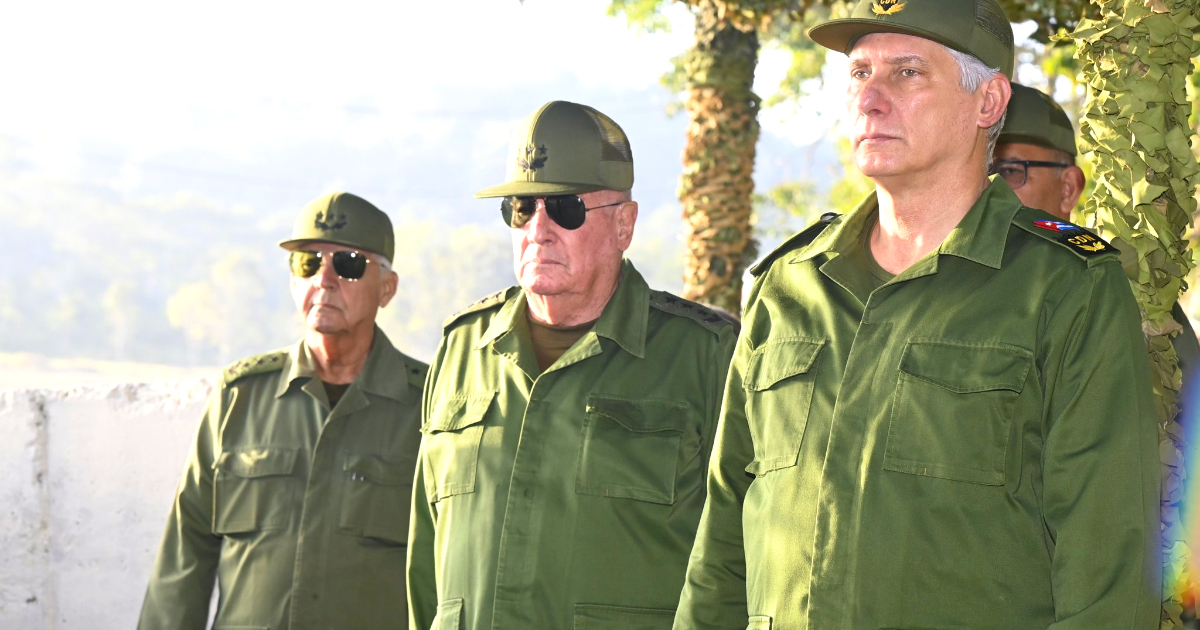
An academic report published this Thursday by the CubaxCuba platform warns that a democratic transition in Cuba will require not only subordinating the Revolutionary Armed Forces (FAR) to civilian power, but also dismantling their political influence and placing the economic framework they manage through GAESA under democratic control.
The study, titled 'Armed Forces and Subordination to Civil Power' and produced by the Comparative Democratic Transitions initiative, examines the experiences of Spain, Chile, Poland, and Venezuela to identify the challenges Cuba would face in a potential process of democratization.
Their central conclusion is that “no transition consolidates while the armed forces maintain veto power over civil authority”. However, the authors caution that removing the political influence of the military is not enough if they retain their own economic resources and areas of autonomy outside the oversight of democratic institutions.
"The economy is the core issue", the report states, identifying the business power of the FAR as one of the main obstacles to transforming the Cuban political system.
GAESA: the economic power that could survive political change
The analysis highlights that the FAR presents a combination of characteristics that set it apart from the examined armies: it is an institution born from the revolution itself, it is subordinated to a hegemonic party, and it has become a major economic actor.
Through the Business Administration Group S.A. (GAESA), established in the 1990s under the Ministry of the Armed Forces, the military structure controls significant tourism businesses, hotel chains, commercial corporations, and financial entities.
The magnitude of that power has been the subject of independent investigations. The economist Emilio Morales, in a study published by Cuba Siglo XXI in November 2025, estimated that the military conglomerate controls over 70% of the Cuban economy and 95% of its finances.
For his part, the economist Pavel Vidal Alejandro, based on the analysis of filtered financial balances from GAESA for 2023 and 2024, calculated that its weight ranges between one third and 40% of the national economy. Although they differ in their estimates and methodologies, both studies agree on pointing out an extraordinary concentration of economic resources under military control, without effective mechanisms for transparency and civilian oversight.
The balances examined by Vidal also revealed that GAESA had accumulated around 14.5 billion dollars in bank deposits by 2024, within current assets estimated at 18 billion. The magnitude of these resources illustrates the financial dimension of the challenge that would come with placing the conglomerate under the control of a future democratic government.
The CubaxCuba report reminds us that General Luis Alberto Rodríguez López-Calleja, who led GAESA for decades until his death in 2022, was a member of the Political Bureau of the Communist Party. It also notes that the current Prime Minister, Manuel Marrero Cruz, previously presided over the Gaviota tourism corporation, which belongs to the conglomerate.
"No comparable cases displayed such a fusion of military command, political power, and economic control," emphasizes the report, citing the work of academics Armando Chaguaceda and Susanne Gratius.
The problem, according to the study, lies in that economic prerogatives tend to outlast political reforms. While military intervention in government can be limited through legal and institutional changes, the availability of its own resources generates material interests that the Armed Forces may seek to preserve.
"An army that generates its own resources, outside the budget approved by Parliament, has interests to defend against any civilian government", warn the authors.
The lessons from Spain, Chile, Poland, and Venezuela
The study examines four historical experiences that illustrate different paths in the relationships between the military and civilian authorities.
In Spain, military reform began during the transition after Franco's regime and progressed in stages. The establishment of the Ministry of Defense in 1977 enabled the reorganization of the military structure, while the failure of the attempted coup d'état on February 23, 1981, facilitated subsequent reforms that consolidated the subordination of the chain of command to civilian authority.
In Chile, on the contrary, the military retained significant prerogatives after the end of the dictatorship of Augusto Pinochet. Pinochet himself remained as the commander in chief of the Army until 1998, and the decisive constitutional reforms did not arrive until 2005.
Economic autonomy lasted even longer. The Reserved Copper Law, which allocated 10% of the overseas sales from the state-owned Codelco to the Armed Forces, was not repealed until 2019, fourteen years after those constitutional reforms, and its elimination was implemented gradually.
Poland is the closest precedent to Cuba regarding the need to transform an army subordinate to the Communist Party into an institution of a democratic state.
Following the political agreements of 1989, Polish authorities gradually introduced civilian officials into the Ministry of Defense. However, tensions regarding who should control the General Staff persisted until a legal reform in 1996 clarified the authority of the civilian Minister of Defense.
The case of Venezuela represents the reverse process: the progressive loss of civilian control over the Armed Forces and their increasing involvement in politics and the economy.
The report indicates that, since the arrival of Hugo Chávez to power, the military has expanded its presence in ministries, regional governments, and public enterprises. During the presidency of Nicolás Maduro, this expansion reached sectors such as banking, transportation, agriculture, and mining, with the creation of the military company Camimpeg in 2016.
For researchers, this experience illustrates the risk of turning economic spaces into mechanisms for linking the Armed Forces and political power.
The negotiating power of the FAR in a Cuban transition
Another finding of the study is that the scope of action for a future democratic government will depend on the power retained by the military at the time of the change and the conditions under which the transition occurs.
The Chilean experience shows that armed forces capable of negotiating the terms of their exit from power can preserve significant prerogatives for years, whereas the Polish case illustrates the difficulties of separating the military from the communist party and establishing a chain of command subordinate to democratic institutions.
In Cuba, there is also a historical peculiarity: the FAR is not an institution that existed prior to the regime, but rather one of its foundational pillars. Raúl Castro led the Ministry of the Armed Forces for decades and later succeeded Fidel Castro as the leader of the country.
The report also notes that the Cuban regime has shown its ability to discipline fractures within the military hierarchy. It cites as an example Case No. 1 of 1989, which ended with the execution of General Arnaldo Ochoa and three other officers.
This precedent, according to the analysis, illustrates the ability of the political system to impose discipline within its own military structure.
A gradual reform: first civilian control, then economic power
Facing these challenges, researchers believe that a Cuban transition would require a gradual strategy capable of separating three functions that currently converge in the FAR: national defense, political intervention, and economic control.
The first task would be to ensure that the Armed Forces do not intervene against the democratization process. Subsequently, it would be necessary to reorganize the chain of command under civilian authority and legally establish the competencies of the new institutions responsible for defense.
The strictly military function could be preserved and professionalized, while the political participation of the FAR should be eliminated. Their business activities, in turn, would need to be subjected to transparency mechanisms, parliamentary oversight, and, when appropriate, restructuring.
The authors warn that trying to address these three dimensions simultaneously could increase the risk of military resistance. However, indefinitely postponing economic transformation would allow for the consolidation of an autonomous power that would be difficult to reverse.
No case achieved civilian control through a coup, states the report, which considers it essential to establish a sequence of reforms tailored to the characteristics of the Cuban system.
The FAR, under increasing American pressure
The publication of the analysis coincides with an intensification of Washington's pressure measures on the military and security structures of the Cuban regime.
During 2026, the administration of Donald Trump announced sanctions against the Ministry of the Armed Forces, the Territorial Troops Militias, the Rapid Response Brigades, and entities linked to the Cuban military apparatus.
The Secretary of State, Marco Rubio, declared that Trump wanted a Cuba governed by its citizens and not by a military elite that controls national resources.
Although the report by CubaxCuba does not analyze those sanctions or propose a U.S. strategy for the transition, its conclusions place the political and economic control of the FAR at the center of any discussion about Cuba's institutional future.
CubaxCuba, which presents itself as a civic think tank, is co-directed by historian and Doctor of Philosophical Sciences Alina Bárbara López Hernández, who recently published an essay in Journal of Democracy discussing the need to build organizational structures within Cuban society to drive political change.
"Designing that sequence is one of the most urgent intellectual tasks for those contemplating the transition," the study concludes, emphasizing that the subordination of the Armed Forces to civilian power cannot be consolidated as long as they retain political and economic prerogatives outside of democratic control.
Related videos:
Filed under: