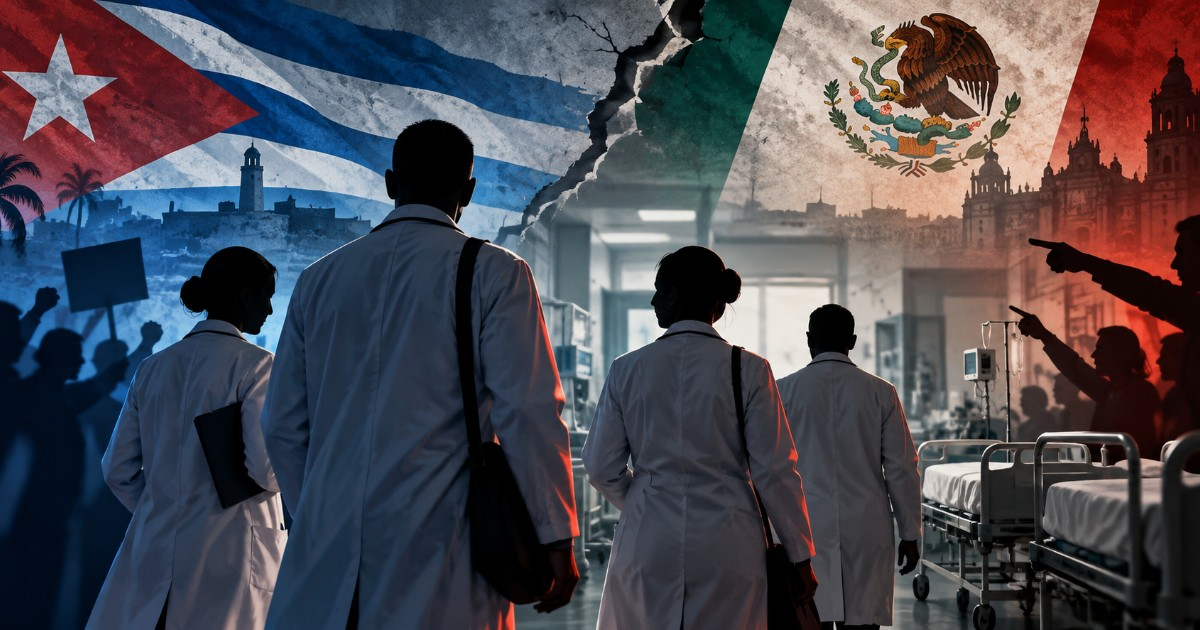
The president of Mexico, Claudia Sheinbaum, denied that the Cuban doctors working in her country earn more than Mexican professionals and asserted that their hiring is "direct," without intermediary companies, amidst a growing controversy over payments to the Havana regime and reports on the working conditions of medical missions.
"The assertion that Cuban doctors earn more than Mexican doctors is false, absolutely false," the president stated during her Friday morning briefing, according to Mexican media Por Esto! and El Financiero.
Sheinbaum also rejected the claims that professionals coming from Cuba are hired through a company.
It is a direct hiring and they earn exactly the same as a Mexican doctor, meaning there is no difference, he stated.
The president defended the presence of Cuban doctors in the public health system and emphasized that they primarily serve remote communities where it is difficult to find Mexican specialists.
"They help us a lot in many remote places where they are working because there are no specialized doctors who go to those areas," he stated, according to coverage by the Mexican press.
However, Sheinbaum's statements contrast with the documented history of payments to Cuban state companies and with the recent complaints from professionals on the Island who claim to have experienced salary delays during their mission in Mexico.
The main question remains how much money the Mexican government currently pays for each Cuban professional, what portion the doctor receives directly, and what amounts, if any, are transferred to entities of the regime in Havana.
During the day, the Mexican Social Security Institute (IMSS) disseminated information about the salaries of its workers.
According to El Financiero, a primary care physician with one year of experience and an eight-hour daily shift for five days a week earns 39,120 Mexican pesos net per month, following a salary increase effective from October 16.
Before the adjustment, which included a 4% increase in the salary scale and another 4% in rent assistance, the net remuneration was 36,896 pesos per month.
These figures correspond to a specific position at IMSS and do not represent a verification of what Cuban doctors receive.
Although Sheinbaum assured that both groups have equivalent salaries, she did not provide an updated breakdown of the individual payments to the professionals from Cuba.
The claim that there are no intermediaries becomes particularly relevant due to the contracts known in recent years between Mexican institutions and the Cuban Medical Services Commercialization Company (CSMC), a state-owned enterprise linked to the Ministry of Public Health of the Island.
In August 2022, an agreement was leaked that included payments of $1,177,300 per month for the services of 610 Cuban doctors in Mexico.
The document, originally published by El Financiero, specified transfers to an account of the Cuban Medical Services Marketing Company at the International Trade Bank in Havana.
The agreement outlined a contractual remuneration equivalent to approximately 39,000 Mexican pesos gross per month for each professional; however, this did not indicate that the total amount would be directly deposited into each doctor's personal account.
This is an agreement from 2022, so it cannot be stated that the same conditions will remain valid in October 2026.
However, it constitutes a documented precedent of contracting through a Cuban state-owned company, differing from the direct contracting mechanism now described by Sheinbaum.
The controversy regained momentum in June 2025 when it was revealed that Mexico had allocated more than 2,019 million Mexican pesos, equivalent at that time to over 105 million dollars for the hiring, maintenance, and distribution of Cuban professionals between 2022 and 2025.
The investigation, originally published by El Universal based on official documents and contracts, identified payments made to both Mexican companies responsible for logistics services and Cuban entities connected to medical missions.
Of the total documented, at least 472 million Mexican pesos were paid to a Cuban state-owned enterprise between July 2022 and December 2023, through agreements settled in euros.
According to that research, IMSS-Bienestar did not have sufficient information to determine what proportion of the transferred resources actually ended up in the hands of health professionals, who were partially identified in the documentation as "external collaborators."
The contracts examined do not alone provide insight into how the entire program currently operates. However, they indicate that for years there was an institutional payment structure involving Cuban companies, which raises the need to clarify whether that mechanism has been replaced and, if so, since when.
This month, doubts about the agreements were compounded by complaints from Cuban doctors working in Mexico who claimed to have gone more than two months without receiving their payments.
On October 4th, three Cuban doctors working in Mexico reported that they had been without pay for more than two months and that their superiors were not providing any answers regarding the salary delays.
One of the doctors explained that the delays affected the two mechanisms used to receive money: one account linked to the Cuban Medical Services Marketing Company and another corresponding to the Bank of Well-Being.
"There has been no payment from the Banjército account —which is supposedly the payment from the Commercializadora— nor from the [Banco del] Bienestar account, which is the Mexican part of the mission. And we have been prohibited from speaking or making any claims," he reported.
According to those testimonies, since March 2026, doctors received two monthly payments totaling approximately 44,716 Mexican pesos, allocated for maintenance and support for housing and transportation.
The professionals also reported pressures to not make public the issues related to payments. In an internal communication, mission officials acknowledged delays attributed to administrative changes, without initially providing a specific date to regularize the deposits.
On the other hand, Sheinbaum's defense comes at a time of increasing political pressure from the United States regarding the conditions under which Cuba exports medical services.
Recently, Republican Congresswoman María Elvira Salazar sent a letter to U.S. Trade Representative Jamieson Greer requesting that the program for Cuban doctors in Mexico be reviewed during the examination of the Treaty between Mexico, the United States, and Canada (USMCA).
Salazar called for holding the Mexican government accountable for what he considers a system of forced labor that economically benefits the regime in Havana.
The legislator stated that Cuban professionals face mobility restrictions, family separations, and salary deductions. She also claimed that, in certain cases, doctors receive only a small portion of the funds that foreign governments allocate for their services.
Salazar invoked the 2025 Trafficking in Persons Report from the U.S. State Department, which kept Cuba at Tier 3, and expressed concerns about the labor conditions of international medical missions.
Related videos:
Filed under: