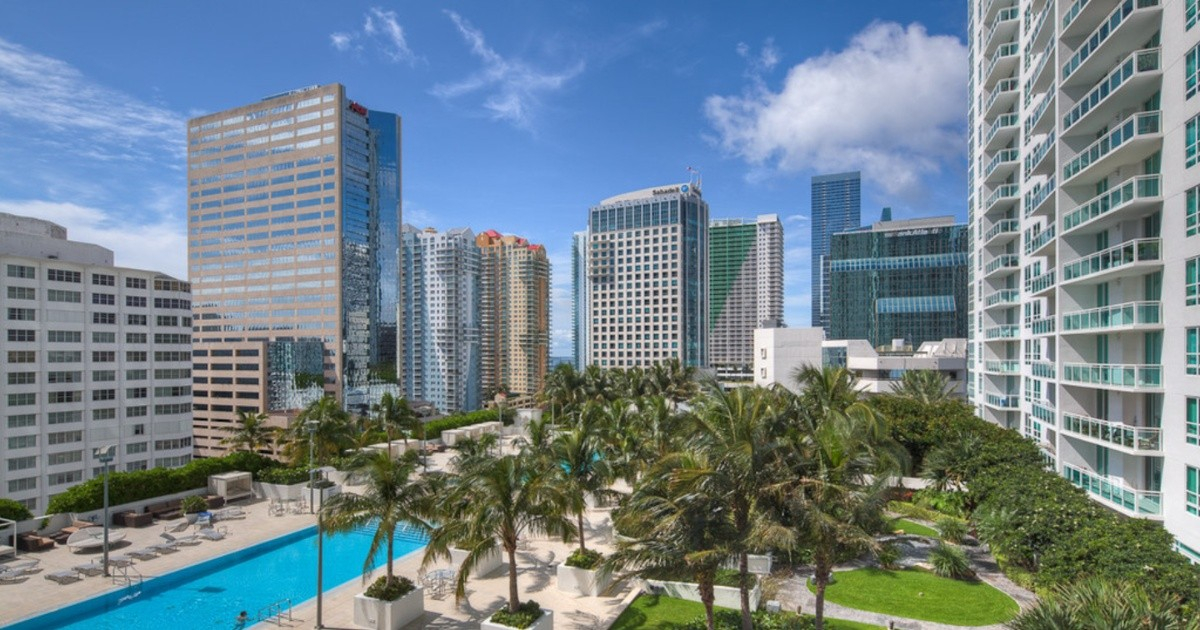
The City of Miami issued a violation notice this week against The Club at Brickell Bay, a 43-story condominium located on Brickell Bay Drive, for allegedly operating as a hotel without permission, as CBS News Miami reported.
Municipal authorities determined that more than 300 units of the building were being advertised on vacation rental platforms, while the property's usage certificate only authorizes 30 units for that purpose.
The notice was addressed to Brickell Bay Plaza Inc., the company holding the use certificate, whose registered agent is Jerome Hollo, the developer of the building and vice president of Florida East Coast Realty.
The city set October 30 as the deadline for the building to achieve compliance. Failure to do so may result in those responsible facing fines of up to 5,000 dollars per day and a hearing before the Code Compliance Board scheduled for December 9.
This notice comes months after the city had already sent a cease and desist letter in August, which was ignored: at the time the news was published, reservations for November were still available online.
Permanent residents have been reporting the consequences of living in what they themselves have dubbed "Animal House" for years. The owner Christina Lardon described it bluntly: "Behind me is an illegal, unpermitted hotel. And it turns out that I live there."
Lardon also expressed his concern about whether individual owners might end up paying the fines: "Am I also responsible? Am I supposed to pay their fines for the crimes they committed by not obeying the city's cease and desist order? That's not fair."
However, the case is entangled in a cross of responsibilities that complicates the application of sanctions.
Hollo stated that his company has no control over the residential units and that the notice was issued in error against their office building at 1201 Brickell: "Florida East Coast Realty and our related corporation, Brickell Bay Plaza Inc., have no involvement in the occupancy or control of the residential units at The Club at Brickell Bay. The Condominium Association is responsible."
For his part, the attorney for the homeowners' association stated that the notice was not directed to that entity either.
The case has a history that illustrates the difficulty of enforcing the law: municipal inspectors had already issued five prior citations to individual operators, but all were dismissed after the hosts temporarily removed their listings from the platforms.
Since around 2020, about 500 of the 643 units in the building —representing between 78% and 85% of the total— have reportedly been converted into short-term rentals, mainly through Airbnb.
In response to the case, the commissioner of District 2, Damián Pardo, is promoting an ordinance to create a mandatory registry of all short-term rentals in the city, along with a multidisciplinary task force that would include code compliance staff, the municipal attorney's office, firefighters, and police. "We will do everything in our power within the law to stop this," he stated.
The debate has direct implications for thousands of residents in Miami, including a large Cuban community that rents or owns units in the area, where the median rent in Brickell hovered around 3,986 dollars per month in August 2026.
The regulation, however, faces a fundamental legal obstacle: since 2011, a state law in Florida limits the ability of local governments to impose new restrictions on short-term rentals, forcing the city to operate within a narrow legal margin.
Related videos:
Filed under: