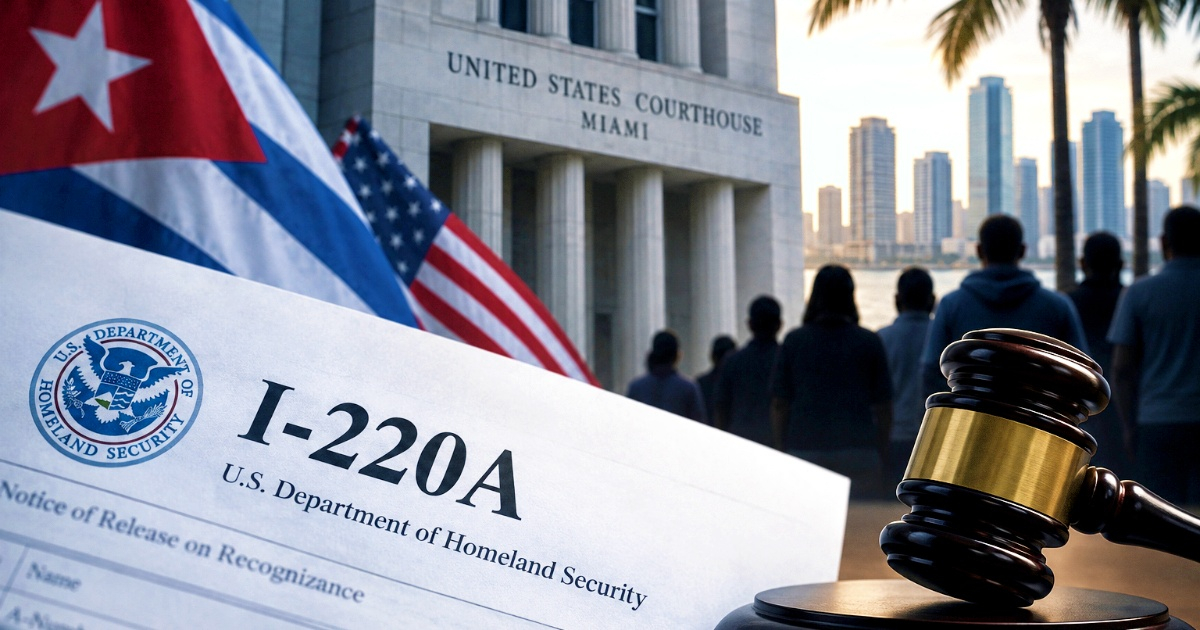
The plaintiffs in the case Bello-Rubio v. Noem (case number 1:25-cv-23665-JB, Southern District of Florida) have formally opposed the federal government's attempt to terminate the litigation. The public record of the case sets October 30, 2026 as the deadline for government attorneys to file their reply.
The movement was reflected in two entries recorded on Friday, October 23.
First, Judge Jacqueline Becerra issued order 85, which allowed the plaintiffs to submit a longer document than the regulatory limit, with double spacing.
The following document 86 is recorded, pertaining to the opposition to motion to dismiss number 77, submitted by the Department of Justice on October 9.
What does each party argue?
In motion 77, the federal government presented two arguments to request the closure of the case: that the court lacks jurisdiction to review certain immigration control and detention decisions, and that release under form I-220A pursuant to INA § 236(a) does not equate to the parole required to qualify for the Cuban Adjustment Act.
The plaintiffs, represented by a legal team led by attorney Mark Prada, oppose the dismissal.
The litigation raises, among other issues, whether the detention and subsequent release of the affected individuals should have been processed under different immigration provisions, including section INA § 235(b), and what the scope of the humanitarian parole outlined in 8 U.S.C. § 1182(d)(5)(A) is.
The judicial record also identifies an annex called «Appendix Agency Memoranda», related to memoranda from federal agencies. The complete content of document 86 and its annex was not available for review at the time this note was finalized, making it impossible to detail all the arguments presented in those writings.
What does October 30 mean?
The seat 86 includes the indication «Replies due by 10/30/2026», which sets Friday, October 30, as the deadline for government attorneys to file their reply, should they choose to do so.
The Government can submit that document before the deadline, wait until the last day, or forgo it.
The date does not imply that a judicial decision will be known on that day.
Judge Becerra will be able to examine the arguments from both parties before ruling on the motion to dismiss.
In mid-October, in a interview with CiberCuba, lawyer Willy Allen indicated that the judge might wait to gather all pending matters before issuing a substantive ruling.
"I suspect that the judge will consolidate all the pending cases and make a future decision from there," Allen declared.
Three pending procedures
The litigation progresses through three procedural avenues: the motion to dismiss, the class certification request, and the precautionary protective measures requested under the All Writs Act.
Document 86 pertains only to the first of those issues.
Their presentation does not grant protective measures to the plaintiffs nor does it determine whether the litigation may extend its effects to a broader group of Cuban immigrants.
After the document was filed, some social media posts presented the movement as a judicial victory.
However, the specialized portal i220a.org noted that filing an opposition is part of the procedure and does not equate to obtaining a favorable ruling.
What hasn't changed for Cubans with I-220A?
The procedural situation of the case remains without a definitive resolution on the main issues.
The motion to dismiss is still pending, the class action has not been certified, and there is no court order for general protection against arrests or deportations arising from this litigation.
It has not been judicially recognized, as a result of this procedure, that the I-220A form is equivalent to the parole necessary to access the Cuban Adjustment Act, nor has permanent residency been granted to the plaintiffs as a result of this lawsuit.
The federal government requested the dismissal again after Becerra rejected a first attempt in September.
While the procedure continues, individuals with an I-220A must continue to fulfill their individual immigration obligations, including the required supervision appointments with ICE. The existence of the lawsuit does not automatically suspend those obligations.
Related videos:
Filed under: