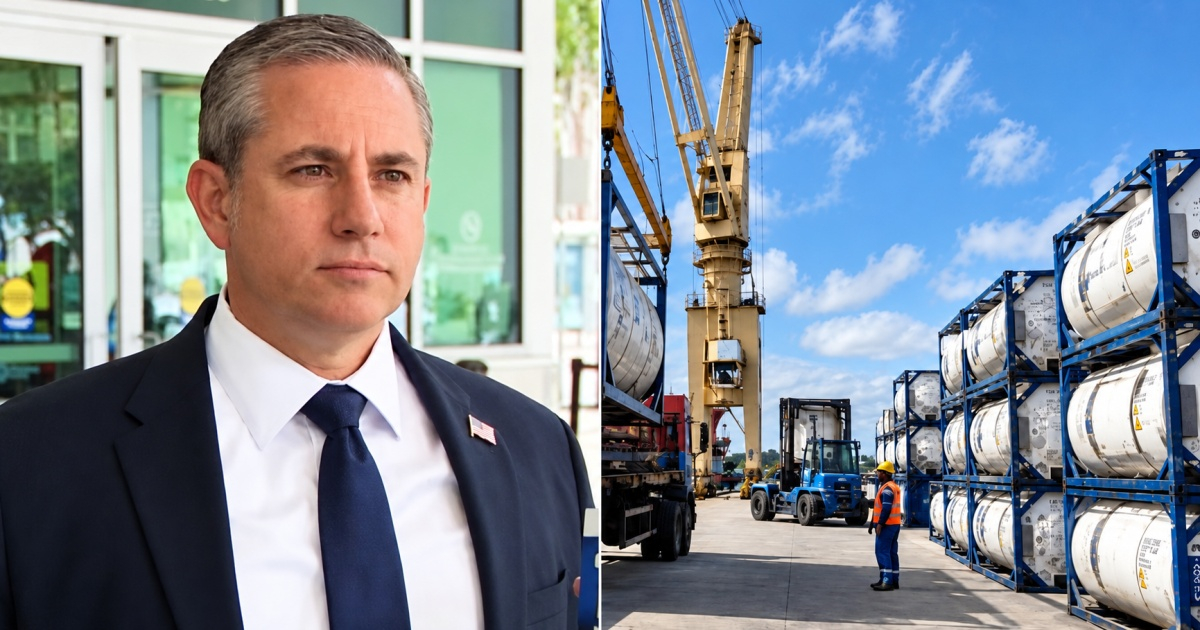
The Miami-Dade tax collector, Dariel Fernández, confirmed that his office is conducting an investigation into the fuel supply to CIMEX, a Cuban corporation sanctioned by the U.S. Treasury Department, and warned that it will revoke the local business tax receipts of companies that conduct transactions with Cuba in violation of federal law.
In an official statement published on Sunday, October 25, Fernández noted that his office is working with the Department of State, the Department of Commerce, and other U.S. agencies to ensure compliance with the country's laws.
"We continue to work on this investigation regarding the fuel supply to CIMEX, an entity sanctioned by the U.S. Department of the Treasury," the official stated.
Fernández specified that the administrative consequences will depend on whether violations of federal legislation are confirmed.
“If we determine that a company conducts transactions with Cuba in violation of federal law, we will revoke its local business license, following the appropriate legal procedures,” he warned.
The collector classified the investigation as a matter of national security and stated that he will not allow companies to use Miami-Dade to evade U.S. sanctions or violate export laws.
"Our message is clear: if you violate the laws of the United States, you will face the consequences. Operating a business in Miami-Dade does not exempt anyone from the law. A local tax receipt does not authorize illegal transactions," he emphasized.
The statement does not identify the companies under investigation, the volumes of fuel involved, or potential outcomes of the inquiry.
What does the revocation of the commercial receipt in Miami-Dade imply?
The local business tax receipt is an administrative requirement for conducting economic activities in Miami-Dade. Obtaining it does not replace other permits or licenses that may be required by municipal, state, or federal authorities.
According to section 205.0532 of the Florida Statutes, those who apply for or renew this document must provide a certification that they do not conduct business with Cuba in violation of U.S. federal law.
The tax collector's office requires that certification to be completed and notes that, once submitted, the receipt may take up to three business days to be available for printing.
The document is mandatory for commercial establishments in the county. Businesses located within a municipality may also require a municipal receipt.
Its validity corresponds to the fiscal year that runs from October 1 to September 30, and the application and renewal processes are managed through the BTExpress. system.
The revocation announced by Fernández constitutes an administrative measure that must follow the corresponding legal procedures.
It does not, by itself, equate to a criminal conviction nor does it automatically lead to the cancellation of other licenses.
The warning pertains to transactions that violate federal law, not to a general prohibition on all authorized commercial operations with Cuba.
CIMEX, fuel and U.S. sanctions
CIMEX is among the Cuban entities sanctioned by the Office of Foreign Assets Control (OFAC) and is part of the military business conglomerate GAESA.
The investigation announced by Fernández coincides with increased scrutiny of U.S. fuel exports to Cuba and their potential final destination.
At the beginning of October, U.S. authorities announced the interception of over 620,000 gallons of biodiesel distributed across 90 shipments intended for ENETEC S.A., a Cuban state-owned company sanctioned by OFAC.
For its part, investigations published by ADN Cuba indicated that CIMEX acquires fuel from at least 16 Cuban small and medium-sized enterprises (mipymes) for distribution through its service station network and supply to state entities, including the Revolutionary Armed Forces (FAR).
On October 24, the U.S. Department of State acknowledged that it cannot rule out the diversion of fuel exported to the Cuban private sector towards entities linked to the island's government.
These findings reflect concerns about the fate of the supplies, although Fernández's statement does not establish a direct connection between the intercepted shipments and the investigation into CIMEX.
History of revocations in Miami-Dade
Fernández's warning adds to other actions taken by his office against businesses suspected of maintaining trade relations with sanctioned Cuban entities.
In September, Miami-Dade revoked the business receipt of Lux Sky Cargo LLC due to alleged ties with ENETEC S.A.
In June, the office also revoked Vanguard Energy's receipt for an agreement related to the shipment of over 250,000 barrels of fuel to Cuba through CUPET.
In February, nearly 4,000 businesses in the county received notifications regarding potential business operations with the island.
The law HB 905, known as FIRE, expanded since July 2026 the powers of local authorities in Florida to take action against companies that violate federal restrictions applicable to their business with Cuba.
"Our office will utilize all legal resources at its disposal and will collaborate with our federal partners to hold those responsible accountable. We will not turn a blind eye," Fernández concluded.
Related videos:
Filed under: