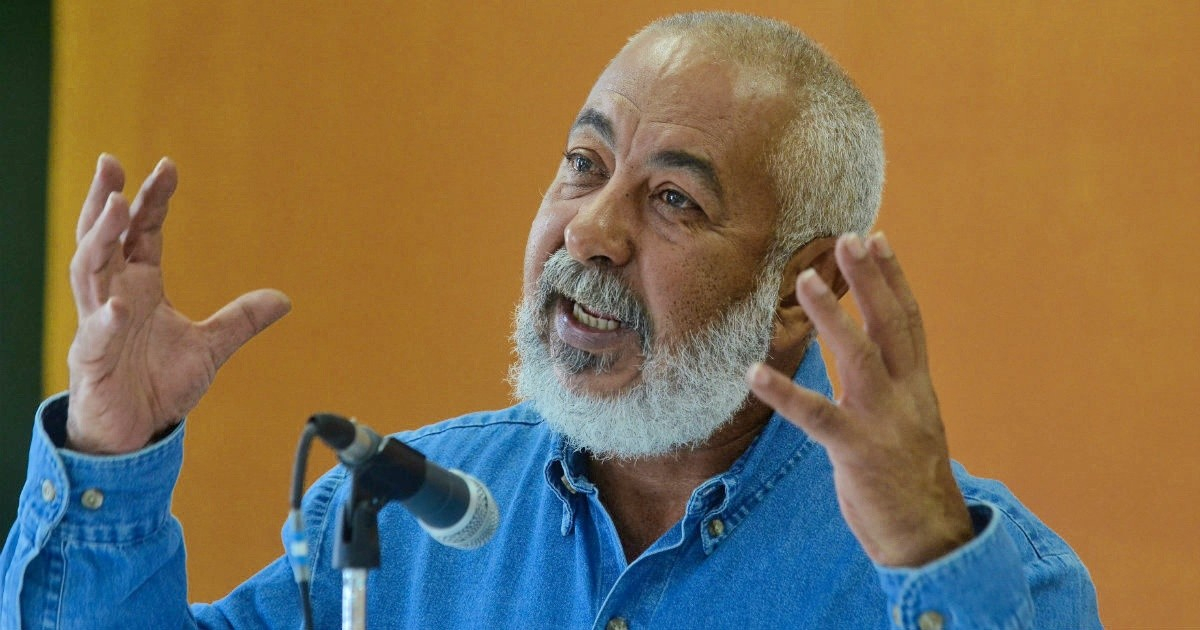
Leonardo Padura published an opinion column this Sunday in the Spanish newspaper El País titled «The Emptied Island», in which he depicts the exodus of Cuban families with children and warns about the consequences of population loss for the country's future.
The writer begins with an everyday scene at José Martí International Airport in Havana: the check-in lines of an airline with flights to Guyana, where he observes family groups leaving the island with their children.
An employee of that company shared with me a phrase that summarizes the magnitude of the phenomenon: “Every week, a classroom disappears. Every two months, a school leaves the country.”
Padura acknowledges that this is an assessment based on the worker's experience, not official statistics, but he believes it reflects a concerning reality.
“The data, utterly empirical, is, however, so real that it generates, at the very least, concern. The nation thus loses part of its future, and this is a situation that will trigger many consequences,” he writes.
Guyana appears in his narrative as one of the destinations used by Cubans to continue their journey to other South American countries, especially Brazil, where the writer mentions the presence of a "little Cuba" in the city of Curitiba.
For years, another of the main migration routes passed through Nicaragua and Central America to the southern border of the United States.
Changes in U.S. immigration policies and entry requirements for Nicaragua have altered those routes, while numerous families continue to seek alternatives to leave Cuba.
A declining population
Padura supports his reflection with figures from the National Office of Statistics and Information (ONEI), according to which the effective population of Cuba at the beginning of 2026 was 9,434,593 inhabitants, compared to 11,113,215 recorded in 2022.
The difference is 1,678,622 residents, a decrease that reflects both migratory movements and other components of demographic evolution.
The writer also considers that the actual number of people living on the island may be lower than the officially estimated figure, due to the difficulties in accounting for those who remain outside the country for extended periods.
"How many then live in Cuba? Possibly fewer than nine million inhabitants, which represents a population difference of more than two million in just four years. Perhaps around 20% of its population," suggests Padura.
This last figure corresponds to the writer's estimate and not to the official data of the actual population.
According to figures from ONEI, Cuba ended 2025 with a net migration balance of -245,264 people, resulting from 317,320 emigrations and 72,056 immigrations.
Emigration is compounded by a negative natural balance: during that year, there were 68,064 births compared to 136,214 deaths, while the fertility rate fell to 1.29 children per woman.
The impact on education
The image of empty classrooms takes on special significance in light of the challenges faced by the Cuban education system.
The 2026-2027 school year began with approximately 24,000 vacant teaching positions and more than 380,000 students without a permanent teacher.
The exodus of teaching professionals, linked among other factors to low salaries and the deterioration of working conditions, has contributed to the shortage of educators.
The loss of young population also coincides with a rapid demographic aging. According to official figures, 26.7% of Cuba's inhabitants are 60 years old or older, and the average age reaches 45 years.
Padura and the Cuba that is Emptying
The migratory exodus is part of the concerns that Leonardo Padura has expressed in his columns about the Cuban reality.
In August, he described daily life on the island as a "struggle for survival," with citizens "immersed in a pit of time."
At the end of September, when receiving the Liber Award 2026 in Barcelona, he described the situation in the country as "a daily hell for the majority of people."
In his new column, the writer, who has reiterated his decision to stay in Cuba, points out material difficulties as one of the main reasons that drive many families to emigrate.
"The shortages of daily life in Cuba have only escalated in recent years to levels that can seem grotesque," he asserts.
For many parents who leave the island with their children, Padura maintains, the destination has taken a backseat to the necessity of leaving.
"Sometimes it doesn't even matter the part, only the distance."
Related videos:
Filed under: