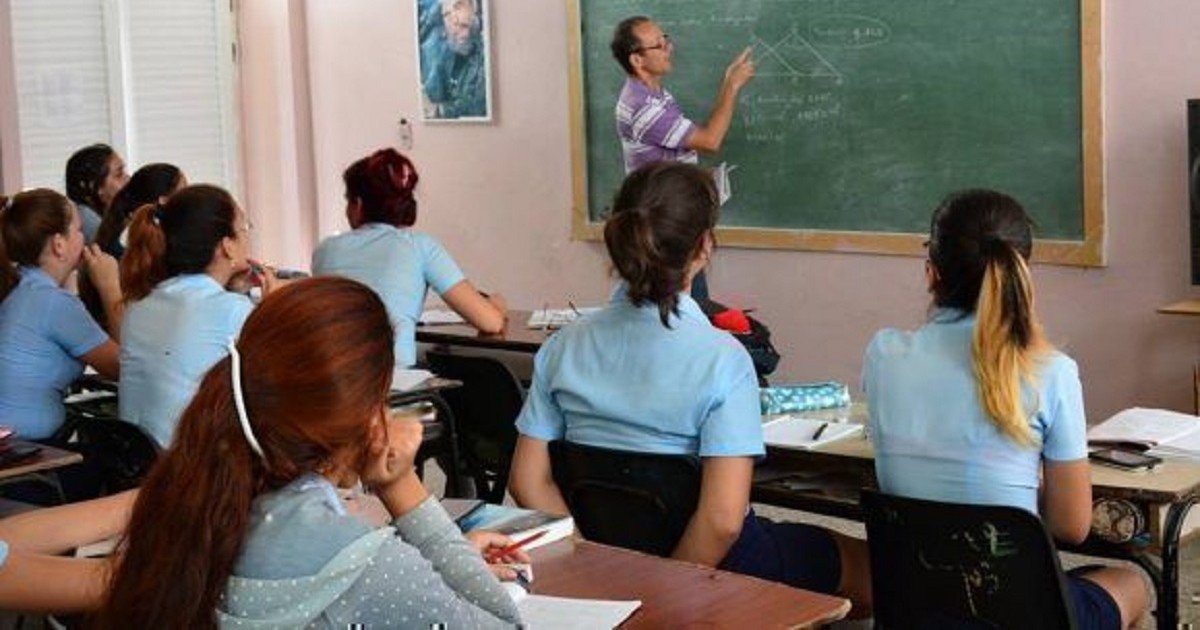
Cuba kicks off the 2026-2027 school year with an open wound that has remained unhealed for years: a deficit of 24,000 teachers which represents 12.5% of the positions planned nationwide, the same figure that has persisted since the 2024-2025 school year without any efforts from the regime to reverse it.
To attempt to fill the gap in the capital, the government has sought to relocate around 3,000 teachers from eastern Cuba to Havana. This measure, rather than solving the problem, merely shifts it: the positions that these teachers leave vacant in their home provinces remain unfilled.
A Facebook post by user Yau ASalcedo precisely summarizes the cycle fueling the crisis: "They work and do not receive what they deserve, they lose motivation and see their conditions deteriorating every day, ultimately becoming disillusioned with an educational system that is also running out of teachers. Some leave the classroom. Others leave the country. And every day there are fewer reasons to stay."
The post generated a chain of comments that depict the magnitude of the collapse from within.
Roger Fredom, a former teacher who ended up emigrating, wrote: "I am one of them. I left the education system because, as a recent graduate, I was required to write the answers to exams on the board for my students, so that the 'communist balloon' could grow. I have always had a calling to teach, but lying doesn't come easily to me."
Another user, Juan Jose Sanchez, pointed directly to the contradiction of the relocation measure: "And who will fill the positions of the teachers who are moving to Havana? How will those children from the East have a teacher in front of them if they are going to be in another province? That is robbing Peter to pay Paul."
Rosinqui Selin was even more skeptical about the final fate of those relocated teachers: "Out of those 3,000, 2,999 will end up living in Havana; that is the fundamental objective when they accepted the mission."
René Ricardo, for his part, warned about the long-term consequences: "It is indeed a concern to be left without teachers. But the state does nothing and does not encourage them to remain in the classrooms. In the not-so-distant future, we will find ourselves teaching our children in our own homes."
The conditions pushing teachers out of the classroom are concrete and well-documented. Many have requested voluntary leave, others report delayed payments, and some have their salaries credited to a card but are unable to access it due to the banking crisis. A teacher from Urbano Noris, Holguín, publicly denounced in August that she had not been paid since May.
The regime approved a new salary scale in July —Resolution 18/2026— which sets salaries between 6,130 and 7,735 Cuban pesos per month depending on the level of education, effective from July first but paid only in the August payroll. Analysts and the teachers themselves point out that this amount remains insufficient in the face of inflation and the real cost of living.
Provinces such as Camagüey, Matanzas, and Sancti Spíritus have accumulated deficits of over 2,000 vacancies each. In Sancti Spíritus, teacher coverage reached only 68% at the beginning of the previous school year.
The problem is not new. In September 2023, an official from the Ministry of Education acknowledged on television that there was a shortage of 17,278 teachers across the country, attributing it to the search for better income, emigration, and absences due to "personal issues." Since then, the number has only continued to rise. And as the deficit deepens, in 2025 the regime sent teachers on an internationalist mission to Jamaica, amid internal shortages.
Related videos:
Filed under: