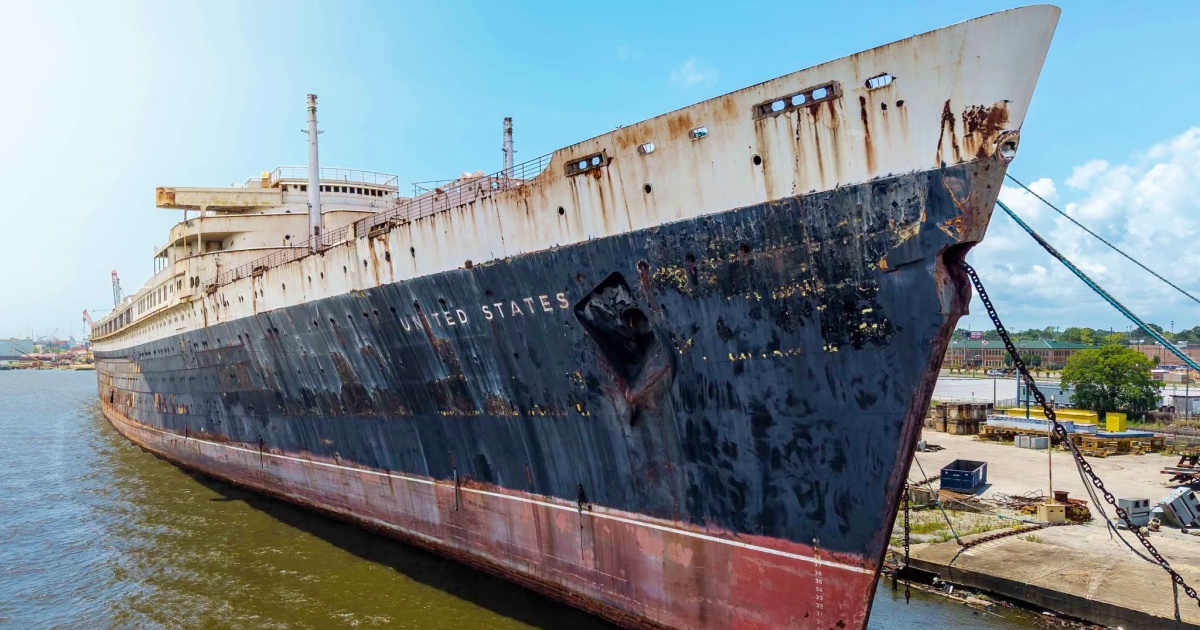
The SS United States, the fastest passenger liner in history and longer than the Titanic, is preparing for its final voyage: it will be deliberately sunk off the coast of Florida to become the largest artificial reef in the world.
The authorities of Okaloosa County plan to carry out the operation during the second week of November, about 22 nautical miles (41 kilometers) southwest of Destin, in the Gulf of Mexico, as reported by Associated Press.
The final date will depend on weather conditions and the completion of decontamination work and necessary environmental inspections.
“This is an exciting advancement to create a unique resource for the environment and for our tourism industry,” county officials stated in a press release.
A giant that surpassed the Titanic
With a length of almost 305 meters, the SS United States exceeds the length of the RMS Titanic by more than 30 meters.
It was designed to serve a dual purpose: to transport luxury passengers and to function as a military vessel if needed, with the capacity to carry up to 14,000 soldiers without refueling.
On its inaugural voyage in 1952, it crossed the Atlantic in three days, ten hours, and 40 minutes, at an average speed of approximately 66 kilometers per hour.
With that journey, he surpassed the record of the RMS Queen Mary by nearly ten hours.
The SS United States holds the record for transatlantic speed for a passenger vessel.
During its 17 years of service, it transported over one million passengers, including four U.S. presidents—Harry Truman, Dwight Eisenhower, John F. Kennedy, and Bill Clinton—along with celebrities like Marilyn Monroe, Grace Kelly, and Salvador Dalí.
From Philadelphia to Alabama: a complex preparation
The transatlantic vessel remained docked in the Delaware River in Philadelphia since 1996.
Various restoration attempts failed due to their high costs, while a dispute over the dock's rent resulted in a court order to evict the vessel.
Okaloosa County acquired the ship in 2024 for one million dollars from the SS United States Conservancy organization.
In February 2025, the ship departed from Philadelphia and was towed for 12 days to Mobile, Alabama, where work is underway to prepare it as an artificial reef.
A team of approximately 30 people, led by Captain Tim Mullane, is working on the removal of materials that could pose an environmental risk, including wiring, glass, plastic, and hazardous chemicals.
The workers have removed more than 300 portholes and the four propellers from the ship. It is also planned to dismantle its two chimneys, which are about 20 meters tall, using a large-capacity crane.
Another primary task involves cleaning the 120 fuel tanks using industrial equipment to remove the oily residues accumulated over decades.
A planned sinking to prevent accidents
The operation requires particularly precise coordination due to the size of the cruise ship.
The plan includes filling its 120 tanks with approximately 6.6 million liters of water to facilitate a controlled descent.
Once relocated to the chosen point, around 20 crew members will use high-powered torches to create openings in the hull and allow the gradual entry of water.
One of the greatest risks is that the liquid may enter unevenly, which could cause the ship to tilt, capsize, or start to sink earlier than expected.
The authorities have studied the precedent of the Spiegel Grove, a vessel that partially capsized during a sinking operation to create an artificial reef in Florida in 2002.
To reduce that risk, Mullane, marine biologist Alex Fogg, and a team of engineers have worked on a detailed model of the SS United States that allows for the planning of the hull openings.
If everything goes as planned, the sinking will last less than 45 minutes. Mullane will be the last to leave the vessel before its final descent.
Environmental inspections prior to operation
The preparation of the ship includes measures to prevent fuels, chemicals, and other polluting materials from ending up in the marine ecosystem.
Alex Fogg, a marine biologist from Okaloosa County, oversees the progress alongside the technical team.
“The SS United States is, without a doubt, the Everest of projects,” Fogg claimed while describing the magnitude of the works.
Once the cleaning is complete, inspections are expected to be carried out to verify the removal of hazardous materials. The U.S. Environmental Protection Agency (EPA) and other regulatory bodies will need to ensure compliance with applicable requirements before operations are authorized.
A million-dollar investment and a legal dispute
The project has a budget of 10.1 million dollars, allocated for the acquisition, transportation, preparation, and sinking of the ocean liner, as well as for initiatives related to the preservation of its history.
Of that amount, one million dollars is reserved for a land-based museum dedicated to the SS United States.
According to information published by Infobae, officials from Pensacola have provided $1.5 million, and Coastal Conservation Association Florida has contributed an additional $500,000.
The initiative has also faced opposition.
A preservationist group known as New York Coalition filed a lawsuit in a federal court in Pensacola in an attempt to stop the sinking due to concerns regarding the historical value of the ship.
Local authorities defend the project as a viable alternative to scrapping the vessel.
A new destination for the legendary ocean liner
The chosen point for the sinking is approximately 55 meters deep. According to forecasts, the upper decks will be about 18 meters below the surface, allowing for diving activities to be organized, subject to the conditions of the site and the preparation of the participants.
The site is located about 12 nautical miles from the USS Oriskany, an aircraft carrier that sank in 2006 and also serves as an artificial reef.
The promoters hope that the SS United States will become a new attraction for diving tourism, sport fishing, and other businesses in the region, which already has over 500 artificial reefs.
Estimates cited by authorities suggest that the new facility could generate millions of dollars annually in economic activity related to tourism.
“There is no project bigger, and there will never be another like it because they no longer build ships like this,” stated Coleen O'Malley, co-founder of Coleen Marine, the company responsible for the operation.
Related videos:
Filed under: