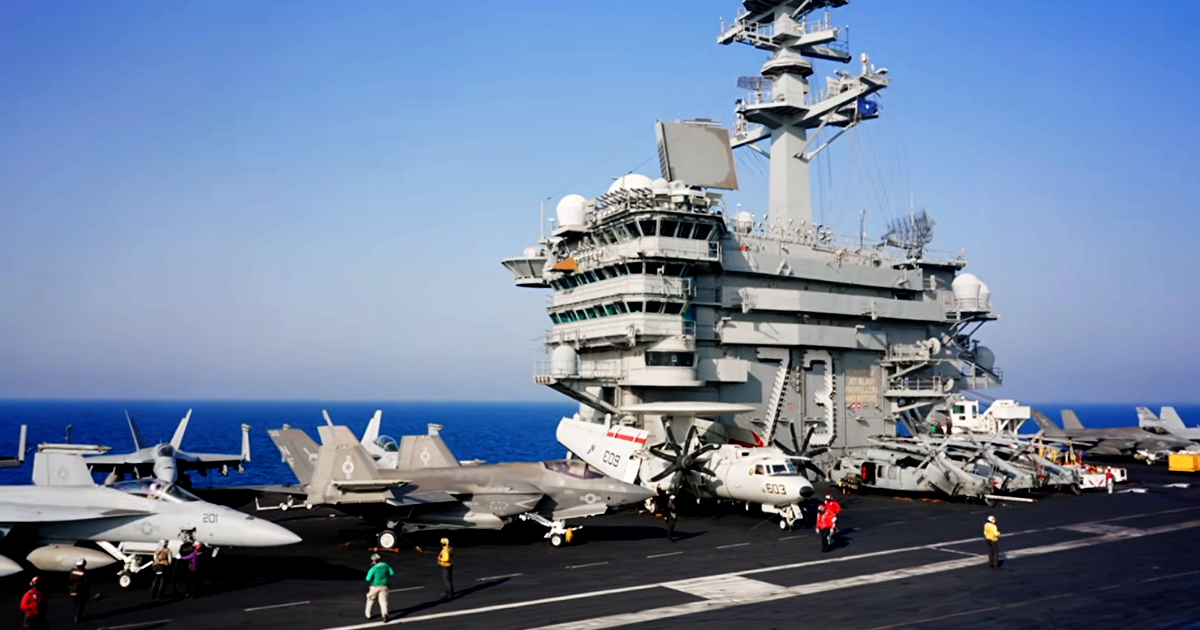
U.S. warships deployed in the Arabian Sea are being rearmed in anticipation of President Trump potentially ordering a new round of attacks against Iran in the coming weeks, according to U.S. officials familiar with the planning.
This is documented in an exclusive report from The Wall Street Journal published this Saturday, which gained rare access to the aircraft carrier USS George Washington and a guided missile destroyer operating in the region.
During the nighttime operations observed by the WSJ, the aircraft carrier received a massive shipment of munitions: long-range surface-to-surface missiles and GBU-31 Victor 4 bunker-busting bombs, designed to penetrate underground facilities and fortified military structures.
The commander Brian García, responsible for the onboard armament, described the extent of the resupply: "We have some items arriving that weigh around 4,800 pounds," he noted, adding that the ammunition is stacked and ready to be sent to the deck whenever the mission requires it.
The captain Nicholas DeLeo, commander of the George Washington, summarized the crew's stance: “This has been a very busy, complex, and even historic deployment. But honestly, this is exactly what our team trains for. We are always attentive, focused on our surroundings, and ready to react reflexively or proactively.”
The aircraft carrier, nicknamed the "vampire carrier" by its crew, carries out all its flight operations at night, while a second carrier in the region operates during the day.
The corridors of the ship are illuminated in red to keep the crew acclimated to the night shift. The total crew amounts to 5,000 people: 3,000 operate the ship and 2,000 make up the air wing, with over 1,000 additional sailors distributed among the accompanying destroyers, including the USS Shoup.
The attack group, based in Japan, deployed to the Middle East in August to relieve the USS Abraham Lincoln, which set a record by remaining 286 consecutive days without making a port call.
Just days after its arrival, the George Washington was already engaged in attacks against Iranian sites near the Strait of Hormuz and against Iranian oil tankers, in response to ballistic missiles launched by Iran at the aircraft carrier.
Preparation is intensifying in the context of a war that has entered its eighth month and has eroded Trump’s approval ratings in the United States. Iran has escalated its attacks on commercial ships in the Strait of Hormuz throughout October: Lloyd's recorded 28 incidents this month, including missile attacks, drones, and naval mines.
A cited official in the report was straightforward about the state of planning: “I wish I had a crystal ball to tell me what’s going to happen. In the absence of that, we have reports, and our reports indicate that commanders across the joint force are preparing for an escalation. That doesn’t mean it’s going to happen, but the preparation is already underway.”
Trump had publicly declared that he would not attack Iran before the legislative elections on November 3, although recent reports indicate that he is considering a campaign of attacks over several days immediately after the elections. The Pentagon, for its part, emphasized that its role is to develop and present military options to the president, and that no decision has been made.
The commander Jeffrey Heams, leading the attack group, conveyed a message of caution to his crew: "I will notify you when I know. For now, let's focus on the day-to-day. Let's ensure we are well-trained for whatever lies ahead and continue to strive every day."
Related videos:
Filed under: