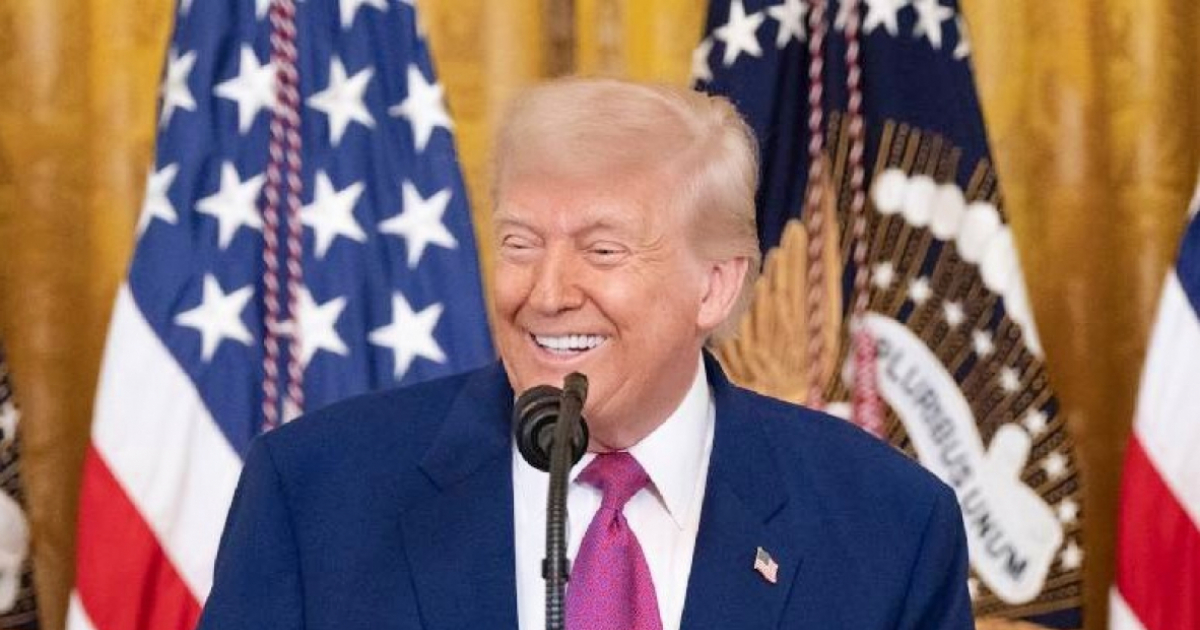
The President of the United States, Donald Trump, questioned the presidential elections in Brazil on Monday and stated that they seemed "rigged," after Luiz Inácio Lula da Silva secured his reelection against Senator Flávio Bolsonaro.
Trump's statements were disseminated this Monday in a video posted by the account Rapid Response 47, linked to the White House, and reported by the Reuters agency and the Brazilian outlet Poder360: "It seemed like another rigged election, frankly. I did not take a side, but it was a terrible image for the world. Elections must be indisputable, and to me, it seemed very bad," the president stated to reporters.
The comment came hours after Brazilians went to the polls to choose between Lula of the Workers' Party (PT) and Flávio Bolsonaro of the Liberal Party (PL) in a second round marked by political polarization.
However, the president also assured that he maintains a good relationship with Lula, despite his criticisms regarding the elections: "I like Lula, I get along well with him," he stated.
In his statements, Trump emphasized that elections must inspire confidence and leave no doubt about their results, although he avoided specifying which elements of the Brazilian electoral system he considered fraudulent.
The stance of the U.S. president contrasts with the results officially announced by Brazil's Superior Electoral Court (TSE), which confirmed Lula's victory following the counting of votes from the second round held this Sunday.
According to the data published by the Brazilian electoral body, Lula received 64,256,232 votes, equivalent to 51.79% of the valid ballots, while Flávio Bolsonaro garnered 59,826,041 votes, or 48.21%.
The difference between the two candidates was 4,430,191 votes, which allowed the current president to secure a non-consecutive fourth presidential term.
Voter turnout was also high. The TSE reported that approximately 128.2 million Brazilians went to vote, while abstention stood at around 19.2%, down from the 21.08% recorded in the first round.
Lula's victory also represented a significant electoral comeback, after Flávio Bolsonaro received more votes than him in the first round held on October 4.
The victory of the Brazilian president after overcoming the results of the first round was one of the most significant political events of the weekend in Latin America.
One of the controversies of the electoral process was related to the court's decision to extend the voting hours from 5:00 p.m. to 7:00 p.m. at polling places that were still open.
The measure was ordered by Judge Cristiano Zanin of the Supreme Federal Court, following reports of difficulties in accessing polling centers due to issues with public transportation.
According to Poder360, both Lula's PT and Flávio Bolsonaro's PL had submitted requests regarding the extension of voting hours.
The president of the TSE, Kassio Nunes Marques, acknowledged that the decision created technical and operational difficulties, as it was made when numerous electronic ballots had already closed and could not be reopened.
According to the organization, it was necessary to temporarily halt the reception of certain ballot boxes to adjust the counting process to the judicial decision.
However, the TSE reported that the measures implemented allowed for the continuation of the counting process and the completion of the electoral day.
Trump's statements coincided with Flávio Bolsonaro's initial refusal to acknowledge his defeat.
The Brazilian senator questioned the election results and announced legal actions, claiming that the extension of voting hours had affected the legitimacy of the elections.
Bolsonaro also stated that he will continue to organize his supporters and the opposing sectors during Lula's upcoming term.
The electoral challenge must be examined by the relevant institutions and supported by evidence that allows for the determination of whether there were irregularities with legal consequences on the outcome.
For its part, Lula's reelection received recognition from numerous foreign governments, including leaders from Europe and Latin America.
Trump, on the other hand, had not publicly congratulated the Brazilian president on his victory when he made his statements this Monday.
The previous day, while the voting was taking place, Trump had refrained from commenting on the candidates and simply pointed out that the United States was monitoring the electoral process.
"I don't want to get into that matter, but we are watching," he stated to reporters at the White House.
Although he stated on Monday that he had not taken a side, Trump maintains political ties with the Bolsonaro family since the term of former President Jair Bolsonaro, Flávio's father.
The U.S. leader welcomed Senator Flávio Bolsonaro at the White House in May of this year and had previously expressed favorable opinions about his political career.
The relationship between Trump and Lula, on the other hand, has gone through periods of tension, especially due to trade differences, tariff measures, and positions on international issues.
However, both presidents had engaged in diplomatic rapprochement months before the Brazilian elections.
On May 7, Lula visited the White House and met with Trump, where they discussed trade issues, bilateral relations, and the situation in Cuba.
After the meeting, the Brazilian president revealed that his American counterpart had assured him that he did not plan a military intervention on the island.
"If the translation is correct, he told me he does not plan to invade Cuba," Lula declared during a press conference held at the Brazilian embassy in Washington.
The Brazilian leader viewed that statement positively and reiterated his willingness to facilitate diplomatic contacts between Washington and Havana.
" If you need help discussing the situation in Cuba, I am completely at your disposal," Lula expressed, according to the translation of his statements reported by Reuters.
Related videos:
Filed under: