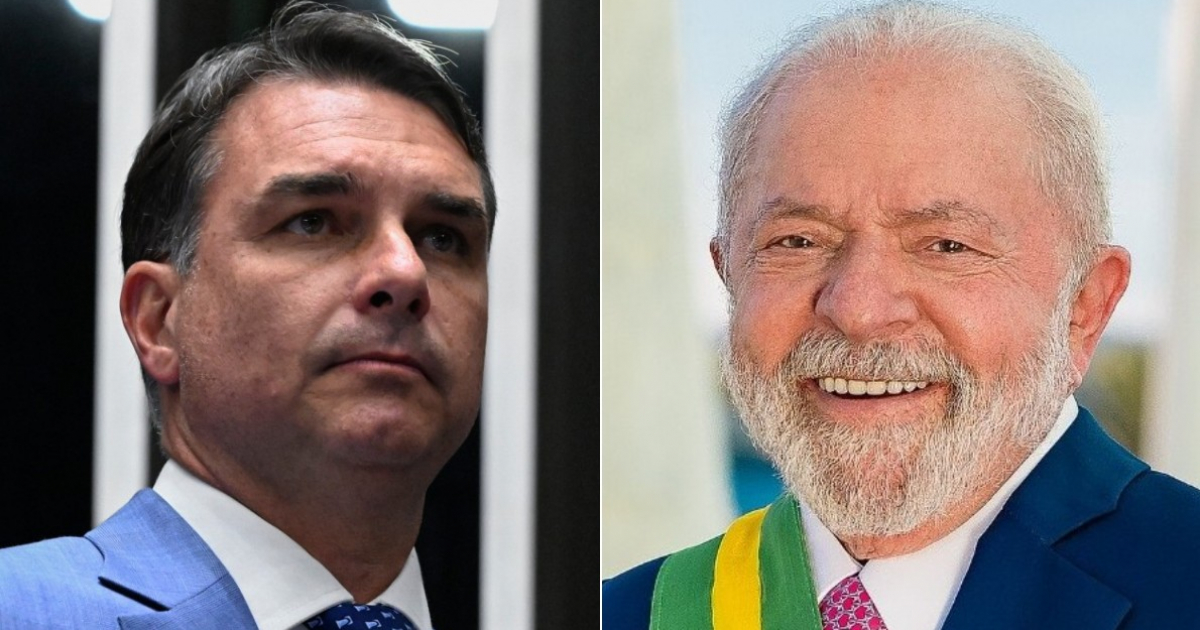
Senator Flávio Bolsonaro triumphed this Sunday over President Luiz Inácio Lula da Silva in the first round of Brazil's presidential elections, garnering 47.06% of valid votes compared to the incumbent's 45.13%, according to the official results from the Superior Electoral Court with 99.88% of the votes counted.
The difference between the two was approximately 2.3 million votes —56,075,582 votes for Bolsonaro compared to 53,778,788 for Lula— which was not enough to surpass the 50% threshold required by Brazilian law to win in the first round. Both will face off in the runoff on October 25.
The result is a significant victory for Flávio Bolsonaro, 45, who was initially seen as a weak candidate and is also facing a corruption investigation. The eldest son of former president Jair Bolsonaro —who was sentenced to 27 years in prison for leading a coup plot and has been under house arrest since March— was designated as the candidate for the Liberal Party (PL) by his father from prison in early December 2025.
Lula, at 80 years old, is aiming for a historic fourth term, but he faces a challenging runoff. Bolsonaro has a head start after winning the first round and may attract voters from other right-wing candidates, while Lula's challenge will be to win over undecided voters.
Political analyst Creomar de Souza was emphatic in evaluating the president's prospects in the runoff: "Historically, we have never seen a comeback in a runoff election in Brazil. It is a very, very difficult scenario for Lula," he said to the BBC. The same analyst pointed out that "Flávio's campaign was very effective, especially in the last seven days, conveying that, in the end, it wasn't about Flávio Bolsonaro, but about removing Lula from power."
The day was also favorable for bolsonarism on other fronts. The governor of São Paulo, Tarcísio de Freitas, was re-elected with a 26-point lead over his rival Fernando Haddad. The PL gained strength in Congress, paving the way for amnesty for those convicted of the coup assault on January 8, 2023. Jair's wife, Michelle Bolsonaro, 44, and two of his children, Carlos and Jair Renan, were elected as parliamentarians. Flávio has promised to pardon his father if he reaches the presidency.
Bolsonaro's partial victory is part of the right-wing wave sweeping through Latin America, with recent victories by Abelardo de la Espriella in Colombia and Keiko Fujimori in Peru, along with similar shifts previously in Argentina, Bolivia, Chile, Ecuador, and Honduras, noted El País. Among the first congratulatory messages Bolsonaro received was from Colombian President De la Espriella, who stated that "true change is defeating the left."
The result has direct implications for Cuba. Under Lula, a historical ally of Havana, Brazil maintained a policy of cooperation with the island: it sent thousands of tons of food and donated medications to treat hundreds of patients.
Additionally, more than 13,000 Cubans requested asylum in Brazil between January and April of this year, accounting for 58% of all requests during that period. A potential government led by Flávio Bolsonaro would likely revive his father's approach, who during his term (2019-2022) criticized the Mais Médicos program, labeled Díaz-Canel a "dictator," and took an openly hostile stance towards Havana.
The second round on October 25 will determine whether Brazil definitively joins the regional ultraconservative wave or if Lula manages to make a comeback that, according to analysts, has never before occurred in the country's electoral history.
Related videos:
Filed under: