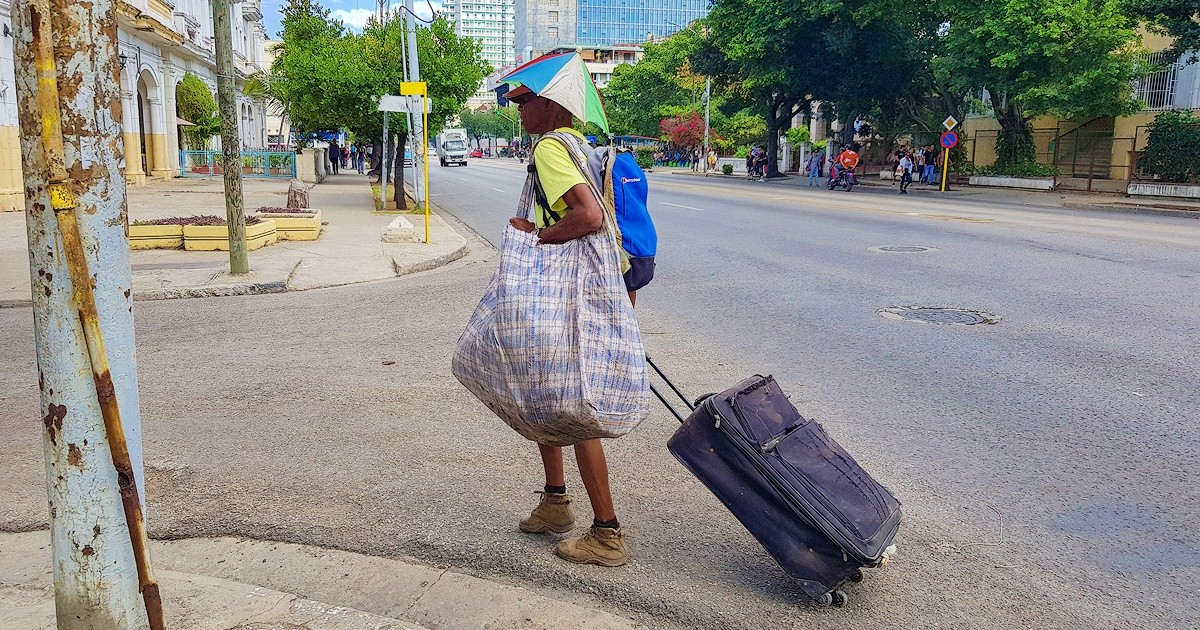
The Cuban Maray Quesada denounced the conditions of poverty faced by the island's population, where obtaining food, water, medication, or electricity has become a daily struggle, and questioned why so many deprivations have come to be accepted as a normal part of life.
In a post made on Sunday on Facebook, Quesada listed the difficulties that, in her opinion, the Cuban regime imposes on citizens and criticized both the material shortages and the pressure to remain silent about them.
“They force us to be thirsty. They force us to go hungry. They force us to bathe with a trickle of water or to stop bathing altogether. They force us to eat only once a day”, wrote the Cuban at the beginning of her reflection.
Her complaint is not limited to the lack of food. She also describes difficulties in transportation, economic dependence on family members who have emigrated, and the inability to access basic hygiene and medical care.
"They force us to walk distances that wear down both body and soul. They compel us to beg for alms from the family member who is abroad —or rather, from those 'worms,' as they like to call them—," he continued.
The reference to "gusanos" alludes to the derogatory term historically used by official sectors to refer to Cuban emigrants or those critical of the political system on the island.
Quesada thus questioned the contradiction he perceives between the stigmatization of emigrants and the dependency that many families have on the financial assistance they receive from abroad.
In another excerpt, he described extreme situations related to the deterioration of basic services and the scarcity of household resources.
“They force us to relieve ourselves in a plastic bag. They force us to cook with coal,” he expressed.
The Cuban also mentioned the difficulties in obtaining medication and the fear of the consequences of publicly expressing discontent.
"They force us to endure pain without medication and SHUT UP or you know what’s coming..," she wrote, using capital letters to emphasize her complaint.
Beyond material shortcomings, Quesada devoted a significant part of his message to questioning what he sees as an expectation of understanding towards those in power, while citizens who protest are labeled as aggressors.
And on top of that, they expect us to feel empathy for those who betray us, for those who oppress us, for those who live better than we do and don't feel even a bit of empathy for us," he stated.
According to his reflection, the authorities and their defenders demand tolerance and understanding for those who support the system, but do not show the same consideration for those who suffer its consequences.
"But when you stop feeling empathy for the oppressor, you cease to be oppressed and —according to their logic— become an aggressor," he stated.
The core of his message is a critique of the normalization of precariousness and the gradual loss of rights that he considers essential for living with dignity.
"To normalize hunger is to accept that dignity is a luxury. To normalize thirst is to resign oneself to the fact that water is a privilege.", he wrote.
For Quesada, getting used to depending on the help of others to meet even the most basic needs also implies a form of humiliation that should not be accepted as inevitable.
"Normalizing the humiliation of begging is to swallow one's pride while others fill their mouths talking about solidarity," he noted.
The Cuban also established a connection between silence and the acceptance of the conditions she denounces.
"Normalizing silence is signing our own condemnation," he warned.
In their opinion, demanding compassion for those they consider responsible for the situation, while delegitimizing the indignation of those who suffer from it, represents another form of inequality.
Quesada rejected the idea that the described difficulties can be merely justified as temporary sacrifices or as a phase of economic problems that the population must endure.
His criticism addresses what he sees as a systematic deprivation of basic needs and freedoms, ranging from access to food and water to the ability to express oneself without fear.
"I'm speaking of a state of affairs that rests on the systematic denial of the most basic needs: eating, drinking, grooming, speaking," he wrote.
The author also warned about the risk that extreme situations lose their ability to provoke outrage when they become part of the routine.
"And when something like that becomes the landscape, when it stops shocking, when it becomes 'the norm,' then there is no turning back," he reflected.
His message concluded with a call to neither resign oneself nor give up on expressing dissatisfaction with the situation the country is facing.
“That’s why we cannot remain silent. That’s why we cannot get used to it. Because getting used to it is the quietest way to die,” he wrote.
Quesada also defended the right to indignation in the face of injustice and distinguished that feeling from violence or hatred.
"And because rage—when it stems from dignity and not from hatred—is not aggression: it is proof that we are still alive and that we still know this is not just, nor human, nor normal," she concluded.
Social media has become a space where more and more Cubans are denouncing the deterioration of their living conditions and questioning the normalization of deprivations that they consider incompatible with a dignified existence.
Last Thursday, Gloria María Sánchez reported from her home in Havana about hunger, blackouts, censorship, and corruption, after spending another night without electricity.
The woman compared the country's decline to an advancing illness and questioned why the authorities continue to ask the population for resilience in the face of increasingly difficult circumstances.
"I believe my Cuba is a staircase with a growing dead tissue. Dead tissue of hunger, misery, censorship, corruption, painful exodus, and prisons filled with youth," Sánchez expressed in his testimony.
In June, another Cuban, known on social media as LaSai DeLa Vida, also questioned whether citizens have become accustomed to living without electricity, water, or enough food.
After staying 20 hours without electricity in Havana, the content creator asked whether it could be considered normal to go to bed without being able to take a shower, to live surrounded by garbage, or to face the hunger of her children without having any food available.
"And do you think it's normal to go to bed and wake up every day sweating and unable to take a shower because you don't even have water?" she questioned then.
His reflection coincided with the central concern now expressed by Quesada: the danger of accepting as inevitable conditions that should provoke rejection and outrage.
The difficulty in ensuring daily food supply has also been documented in numerous testimonies from Cuban mothers.
In August, several women described the physical and emotional exhaustion of waking up each morning not knowing what they will be able to cook for their families.
One of them, identified as Mary Yllas, summarized that uncertainty as a succession of anguish and fleeting relief, because securing food for one day does not eliminate the worry for the next.
Another participant, Yhelsa Isabel Rodríguez, stated: "It simply means not living. This is pure and harsh survival."
The problem does not only affect those who are unemployed. In August, the young Cuban Lauren Daniela reported that working for years does not guarantee having enough money to eat.
"Here, even if you work yourself to the bone, it's not enough to eat. Not even a doctor can make ends meet with their salary," he expressed, as he recounted the economic hardships faced by several generations of his family.
The scarcity of water, another deprivation reported by Quesada, has also led to accounts of exhaustion and frustration.
Related videos:
Filed under: