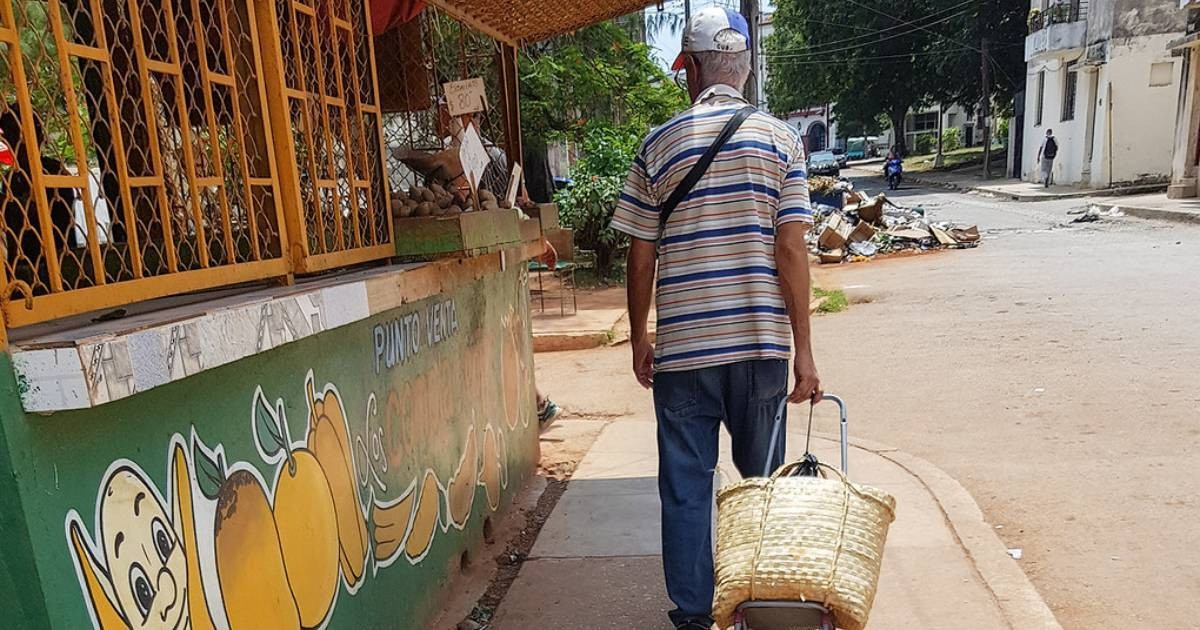
"What does it really mean to live in a constant search for what to eat?" A seemingly simple question posted on Facebook opened the door to dozens of testimonies from Cuban women who described the physical and emotional exhaustion of waking up each day not knowing what they will be able to put on the table.
The question arose in the group "Madres Cubanas Luchadoras 2" and was posed by a user identified as Lionelky Carrazana. The post garnered nearly 200 reactions and dozens of comments that, in various words, arrived at the same conclusion: the constant worry about obtaining food has turned the daily lives of many Cuban families into a perpetual struggle for survival.
"Fear, stress, anguish, desperation, tears, until you find something, but you don't calm down, you feel relieved, because it's today, and already today you're thinking about tomorrow," wrote Mary Yllas.
Her testimony encapsulates one of the ideas most frequently echoed among the participants: obtaining food for a day does not solve the problem; it merely postpones it for a few hours.
Bertha Martin, pregnant and responsible for a 10-year-old daughter and her sick mother, described the consequences that this uncertainty has on her health.
"Living in Cuba and going out to look for daily food means dealing with high blood pressure, circulation issues, physical exhaustion, sleepless nights, and worrying about what to cook the next day. Here, life means nothing," he lamented.
The comments create a collective portrait of fatigue, anxiety, and helplessness in the face of a crisis where obtaining food depends not only on finding it but also on having enough money to pay for it.
"It simply means not living. This is pure and harsh survival," declared Yhelsa Isabel Rodríguez.
In addition to the scarcity and high prices, there is another problem that affects even the possibility of storing the little food a family manages to obtain: blackouts.
Grettel García Sánchez explained that the prolonged power outages often force people to shop almost daily to prevent food from spoiling.
"Sometimes you go out and find nothing, or it's too expensive, or you only have a transfer and they don't want to accept it," he recounted.
Iracema Copello turned to an even harsher image to explain how she feels while trying to obtain basic products like oil, chicken, or eggs.
"I feel like I'm in a pack, unable to eat every day. And when I think I'm about to catch a meal —the oil, the chicken, the eggs— other wild animals come along, raise the price, and take them away. And I hardly ever eat."
One in three families report hunger
The testimonies from the group do not describe isolated cases. The available data on food insecurity shows that the problem affects a significant portion of the Cuban population.
A survey on food security in Cuba, presented in May by the Food Monitor Program and Cuido60, revealed that 33.9% of the households consulted reported that at least one member had gone to bed hungry during the previous 30 days.
The study also found that 94.9% had experienced some decline in their ability to purchase food over the past year.
The gap between income and the cost of food helps explain that reality.
The minimum wage set in July 2026 is 3,210 Cuban pesos per month, equivalent to about 4.65 dollars based on the informal exchange rate used as a reference. However, Cuban economists estimate that a person may need more than 70,000 pesos per month just to cover their food needs.
A liter of oil costs around 3,000 pesos and a carton of 30 eggs can cost between 3,000 and 4,000. In practice, a single basic product can consume practically the entire minimum monthly salary of a worker.
Cuban authorities themselves have acknowledged the state's inability to ensure basic food supplies.
In June, regime officials acknowledged the serious deterioration of the supply. The Minister of Food Industry, Alberto López Díaz, admitted that during the first months of the year, the regulated basket had failed to distribute products such as oil, chicken, and yogurt.
It also acknowledged that more than 100,000 children were not receiving their daily ration of milk.
That same month, the government announced that the supply booklet would no longer have a universal character, marking one of the most significant changes to the rationing system since its creation in 1962, with the aim of concentrating subsidies on retirees, individuals with chronic illnesses, and those considered vulnerable.
"A constant psychological torture"
Behind the statistics, stories emerge like those shared in "Madres Cubanas Luchadoras 2," where many women describe the added weight of being the primary responsible parties for obtaining and managing the household food.
For those who raise their children alone, that pressure can be even greater.
"It means stress, pain even in the heart, especially for mothers who raise their children alone because the fathers have distanced themselves from them," wrote Zurama Gamboa.
Yuli Pereira Jiménez summarized the impact of that routine in a few words: "It is a constant psychological torture, a daily physical and emotional burnout."
Related videos:
Filed under: