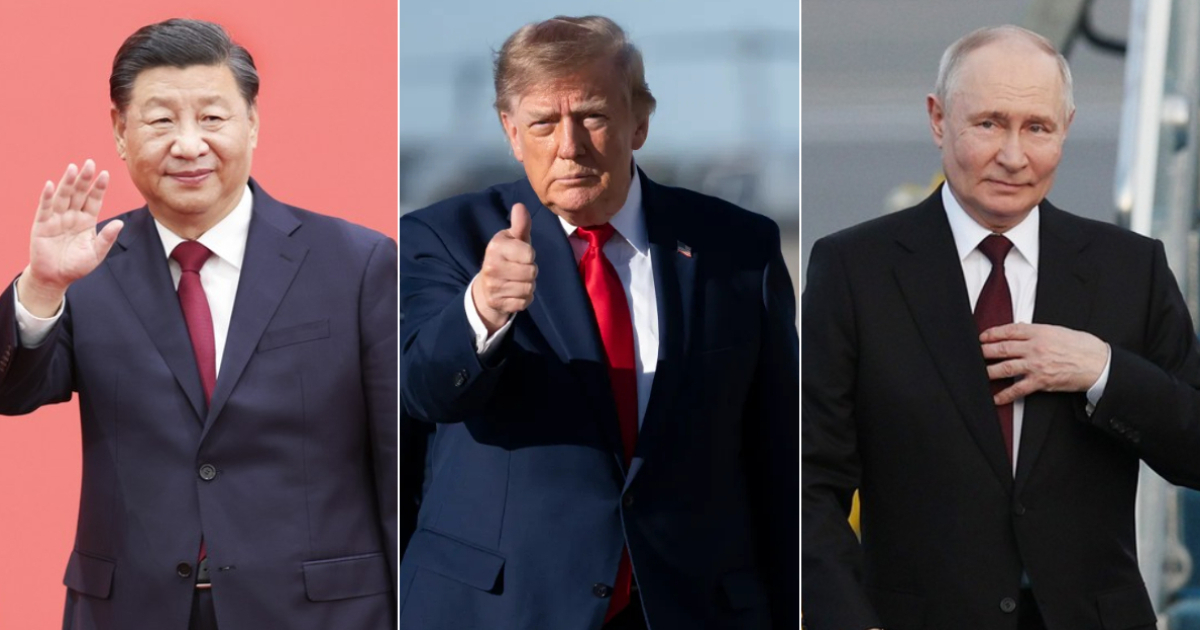
President Donald Trump hinted at his willingness to participate in a trilateral summit with Russian Vladimir Putin and Chinese Xi Jinping focused on nuclear weapons, but national security experts warn that even if the meeting takes place, the chances of reaching meaningful agreements are minimal, according to an analysis by Axios.
The proposal emerged on October 19, when Trump stated that he is open to trilateral negotiations on "nuclear weapons and denuclearization", clarifying that the focus would not be on the war in Ukraine.
The leader conditioned his attendance on Beijing's position: “If President Xi wants to hold it, I would attend.” The idea took shape after a call between Trump and Putin on October 9, during which both explored the possibility of a meeting.
The most likely venue for the meeting would be the Asia-Pacific Economic Cooperation (APEC) leaders' summit in Shenzhen, scheduled for November 18 and 19, which Trump intends to attend. However, as of Tuesday, the trilateral meeting had yet to be confirmed: the Kremlin indicated that there were no concrete proposals or agreed agenda, and China stated it had no information about a confirmed meeting.
Such a meeting would be unprecedented. Trump, Putin, and Xi have engaged in bilateral contacts in various forums — the G20, APEC, or direct summits — but they have never held a formal joint meeting together.
Trump and Xi met at the White House in September, during which the U.S. president reiterated calls for trilateral arms control talks; he held a bilateral summit with Putin in Alaska in August 2025.
The context in which the proposal emerges is of maximum nuclear tension. The New START treaty—the last binding agreement between Washington and Moscow regarding strategic arsenals—expired in February 2026 without a successor, leaving the two largest nuclear powers without formal restrictions for the first time since 1972.
Russia had suspended its participation in the pact in 2023. China, for its part, has never entered into bilateral arms control agreements with either of the other two powers and is experiencing the largest expansion of its arsenal in history: from about 260 warheads in 2016 to approximately 620 today, with Pentagon projections indicating a rise to 1,000 by 2030.
In total, nine countries have 12,100 nuclear warheads, according to the Arms Control Association. The vast majority are held by the U.S. and Russia; China holds a distant but not irrelevant third place.
The Secretary of State Marco Rubio described the dialogue between the three leaders as "positive" and dismissed the criticism of talking with Moscow and Beijing. However, analysts remain skeptical.
"The nuclear threat is worsening; all countries are either increasing or modernizing their nuclear weapons. There is a significant need for this, but the record of the Trump administration is quite poor," said Jon Wolfsthal, a nuclear policy researcher at Pax Sapiens. "The chances of moving from a whim — 'Let's meet and denuclearize' — to a comprehensive and verifiable agreement are extremely low," he added.
Andrea Stricker, deputy director of the non-proliferation program at the Foundation for Defense of Democracies, acknowledged that the summit "could be the beginning of a longer conversation" and that the diplomatic effort is something "positive," but she warned: "I would be very surprised if China accepted nuclear arms control at this moment. It is not even clear that Russia and the United States are truly seeking a new agreement."
"The only thing less likely than a trilateral summit on nuclear issues would be concrete results that matter more than the image," summarized Chris Estep, Indo-Pacific security expert at the Foreign Policy Research Institute. "Sometimes, when something has never happened before, there’s a pretty good reason for it."
Related videos:
Filed under: