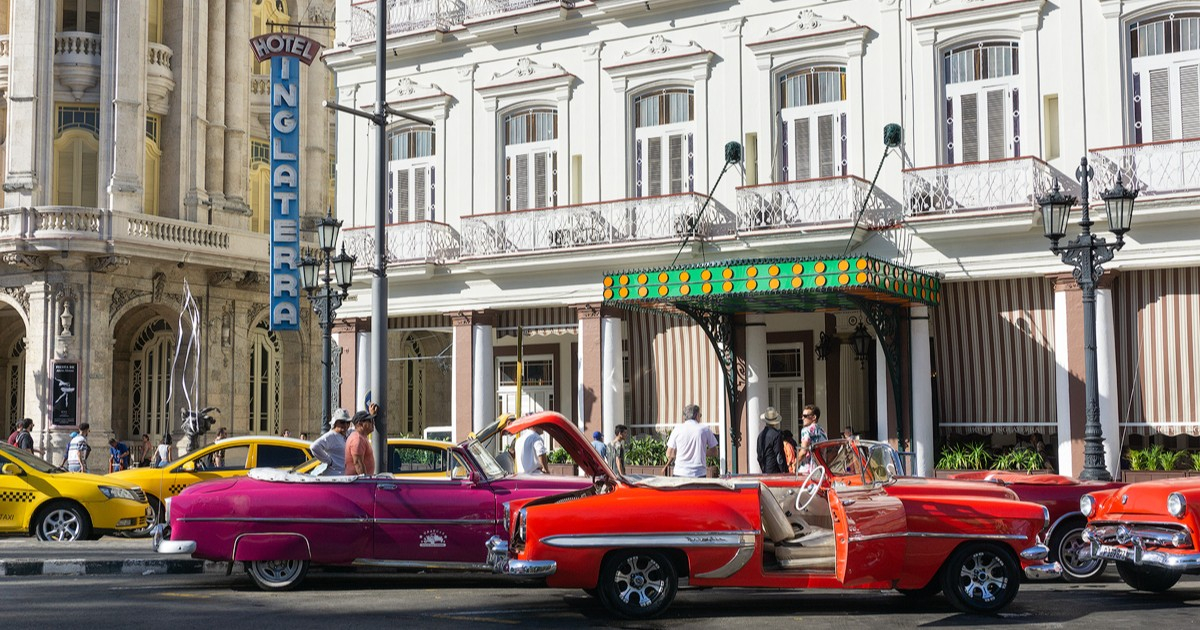
The Hotel Inglaterra in Havana, regarded as the oldest active hotel in Cuba, will celebrate its 151st anniversary on December 23. Since its opening in 1875, it has welcomed personalities from politics, culture, and the arts.
Located on the Paseo del Prado, between San Rafael and San Miguel streets, in front of Parque Central, the hotel has a history closely linked to some of the most significant events and figures of the 19th and 20th centuries in Cuba.
The stay of Antonio Maceo at the Hotel Inglaterra
One of its most famous guests was General Antonio Maceo, who stayed at the Inglaterra during his time in Havana in 1890. He resided there from February 5 to July 24 of that year, while remaining involved in the efforts to achieve Cuban independence.
Maceo stayed in room 117 of the hotel. His presence caused a genuine stir in Havana. War veterans, intellectuals, young people, and citizens from all social classes came to meet and greet the independence hero, who was even honored by the Spanish military as a general.
In light of rumors about a possible attack, a group of young people from the famous Acera del Louvre became his improvised escort and accompanied him for protection. Maceo was impressive both for his military prestige and his elegance: he wore an English frock coat, a top hat, and a belt with a buckle displaying the coat of arms of the Republic of Cuba.
The list of personalities who have stayed at the Hotel Inglaterra also includes General Máximo Gómez.
Winston Churchill and other historical visitors
Another prominent name is Winston Churchill, who visited Cuba for the first time in December 1895, when he was a young British officer interested in closely observing the war between the Cuban independence fighters and the Spanish troops.
During that stay, the future Prime Minister of the United Kingdom lodged at the Inglaterra Hotel, according to the establishment's history. On his second trip to the island in 1946, he stayed at the Nacional Hotel.
During his stay in Cuba in 1895, Churchill accompanied a column of the Spanish army, under the command of General Álvaro Suárez Valdés, which was fighting against the independence forces led by Máximo Gómez and Antonio Maceo.
Other world-renowned visitors who walked through the halls of the Inglaterra include: the world chess champion José Raúl Capablanca, the Nicaraguan poet Rubén Darío, the Russian dancer Anna Pávlova, and the French theater and film actress Sarah Bernhardt, as well as the Mexican singer and actor Jorge Negrete.
The scandal of a forbidden love
The Inglaterra Hotel was also the setting for one of the biggest love scandals in Havana's high society in the early 20th century.
In 1905, Catalina Lasa, a renowned Cuban beauty married to Luis Estévez Abreu, son of the patriot Marta Abreu, began a clandestine relationship with the wealthy landowner Juan Pedro Baró, who was also married.
The suspicions led to an aunt of Catalina's husband hiring a private detective, who discovered the lovers in a suite at the Hotel Inglaterra. The incident sparked a scandal that resulted in Catalina being expelled from her home and stripped of custody of her children.
The Lasa - Baró Couple ended up moving to Europe and, following the approval of the Divorce Law in Cuba in 1917, they were able to formalize their relationship. They got married and returned to live in Havana. It is one of the most famous love stories of the 20th century in Cuba.
From a Havana café to a hotel with 151 years of history
The history of the Hotel Inglaterra dates back to 1844, when the establishment known as El Escauriza Saloon opened in that location. It was later renamed Café El Louvre until the building was transformed to house the Gran Hotel de Inglaterra, which was inaugurated on December 23, 1875.
The property has undergone several expansions and modernizations. Among the most significant are those from 1901, when it incorporated electricity, telephones, and private bathrooms. In 1914, its third floor was built, and it received most of the architectural adjustments that characterize it to this day. It closed in 1931 during the Great Depression, but reopened in 1939. Since then, it has undergone various renovations that have helped preserve its structure and decor.
The Hotel Inglaterra was declared a National Monument in 1981. It has 83 rooms and is notable for a history that spans three centuries. It is a significant part of the historical and cultural memory of Havana, but currently, very few tourists enjoy its classic entrances, and few Cuban couples can afford a romantic getaway there.
Related videos:
Filed under: