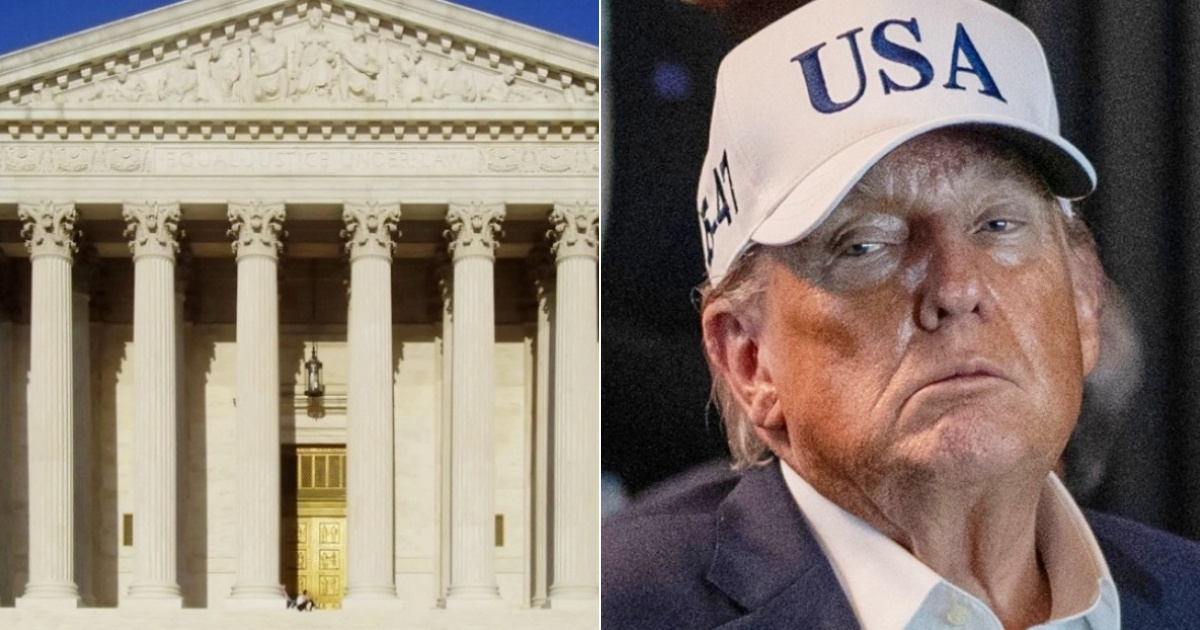
The Supreme Court of the United States rejected an emergency request on Tuesday to reinstate the regulation that allowed immigration judges to temporarily suspend certain deportation proceedings while migrants sought other legal ways to remain in the country.
The decision, issued on October 27 without a written explanation or recorded dissenting votes, upholds a court order that blocks the regulation approved during the Joe Biden administration in 2024.
The outcome favors the position of the Government of Donald Trump and the state of Texas, which had agreed to nullify that regulation.
The Supreme Court did not make a definitive ruling on the substance of the dispute, but its decision currently prevents the reinstatement of the administrative closure powers outlined in the challenged regulation.
What is administrative closure and why does it matter?
The administrative closure is a procedural tool that has been used for decades in U.S. immigration courts.
Allows temporarily withdrawing a file from the active calendar without dismissing it or definitively resolving the person's immigration situation.
This mechanism could be used, for example, when a migrant was awaiting the resolution of a family petition, a humanitarian visa, or another procedure that could affect their deportation case.
Unlike a dismissal, an administrative closure does not terminate the proceedings. The case remains inactive and may be reopened later.
The Biden administration formalized this practice through regulation in 2024, arguing that it facilitated the management of files and contributed to ensuring proper handling of cases.
According to government statistics cited by The Washington Post, approximately 360,000 migrants have received administrative closures since 1990.
How did the case reach the Supreme Court?
After Trump's return to the White House in January 2025, the Executive Office for Immigration Review (EOIR), under the Department of Justice, announced that it would not defend the 2024 regulation against a judicial challenge.
In June, Texas filed a lawsuit against that regulation. The state argued that the administrative closure allowed for the indefinite prolongation of the stay of certain immigrants without legal status in the United States.
On the same day the lawsuit was filed, Texas and the Department of Justice reached an agreement to rescind the regulation.
The federal judge Reed O'Connor, in Wichita Falls, approved the agreement, which blocked its enforcement nationwide.
The cities of Baltimore, Columbus, and New Haven, along with the organization Centro Legal de la Raza, sought to intervene in the process to defend the regulation.
The plaintiffs, represented by Democracy Forward, argued that the agreement between Texas and the federal government had allowed for the removal of a regulation without following the standard administrative procedure.
They also argued that the administrative closure favored the efficiency of the courts and protected procedural guarantees, especially in situations involving victims of crimes and vulnerable minors.
After their attempts to intervene in the lower courts were rejected, they appealed to the Supreme Court through an emergency request.
The Department of Justice opposed that request and argued that the cities and the suing organization had not demonstrated sufficient standing to intervene or an immediate harm that would justify the requested measure.
The Supreme Court rejected the request, meaning that the judicial block on the regulation remains in effect while the legal dispute continues.
How can the decision affect Cubans in the United States?
The resolution may have consequences for Cubans facing deportation proceedings while awaiting responses to immigration applications that could allow them to remain legally in the United States.
Among the procedures that may coincide with an expulsion process are family petitions and certain applications for humanitarian protection.
The administrative closure allowed, in cases where it was appropriate, to temporarily remove the file from the court calendar while those matters were being resolved.
The 2024 regulatory block limits the availability of that tool.
The decision adds to other recent changes in immigration procedures.
In October, the Board of Immigration Appeals (BIA) limited the ability to postpone deportation proceedings solely based on the existence of certain pending applications, such as a U visa or a family petition I-130.
The Supreme Court's ruling does not automatically order the reopening of all cases that had already been closed administratively.
It also does not mean that all migrants with pending applications must be deported, nor does it on its own eliminate any other legal avenues for seeking a deferral.
Its immediate effect is to keep the federal regulation of 2024 that authorized administrative closure under certain circumstances blocked.
The situation of each migrant will depend on their case file, the available procedural measures, and the decisions of the competent authorities.
Related videos:
Filed under: