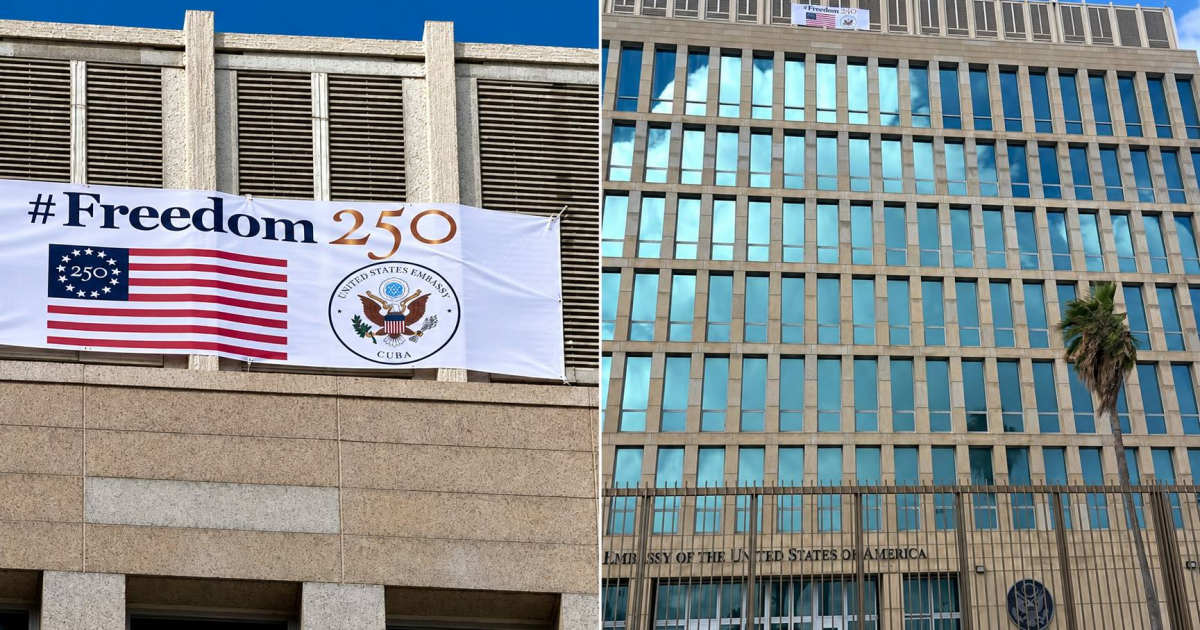
The facade of the United States Embassy in Havana was adorned on Wednesday with a large banner reading "Freedom 250," the official branding with which Washington commemorated the 250th anniversary of its independence, as reported by the agencies EFE and AFP from the Cuban capital.
The poster is identical to those that adorned buildings and public spaces during the July 4 celebrations in Washington, where the Freedom 250 commission, backed by the White House, organized fairs, races, and a fireworks display described as the largest in the history of the U.S. capital.
It is not an improvised gesture. Since May, the diplomatic mission has been conducting a public diplomacy campaign under the hashtag #Freedom250, inviting Cuban citizens to share messages about freedom.
On July 4, mission chief Mike Hammer delivered a speech that connected the American anniversary with a direct call for freedom in Cuba, and the following day the embassy released a video featuring testimonies from Cubans under the hashtags #Freedom250 and #ConCubanosDeAPie.
The display of the poster coincided with a day of heightened bilateral tension. That same Wednesday, the UN General Assembly approved the Cuban resolution against the U.S. embargo with 130 votes in favor, 17 against, and 25 abstentions, the lowest support Cuba has received in three decades, according to AFP. In 2025, the same non-binding resolution had garnered 165 favorable votes.
Among the Latin American countries that voted against this time were Argentina, Colombia, Paraguay, Ecuador, and Costa Rica. Hungary, Morocco, Ukraine, and the United Arab Emirates also rejected the initiative.
The night before, Cuban Foreign Minister Bruno Rodríguez Parrilla and the U.S. Ambassador to the UN Mike Waltz engaged in a heated confrontation during the debate, with the Cuban delegation banging on tables and interrupting the session.
The Cuban diplomat Richard Tur de la Concepción attempted to seize the phone from the Chief of Strategic Communications of the U.S. mission, which resulted in his expulsion signed by Secretary of State Marco Rubio.
The Cuban regime also called for a demonstration in front of the embassy in Havana for that same Wednesday, which led the mission to temporarily suspend its in-person services.
The Cuban government has a history of interpreting gestures on the facade of the U.S. mission as provocations. In 2006, when the then Section of Interests installed an electronic panel with messages about human rights, Fidel Castro responded by erecting in front of the building the so-called "Mount of Flags": 138 poles about twenty meters high with black flags to visually block the screen. The U.S. permanently turned it off in 2009.
Since 2017, the embassy has operated with minimal staff following the reduction ordered by Trump due to the incidents related to the so-called Havana Syndrome. It was formally reopened in August 2015 during the "thaw" initiated by Barack Obama and Raúl Castro, after more than five decades of diplomatic rupture.
In front of the UN, Waltz stated that "the hardships faced by the Cuban people are solely the fault of this corrupt communist regime" and pointed out that between January and August, his government sold goods worth 875 million dollars to the Cuban private sector, including fuel. "What annoys this communist regime is the term 'private sector'," the ambassador concluded.
Related videos:
Filed under: