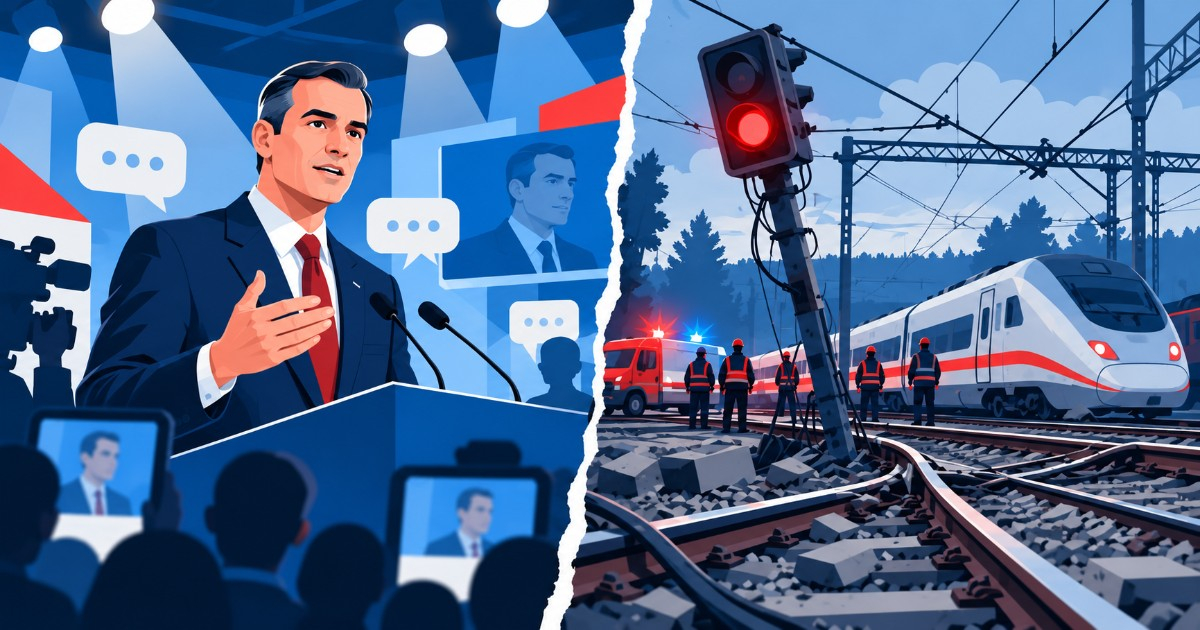
Yesterday, at least 69 people died in Urda, Toledo, when an AVE collided with an Iryo train that was stopped on the track. On January 18, in Adamuz, Córdoba, more than 40 people lost their lives on the same line, the Madrid-Andalucía line (46 in total, including those who died later in hospitals).
Nine months have passed, and in Adamuz, there are still no culprits. No one has resigned, and no one has taken responsibility. The minister who was in office then is still at his desk today, and his first reaction has been the same as always: to find an operator to blame.
I don't write this to talk about an accident. I write to discuss a pattern.
Those of us who come from Cuba, and many of those who have arrived from Venezuela, learned to recognize it before we knew how to name it. It is not necessary for a country to be a dictatorship for it to begin to follow some of the paths that lead to one. It is enough for a government to stop governing to focus on campaigning, to divide society between "the people" and "the powerful," and to confuse managing a country with distributing it.
Spain is neither Venezuela nor Cuba. Here, there are genuinely free elections, judges who have imprisoned a former minister from the very Government, and a press that can write what I am writing today. However, the Government of Pedro Sánchez follows guidelines that any Cuban would find familiar.
The first guideline is the discourse. Entrepreneurs are labeled as enemies, and those who create jobs are turned into suspects. Governance is delivered through narrative, in studios and on social media, while real problems pile up in drawers.
The second is fiscal. Extraordinary taxes are being levied on banks and energy companies, along with a tax on large fortunes, and they refuse to adjust the personal income tax (IRPF), meaning that inflation is increasing taxes on the middle class without anyone voting for that increase. The government has never collected as much revenue as it does now.
The third is spending. We have the Government with the most ministries in democracy, more public employment, and subsidies that are distributed with one eye on the polls. It is an increasingly larger, more expensive, and more self-absorbed State.
The fourth and most serious issue is the abandonment of management. Years go by with extended budgets. Investment is announced but then not executed. Railway workers have been warning about maintenance for some time and no one is listening to them. Services that used to function have ceased to operate.
Urda summarizes it all. The security system that failed yesterday, the LZB, has been in operation on the Madrid-Sevilla line since 1992. Its replacement with the European standard ERTMS was approved in late 2019, but the first tender had to be canceled due to an error by Adif itself, and the contract was awarded in 2021 with a timeframe of 52 months. Five years later, the old system is still in place, and the train operators had been reporting transmission losses and blockages for months. So what did the Government do on Tuesday, less than 24 hours before the collision? The Council of Ministers approved an increase of 11.5 million euros to the maintenance contract of that signaling, which is held by a UTE controlled by Hitachi, and which Adif awarded the service to with a single bid. The contract explicitly covers the maintenance center in Urda. There was money available; what was lacking was management.
Sánchez has been in La Moncloa for over eight years. He cannot claim he didn't have time. Nor can he say he wasn't aware: after Adamuz, he had nine months to thoroughly review the security of the network, and the result is Urda.
There lies the paradox that should appall any taxpayer: we have never paid so much and things have never worked so poorly. The money has not disappeared; it has shifted its destination. It has gone to support the political machinery and not to uphold what protects us.
High-speed rail has been the pride of modern Spain for decades. Today, it reflects a government that believes it is enough to present things favorably for them to cease being true. In Cuba, we understand that mechanism very well. There, hospitals were also described as "a medical power" in speeches while patients brought their own sheets. The narrative always survives reality, until reality catches up with someone.
In Urda and Adamuz, reality has claimed the lives of more than 100 people in nine months.
The technical causes will be determined by the investigators, and their conclusions must be respected. However, political responsibility does not require experts. A government that retains the minister of Adamuz, blames an employee before the fires are extinguished, and allocates more energy to the pre-election campaign than to the maintenance of the roads cannot claim bad luck a second time.
Cubans know how a country ends up when no one takes responsibility for anything: with everything dependent on the State and a State that takes responsibility for nothing. Spain is still very far from that. Precisely for this reason, it is the moment to say it out loud, while we can, while we vote, and while there is still time to correct the course.
The victims of Urda and Adamuz deserve the truth, they deserve for the guilty to be held accountable, and they deserve for this never to happen again.
Related videos:
Filed under:
Opinion article: Las declaraciones y opiniones expresadas en este artículo son de exclusiva responsabilidad de su autor y no representan necesariamente el punto de vista de CiberCuba.