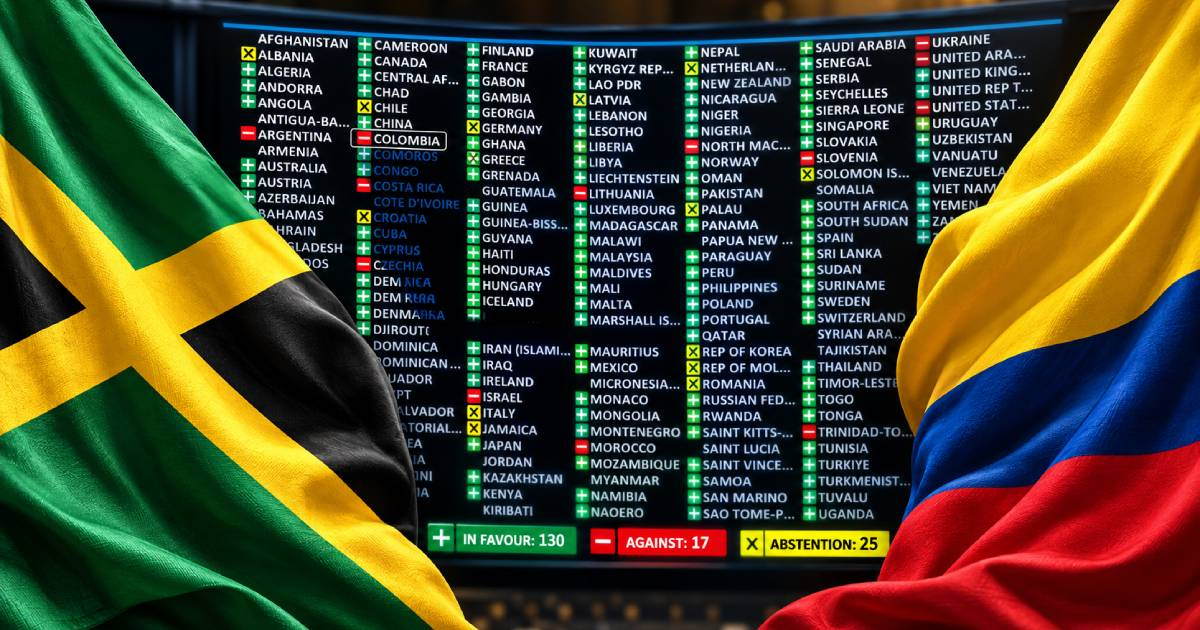
Jamaica and Colombia defended their respective decisions to change their votes on Cuba at the United Nations, albeit with different arguments: the Jamaican government denied having received pressure from the United States to abstain, while the Colombian Foreign Ministry justified its vote against the resolution with a firm stance against authoritarian regimes.
Both countries changed their traditional stance during the vote on Wednesday, October 28, when the UN General Assembly once again adopted a resolution calling for an end to the US economic embargo against Cuba, this time with a considerably lower level of support than in previous years.
Jamaica claims that no one pressured her to change her vote
Jamaica's Minister of Information, Dana Morris Dixon, denied that her government acted under foreign pressures by abstaining from voting in favor of the resolution.
According to the Jamaican broadcaster IRIE FM, the official stated during a press conference held on Wednesday that no country influenced the decision.
The Minister of Foreign Affairs, Kamina Johnson Smith, acknowledged that the abstention marks a change in Jamaica's foreign policy, which for more than three decades had supported the resolution against the embargo.
However, he explained that Kingston continues to oppose unilateral economic measures and believes it is necessary to broaden the approach to discussions about Cuba.
According to the chancellor, the resolution does not include aspects related to economic and institutional reforms on the island, respect for human rights, and the need to promote dialogue between the Cuban and U.S. governments.
Johnson Smith argued that continuing to endorse the same document each year, without improving the living conditions of Cubans, is not yielding the expected results.
"We did not vote against it because we do not support unilateral actions," explained the chancellor, according to statements reported by the Jamaica Observer.
The official stated that they also did not vote in favor because they believe that repeating the same procedure while the humanitarian crisis deepens does not benefit the Cuban people.
The Jamaican opposition questions the change
The decision sparked criticism from the opposition People's National Party (PNP), which demanded explanations for the abandonment of a diplomatic stance maintained for decades.
The opposition spokesperson for Foreign Affairs, Donna Scott-Mottley, questioned the apparent contradiction between a motion approved by the Jamaican Parliament regarding the situation in Cuba and the abstention registered just one day later.
"What has changed in 24 hours?" asked the legislator, who called for transparency regarding the reasons behind the decision.
Scott-Mottley recalled that Jamaica and Cuba have historic ties of cooperation, especially in the fields of health and education, and emphasized the need to preserve the principles of sovereignty and self-determination.
Colombia votes against and sends a message against authoritarian regimes
While Jamaica defended its abstention, Colombia took a bolder stance by directly voting against the resolution calling for the lifting of the U.S. embargo.
The Colombian Foreign Ministry confirmed on its official X account that the decision was made following instructions from President Abelardo de la Espriella and was executed under the leadership of Chancellor Omar Bula.
"Under the instruction of President @ABDELAESPRIELLA and the leadership of Chancellor Omar Bula, Colombia voted at the UN General Assembly against the resolution calling for an end to the alleged U.S. embargo on Cuba," stated the Ministry of Foreign Affairs.
The institution described the vote as historic and stated that it reflects a foreign policy grounded in the defense of democracy, freedom, and national security.
"Colombia strengthens its strategic alliances and maintains a firm stance against authoritarian regimes and those complicit in narco-terrorism," the Foreign Ministry added.
With this decision, Colombia broke with its traditional support for the resolution against the U.S. embargo.
The decision also faced opposition within Colombia. The opposition movement Pacto Histórico criticized the government's vote and defended respect for Cuban sovereignty, as well as Havana's role in Colombian peace efforts.
Cuba loses 35 votes of support at the United Nations
The positions of Jamaica and Colombia are part of a broader shift in international voting regarding the U.S. embargo.
The United Nations General Assembly approved the resolution on Wednesday, October 28, with 130 votes in favor, 17 against, and 25 abstentions.
In comparison, in 2025 the initiative received 165 favorable votes, seven against, and 12 abstentions. This year's result represents a decrease of 35 votes in favor of the resolution.
Colombia joined countries such as Argentina, Costa Rica, Ecuador, and Paraguay, which voted against the resolution, while Jamaica became part of the group of governments that chose to abstain.
The decline in support for the resolution presented by Cuba occurred amid a diplomatic offensive by Washington to reduce backing and Havana's claims of alleged U.S. pressures.
Related videos:
Filed under: