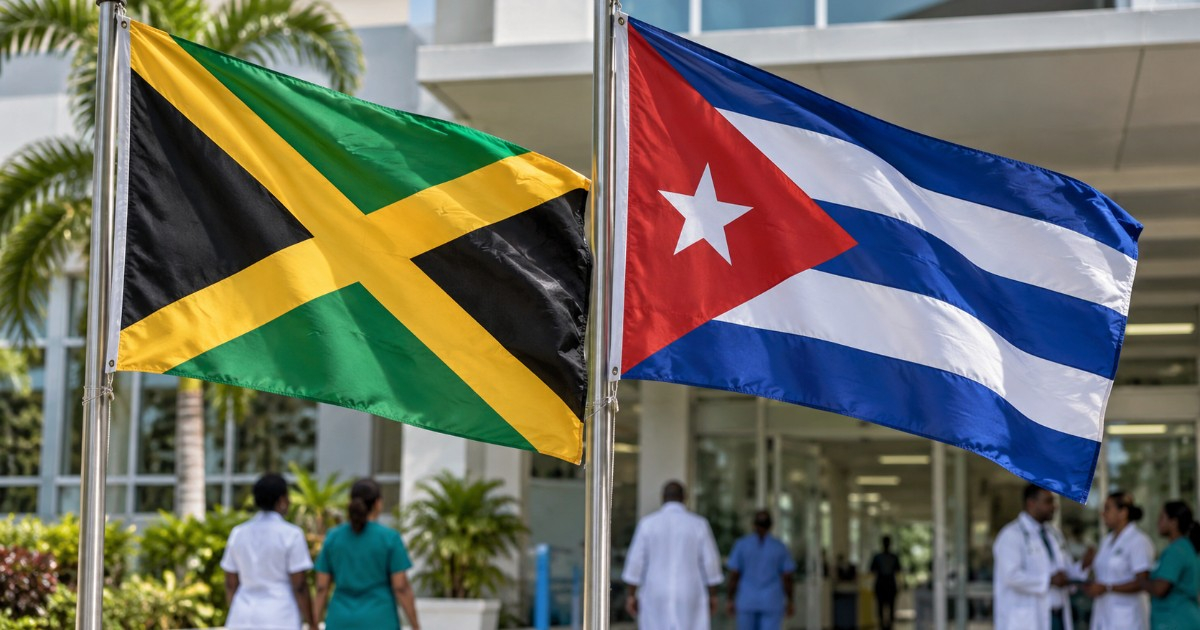
Jamaica has reintegrated 157 Cuban health professionals under an individual hiring model, after the bilateral agreement that allowed the Cuban government to send healthcare personnel to that Caribbean country for decades came to an end in March. With these returns, 200 Cuban workers are currently providing services in the Jamaican public system, but no longer under the previous agreement between Havana and Kingston.
The Minister of Health and Wellness of Jamaica, Christopher Tufton, announced the figures during the press conference following the Cabinet meeting on Wednesday, October 7. As reported by Jamaica Observer and The Gleaner, the 157 re-enrollees join another 43 Cuban professionals who decided to remain in Jamaica after the previous program was terminated.
The news is not only the return of doctors and nurses: Jamaica hires them directly, without using the Cuban government as a contractual intermediary. Tufton explained that professionals were offered the opportunity to return voluntarily and work under individual contracts. The system now includes 200 Cuban healthcare workers, compared to about 277 who were part of the program before its termination.
Where are the 157 Cuban healthcare workers who have been reinstated working?
Tufton specified that the professionals were allocated according to the needs of the public health service. A total of 69 joined the Southeast Regional Health Authority; 28 to the western region; and 26 to the southern region.
Others 25 were assigned to the University Hospital of the West Indies, while the remaining nine work at the Ministry of Health and Wellness and at the health authority of the northeastern region. The distribution was announced by the minister and reported by the Jamaican press on October 8.
The 43 professionals who remained in the country had already accepted individual contracts months earlier. In May, the Jamaican government itself confirmed that more than 40 Cuban workers had chosen to stay and that others had been invited to return under the new arrangements, according to the Jamaica Information Service (JIS). CiberCuba reported at that time that some had also applied for permanent residency.
Why Jamaica ended the medical agreement with Havana
The change originates from the decision announced on March 5, 2026 by the Jamaican Ministry of Foreign Affairs. In an official statement, Kingston explained that both governments had failed to agree on the terms of a new agreement following the expiration of the previous one in February 2023. At the same time, it left the door open to individually hire Cuban healthcare workers in accordance with local labor laws.
Two days later, the Jamaican Foreign Ministry detailed the issues identified upon reviewing the program. According to the Jamaican government, numerous Cuban professionals did not possess their passports, and the agreed salaries —calculated at levels equivalent to those of Jamaican staff— were transferred in U.S. dollars to the Cuban authorities. The workers received payment for overtime hours directly from Jamaica only.
The review, Kingston noted, had not found issues with the accommodation, permits, or the freedom of movement of workers in Jamaica. However, the authorities questioned why the previous contract did not specify what portion of the salaries transferred to the Government of Cuba ended up in the hands of each professional. Jamaica believed that the mechanism posed serious compliance problems with its labor and tax regulations.
The Jamaican government stated that it attempted to renegotiate those conditions with Havana before terminating the bilateral mechanism. The Cuban government, for its part, attributed the withdrawal of its medical brigade to pressures from the United States and defended the continuation of medical missions abroad.
With individual contracts, Jamaica aims to retain the contributions of Cuban professionals without reproducing the payment system through the authorities in Havana. The specific salaries of the 157 re-incorporated individuals and the complete clauses of their contracts have not been published in the consulted documents, making it impossible to determine how much each worker will earn.
Jamaica still needs medical staff
The termination of the agreement left vacancies in hospitals and specialized services. In May, Tufton acknowledged that the departure of Cuban medical professionals had impacted, among other things, the ophthalmology care program and certain hospital specialties, while the country sought new professionals both domestically and abroad.
In his appearance in October, the minister also explained that Jamaica is maintaining plans for international recruitment, including agreements with African countries such as Ghana and Nigeria, to address the needs for doctors, nurses, and specialists.
The new balance presents a significant conclusion: Jamaica is once again turning to Cuban medical talent, but the contractual relationship has changed. Of the nearly 280 professionals linked to the previous program, 200 are now working again in the Jamaican public system under a framework in which, according to the authorities in Kingston, each healthcare worker decides whether to accept the offer and contracts individually.
Related videos:
Filed under: