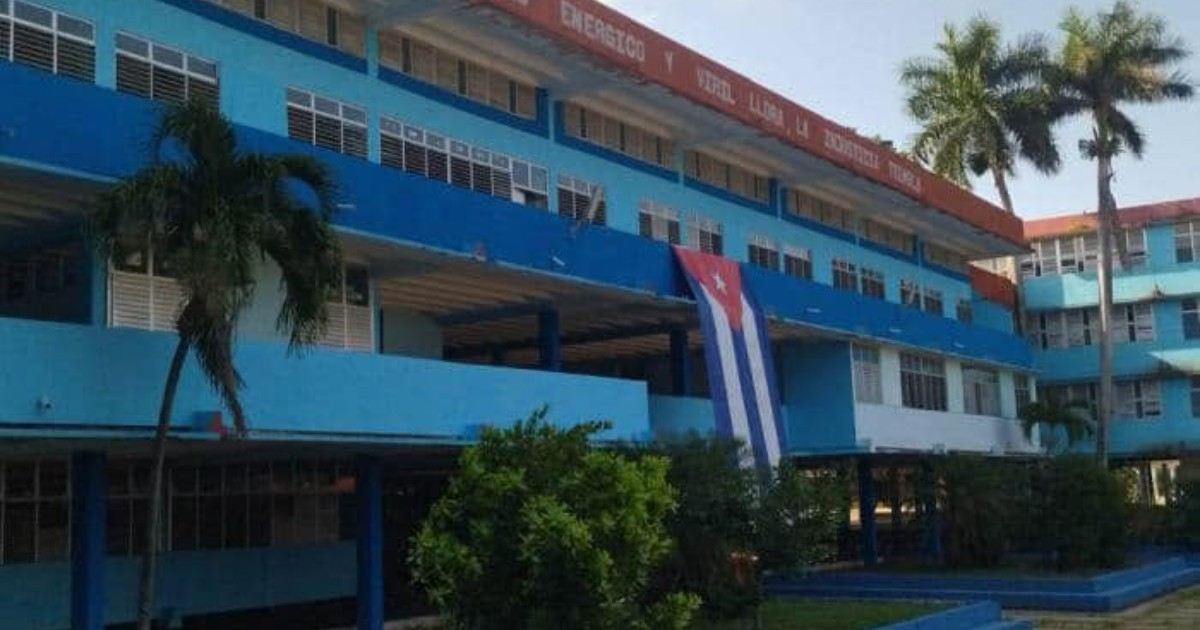
Roxana Calzadilla, a 16-year-old girl who practiced synchronized swimming at the School of Sports Initiation (EIDE) "Mártires de Barbados" in the Cotorro municipality of Havana, made a decision this September that will mark her sporting future: she will not return to the boarding school for her third year of secondary education.
Calzadilla, originally from Villa Clara, explained to IPS Cuba the reasons for her departure with a phrase that summarizes the crisis facing Cuban sports boarding schools: "Last year I got sick, and in the school's health area, there wasn't even a pill to reduce my fever. I don't want to go through that much hardship again; I'd rather be at home with my family."
The athlete acknowledged that her decision harms her career, but she felt that the conditions of the internship—locally known as a "scholarship"—make it impossible to stay.
Calzadilla's case is not an isolated one. The EIDE "Mártires de Barbados" is part of a network of high-performing internal schools in the capital, which also includes the Vocational Pre-University Institute of Exact Sciences (IPVCE) "Vladimir Ilich Lenin" and the National School of Art, all affected by the same structural crisis.
In the Lenin, where the 2026-2027 school year started without breakfast and with power outages lasting most of the day, the situation is equally serious.
With over 1,200 students enrolled, the cafeteria only offers lunch and dinner, with a menu that consists of rice, peas, and mashed root vegetables; families must provide proteins and cover breakfast on their own.
Water does not reach the second, third, and fourth floors of the dormitories. Tenth-grade student Claudia Alcántara described the nighttime situation: “There is electricity for only a few hours a day. When the school day ends and we go back to the dormitories, it becomes very difficult to be in the dark all the time.”
The campus cafeterias were leased to private businesses at prices that the students themselves describe as prohibitive. The gym, the multipurpose court, and the cinema have been out of service for more than five years.
Medical care partially depends on external donations, such as those from the project "A Cuba hay que quererla," coordinated by Dr. Amado Riol.
The Minister of Education, Naima Trujillo, outlined the situation on August 27 when presenting the guidelines for the school year: “We will start the school year with all the difficulties.”
Dailin Santana, the mother of a student at the Lenin school, summarized the feelings of many families in a message directed to the authorities: "Let this serve as a call to all the leaders in Education, the Electric Union, the Communist Party of Cuba, Aguas de La Habana, and anyone committed to the proper development of this school, to do whatever it takes so that the future men of science do not have to carry water anymore, that their nutrition is adequate, and that the electrical supply is not a mere flicker."
The fuel crisis also requires that departures from the boarding school occur every 15 days, which extends the stay and increases the expenses that families have to bear.
The deterioration is not limited to the capital. The Lino Salabarría EIDE in Sancti Spíritus reduced its boarding students from around 300 to just 100 for this academic year, and last May, its students had to return from vacation on their own due to a lack of fuel.
The Julio Díaz EIDE in Artemisa started the year with leaks in the dormitory, broken windows, and deteriorated sports facilities.
At the national level, the National Institute of Sports (INDER) reported an enrollment of 13,350 students on scholarship at EIDE across the country for the 2026-2027 school year, with the 2027 Pan American Games in Lima as the main objective.
However, sports communicator Carlos Hernández Luján warned that “a lot has been lost from the sports pyramid in Cuba” due to the emigration of athletes and economic limitations.
Related videos:
Filed under: