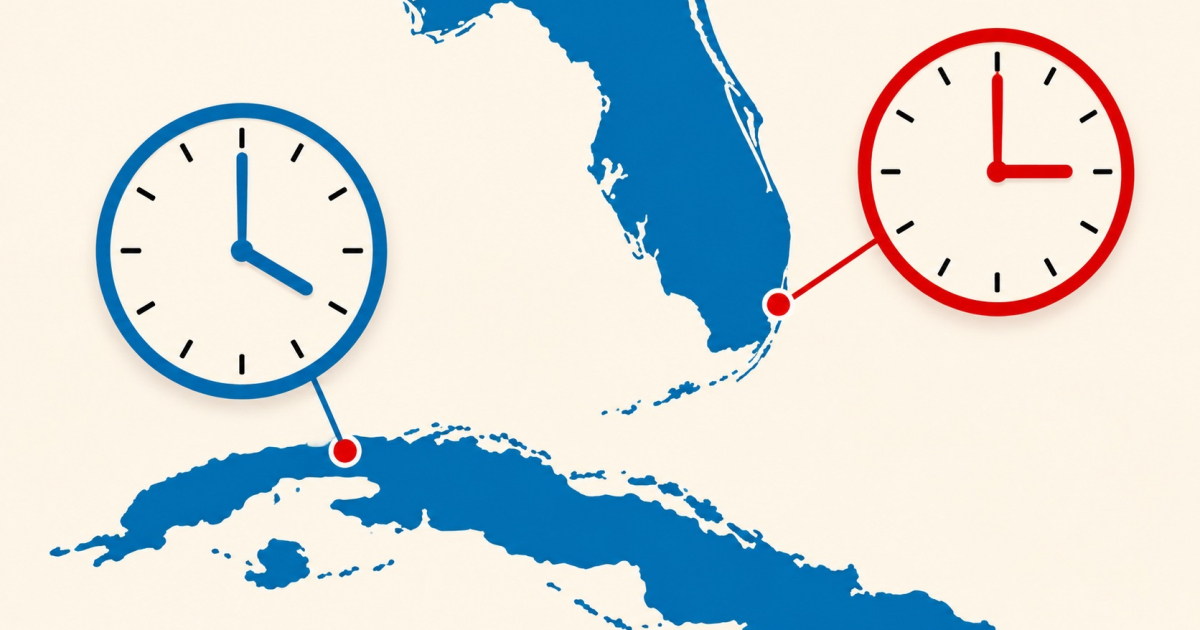
Cuba woke up this Sunday, November 1, 2026, one hour ahead of Miami, after the Florida city set its clocks back while the island maintained daylight saving time. Since early this morning, when it is 3:00 a.m. in Miami, it is 4:00 a.m. in Havana.
The adjustment took place at 2:00 a.m. in the Eastern Time Zone of the United States, when clocks were set back to 1:00 a.m., according to the National Institute of Standards and Technology (NIST) calendar. Miami moved to UTC−5, while Cuba remains at UTC−4.
The difference also applies to other cities in the Eastern Time Zone, such as New York and Washington. For those coordinating calls, appointments, or travel between Cuba and Miami, it will be necessary to clarify which of the two time zones is being referred to starting today.
Why Cuba did not set the clock back this Sunday
The Ministry of Energy and Mines and the Ministry of Labor and Social Security announced on October 24 that the island will maintain daylight saving time until November 7, 2027. The joint statement from both agencies suspended the return to standard time that was scheduled for this Sunday.
The regime linked the decision to the electricity crisis. The ministries estimated that maintaining daylight saving time would prevent an increase of 126 megawatts in the impact during the peak evening demand period: 76 MW from reduced use of artificial lighting and 50 MW from harnessing solar generation during that time.
Since sunrise occurs later according to the clock than it would have under standard time, it was also decided to postpone the start time for schools and workplaces by 30 minutes from November 1, 2026, to March 14, 2027.
Until when will there be a one-hour difference with Miami?
With the current calendar, Miami will spring forward its clocks on March 14, 2027, the second Sunday in March. From that change, Cuba and Miami will again align at UTC−4.
It is advisable to check the clocks and alarms on devices in Cuba: if the system retains the calendar prior to the announcement, it could cause a delay that is no longer applicable. The reference that should be maintained on the island is UTC−4.
The discrepancy also occurred after 2006
An image shared on social media correctly shows the equivalence between 4:00 a.m. in Havana and 3:00 a.m. in Miami, but adds an erroneous statement: that the difference had not existed since 2006.
The historical records of the IANA time zone database document that the United States ended daylight saving time on November 6, 2011, while Cuba extended it until the 13th. During that week, Havana was also one hour ahead of Miami.
The precedent from 2006 corresponds to another event: Cuba consistently maintained daylight saving time from March 2004 until October 2006. In subsequent years, there were new discrepancies with the United States when the changeover calendars did not align.
Related videos:
Filed under: