A day before the midterm elections on November 3rd, Florida Republicans are experiencing an anxiety they haven't felt in years: the early voting data does not align with their expectations and the possibility of losing a state race—something unthinkable just months ago—is no longer being dismissed in private, according to an analysis by Axios.
"Nerves on edge", a veteran of the Florida Republican Party described the internal mood. It's not declared panic, but rather a real tension fueled by worrisome numbers: Republicans lead the early voting by just 3 percentage points over Democrats, a significantly smaller advantage than in the last two general elections, even though their voter registration margin is 11 points and 1.5 million people in absolute terms.
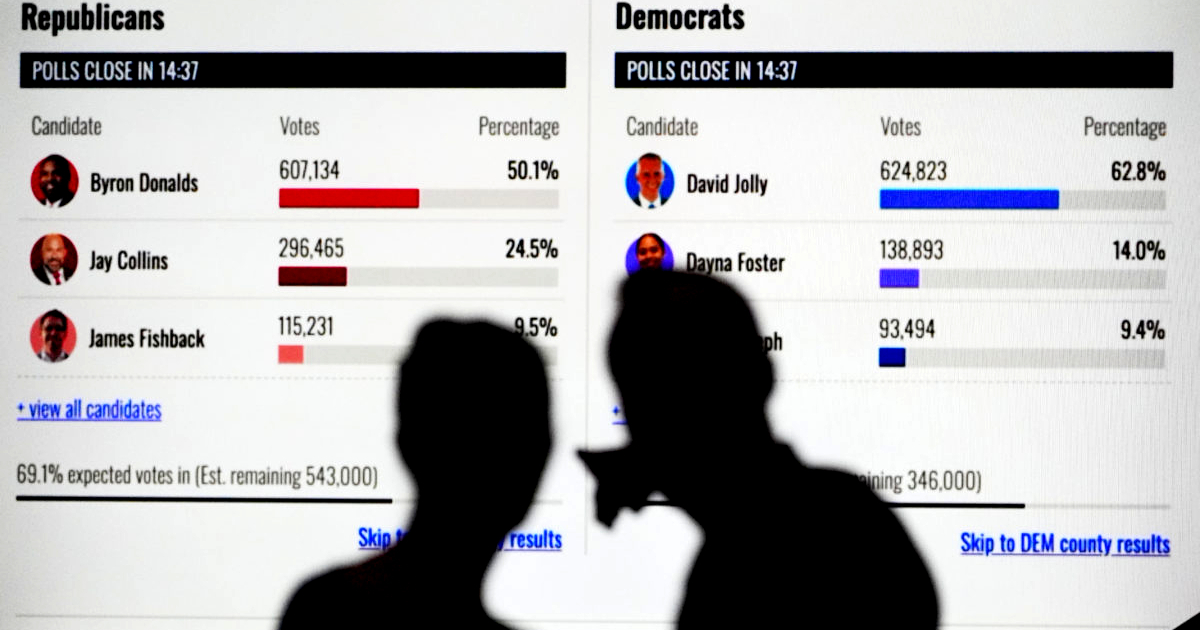
The race that most concerns the party is that of Byron Donalds, a congressman running for governor against the Democrat David Jolly.
Donalds has a narrow lead in most polls, but internal estimates from both parties shared with Axios warn that he could arrive on Election Day facing a deficit of up to 500,000 votes in early voting.
To reverse it, I would need to win Tuesday's vote by a two-to-one ratio, a feat that Republicans have accomplished before—notably in 2022—but which seems more challenging in this cycle.
The weakness is particularly pronounced in the 17 counties of the Panhandle and rural northern Florida that Donalds lost in the Republican primary, where GOP participation is 3.2 points lower than in 2022, compared to just 1.1 points in the counties he won, according to political scientist Michael McDonald from the University of Florida.
Governor Ron DeSantis did not hide his concern last week: «I don't necessarily want to be the bearer of bad news, but I don't think turnout will be as strong as we would like to see».
The numbers by demographic groups paint a more concerning picture. Among active Democratic voters, 50% of whites, 39% of blacks, and 34% of Hispanics have already voted early; among active Republicans, those figures drop to 35%, 21%, and 28%, respectively. The gap among young voters is even more pronounced: 25% of registered Democrats under 30 have voted, compared to only 9% of Republicans in that age group.
Democrats have already exceeded their total of early and mail-in votes from 2022 in 15 counties of Florida; Republicans have done so in only four. Additionally, independent voters favor Democrats by double digits in almost all state polls.
In the 27th District of Miami, Cuban-American representative María Elvira Salazar is facing a tight race against Democrat Eliott Rodríguez, with warning signs in the district's voting patterns. On a national level, the environment is so challenging for the GOP that states like Texas, Kansas, Ohio, Alaska, and even South Carolina are emerging as competitive.
Even so, Republican leaders insist that history is on their side. “We always win on election day and we know how to do it,” declared Evan Power, president of the Florida Republican Party. “Much of the anxiety comes from the fact that the last time we had a close election was eight years ago, and people have forgotten what that looks like here.”
A Republican consultant involved in one of the state races captured the mood with a phrase that reflects the uncertainty of the moment: "Just a few weeks ago, I didn’t think I would feel this way. It’s not panic. At least, not yet."
Related videos:
Filed under: