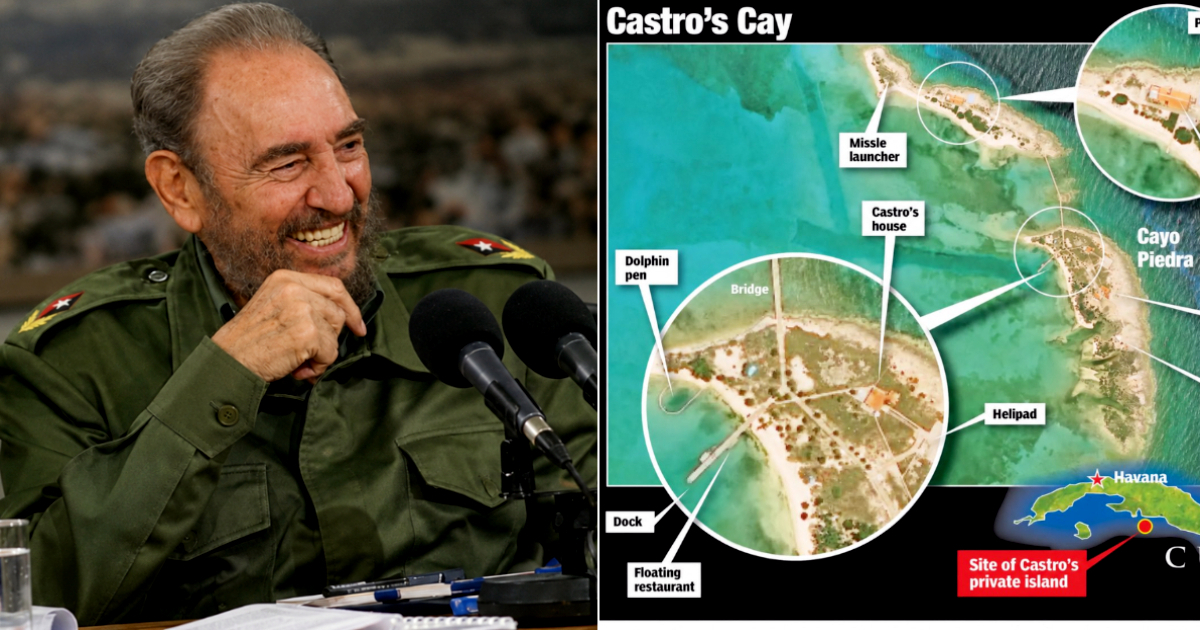
Satellite images taken at the end of October and examined by elTOQUE reveal that Cayo Piedra, the island enclave off the southern coast of Matanzas that U.S. Ambassador to the UN Mike Waltz showcased to the General Assembly as a symbol of the privileges of the Castro elite, maintains its facilities in seemingly good condition and shows signs of recent activity.
Waltz presented a map titled Castro's Cay on October 27 during the annual debate on the resolution calling for an end to the U.S. embargo against Cuba. Before the delegates, he described the caye as a complex exclusively for Fidel Castro, his family, and guests, featuring a marina, private boat, floating restaurant, and a lagoon with dolphins, contrasting it with the hardships faced by the Cuban population.
The complaint was not limited to the cay. Waltz also presented two Rolex watches attributed to Castro valued at 40,000 dollars —equivalent, according to his comparison, to 55 years of the average Cuban salary—; a beach residence in Varadero of 14,000 square meters with swimming pools, marble floors, sauna, and jacuzzi, and a 50-meter yacht whose fuel tank requires about 15,000 gallons of fuel.
Hours later, Secretary of State Marco Rubio amplified the accusation on X with a satellite infographic that identified on the key the main house of Castro, a guesthouse, a swimming pool, a helipad, a floating restaurant, a dolphin enclosure, and in the northern area, a missile launcher.
Rubio accompanied the post with the message: "Private island of the corrupt regime in Cuba."
An analysis conducted by the independent media elTOQUE using images from Google Earth Pro, Google Maps, Soar Atlas, and Sentinel Hub captured on October 26 and 28 confirms the existence of those structures.
Aerial views reveal several structures with red-tiled roofs, paved pathways, and clear areas of grass. On Google Maps, the main building is labeled as "protocol house of Fidel Castro." A semi-Olympic rectangular swimming pool holds water—although not to the brim, it covers more than half of its capacity—and in some detailed views, figures that appear to be people can be seen on the paths and in the surroundings of the buildings.
The two portions of the cayo are connected by a concrete bridge over 260 meters long. In the central area, there is a paved platform that matches the characteristics of the helipad mentioned by Rubio, and in the waters near the shore, submerged rectangular structures can be seen, divided into compartments compatible with a facility for dolphins, although the images do not allow for confirmation of whether the space is still operational.
What points to recent investments is the finding of researcher Luis Domínguez, from the Foundation for Human Rights in Cuba. According to research by Martí Noticias, Domínguez compared satellite images from April 2 and September 27, 2026, and detected structures consistent with solar panels installed on the roof of a guest house and a warehouse near a power plant.
Such energy renewal would have occurred while Cuba is undergoing serious electricity crisis with prolonged blackouts affecting millions of Cubans daily.
The complex has documented history. According to the testimony of Castro's former bodyguard Juan Reinaldo Sánchez, gathered in his book The Hidden Life of Fidel Castro (2014), the Cuban leader became acquainted with the place after the Bay of Pigs invasion in 1961 and turned it into a private refuge.
The main works were carried out in the 1970s under the direction of Osmany Cienfuegos, and among the guests who visited the island were Gabriel García Márquez, Ted Turner, and Erich Honecker. Sánchez claims to have accompanied Castro there "hundreds and hundreds of times" between 1977 and 1994.
Waltz's intervention sparked a tense confrontation with the Cuban Foreign Minister Bruno Rodríguez Parrilla, who got up from his seat and moved towards the podium. The presidency of the Assembly, led by Khalilur Rahman, briefly suspended the session.
The resolution against the embargo was approved with 130 votes in favor, 17 against, and 25 abstentions, the worst result in the history of this initiative since Cuba first introduced it in 1992.
Related videos:
Filed under: