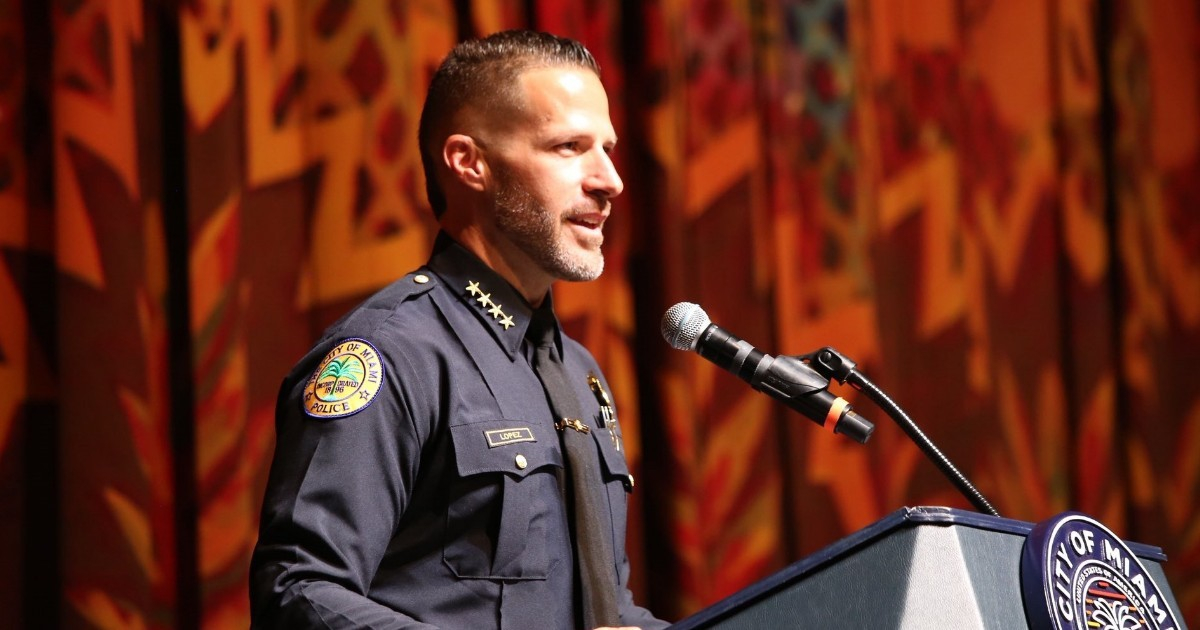
The Cuban-American Edwin López, chief of the Miami Police Department, presented the results of his first 100 days with news that his neighbors were hoping for: crime has decreased in the city, according to data from the department itself.
The figures, corresponding to the period between June 15 and September 22, 2026, compared to the same period in 2025, show a 3% decrease in overall crime and a 7% decrease in violent crimes.
The most pronounced declines were recorded in homicides — from 10 to seven cases, a reduction of 30% — burglaries — from 83 to 63, a decrease of 24% — and stolen vehicles — from 285 to 215, a drop of 25%. The figures come from the department itself and have not been independently verified.
Not all categories improved at the same pace: aggression and injuries barely decreased by 2%, and theft or larceny only by 1%, indicating that some types of crime remain a challenge.
López attributed the results to a combination of factors: the increased deployment of patrols, the use of technology—drones and surveillance cameras—and the work accumulated by previous administrations.
During that period, the department also issued more than 25,000 traffic citations and made over 1,000 arrests for traffic violations.
The police chief also visited the 13 neighborhoods of Miami in his first 100 days to understand firsthand the needs of each community, including areas with a high concentration of Cuban-Americans such as Little Havana, Flagami, and Allapattah.
López, born in Miami to Cuban immigrant parents, was sworn in on June 15 as the 44th chief of the department, appointed by Mayor Eileen Higgins.
He is the second Cuban-American chief in a row: his predecessor, Manuel «Manny» Morales, retired after 32 years of service. With over 28 years of experience in law enforcement in South Florida, López commands approximately 1,400 sworn officers and 400 civilian employees in a city of nearly 500,000 inhabitants.
Beyond the crime data, López faces a tension that has not disappeared since he assumed office: the collaboration of his department with federal immigration authorities.
According to a report on migrant arrests in Miami-Dade, the Miami Police is the county agency with the highest number of detainees under the 287(g) program: 451 arrests between August 2025 and August 2026, of which nearly 29% are Cuban. This contrasts with the statement made by López when he swore in, claiming that his priority “is not to enforce anything related to immigration.”
Another open front is the possible approval of Florida's Amendment 3, which is set to be voted on this Tuesday and would expand the property tax exemption. If it passes—needing 60% of the votes—Miami-Dade could lose between $359 and $445 million annually in revenue, putting public safety funding at risk.
The mayor of Miami-Dade, Daniella Levine Cava, warned about the possible closure of up to 19 fire stations and the elimination of more than 600 positions. When asked how he would tackle that scenario, López responded that the department would address it when the time comes.
In preparation for the upcoming 100 days, the police chief announced that he will maintain the current patrolling and technology strategies, and he hinted at additional public safety initiatives for the holiday season, although he did not provide details.
Related videos:
Filed under: