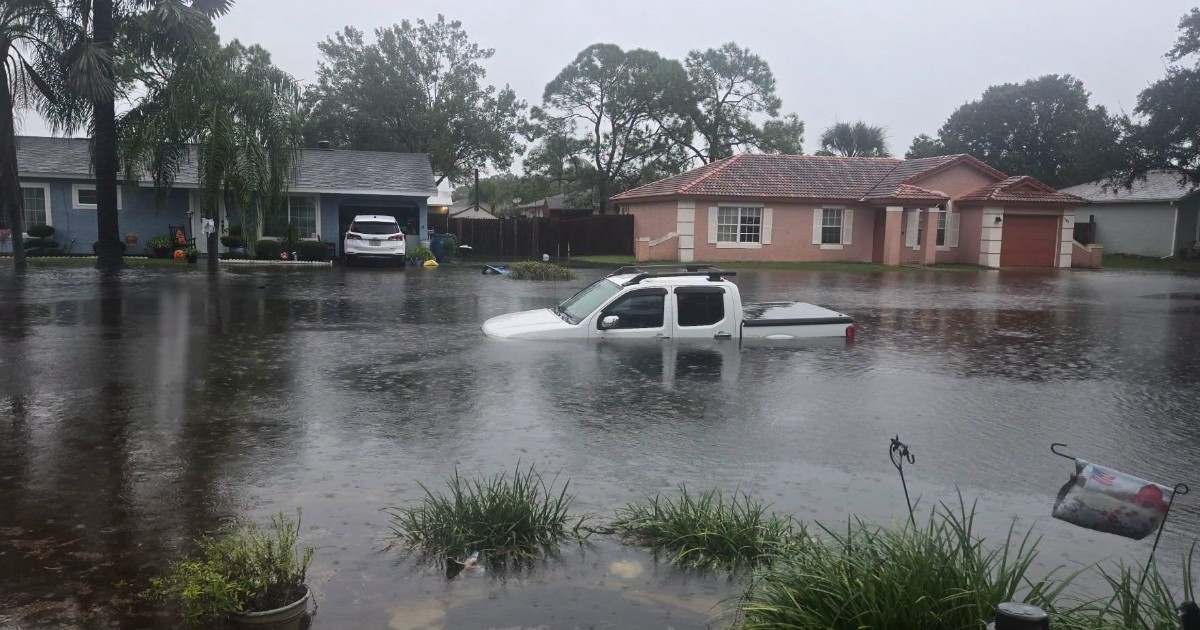
The governor of Florida, Ron DeSantis, declared this Monday a state of emergency in seven counties in the central and southern parts of the state due to the intense rains and flooding that have impacted roads, homes, and utilities.
The decision was established through the Executive Order 26-227, signed this Monday, which allows for the mobilization of extraordinary resources and the acceleration of response and recovery efforts in the affected communities.
The seven counties included in the statement are Brevard, DeSoto, Hardee, Highlands, Indian River, Martin, and St. Lucie.
The document notes that a broad low-pressure system that moved across the Florida peninsula between October 31 and November 2 caused heavy rainfall and several episodes of significant flooding.
According to the order, at 12:30 p.m. on Monday, there were warnings for flash floods in areas of the seven counties. Authorities warned that the new rainfall forecast could worsen the situation in already affected areas.
The state government also noted that the rainfall and flooding had harmed, or could continue to harm, the operation of essential infrastructure, including roads, airports, and schools.
The Florida Division of Emergency Management confirmed this Monday on its official X account that DeSantis had signed the order to accelerate the delivery of resources and assistance to the affected communities.
The agency explained that it maintains close coordination with local authorities to support residents during response and recovery operations.
It also reported that it is sending pumps to drain the accumulated water and thousands of feet of hoses from its warehouse at the Central Florida Operations and Coordination Center (FL-COCO), with the aim of assisting the areas that are still experiencing flooding.
The order allows for the mobilization of the Florida National Guard and the State Guard when necessary, as well as coordinating rescue, evacuation, and recovery operations.
In addition, it authorizes state agencies and local governments to expedite certain administrative procedures and contracts to respond to the emergency.
The Florida Department of Transportation may suspend toll fees when necessary to facilitate assistance or evacuations, in addition to managing traffic and closing roads for safety reasons.
The statement also includes the use of public facilities as temporary shelters, when local emergency authorities request it, and the mobilization of state funds allocated for disaster response.
Among the provisions for residents is the possibility of obtaining an emergency refill of up to 30 days of certain maintenance medications, in accordance with the requirements set forth by Florida law.
The order also establishes that it is prohibited to sell or rent essential goods and services at abusive prices in the territories included in the declaration.
Due to the general elections scheduled for Tuesday, the document includes a special measure for electoral supervisors who are unable to meet certain legal requirements related to polling places.
In those cases, any modification or alternative measure must be reported to the Florida Department of State and approved by the Secretary of State.
The statement took effect immediately upon its signing and will have an initial duration of 60 days, unless the governor decides to extend it.
The measure facilitates the mobilization of public resources, but it does not imply that all residents of the seven counties will have automatic access to individual financial assistance. Specific assistance programs will be subject to their respective requirements.
One of the territories most affected by the rains has been Brevard, where the National Weather Service (NWS) declared an emergency due to flash floods in Palm Bay and West Melbourne on Monday, with a warning of potentially catastrophic damage.
In a bulletin issued at 9:34 a.m., the agency reported that between 12 and 15 inches of rain had accumulated in areas of the affected zone, according to radar estimates and rain gauge data.
It also warned that another three to five inches of rainfall could be recorded.
In this regard, meteorologist Matt Devitt reported on Facebook accumulations of between 20 and 24 inches of rain in just 12 hours in the southern part of Brevard County, particularly in Grant-Valkaria.
These amounts are approximately equivalent to between 508 and 610 millimeters of water. Devitt described the rainfall as historic and reported severe flooding from Palm Bay to Melbourne, with water entering homes, stranded cars, and closed roads.
The meteorologist explained that the intensity of the episode was due to a combination of factors: an almost stationary atmospheric convergence zone, a disturbance that favored the development of storms, and exceptionally high tropical humidity.
This was compounded by the phenomenon known as training (the successive passage of storms over the same area), which occurs when several storms repeatedly release rain over the same locations, leading to extraordinary accumulations in just a few hours.
The rains forced the suspension of classes in public schools in Brevard County and caused road closures, including some sections of Minton Road in West Melbourne.
The images shared from various communities in Brevard show vehicles navigating through flooded streets, people moving in kayaks, and large areas of pavement submerged in water.
The National Meteorological Service urged residents in emergency areas to seek higher ground and avoid crossing flooded roads, whether on foot or in vehicles.
Miami-Dade, Broward, and Palm Beach, where alerts for rain and flooding were also issued over the weekend, are not among the seven counties included in the executive order signed this Monday.
Related videos:
Filed under: