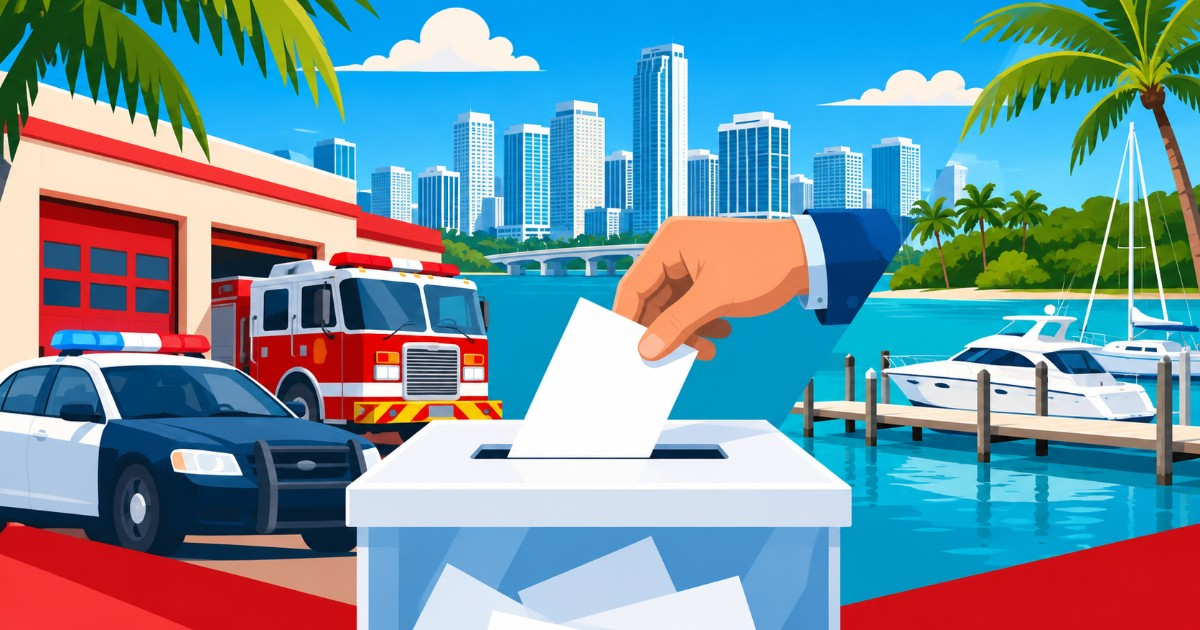
Voters in the city of Miami will decide this Tuesday, November 3, on three municipal proposals: to authorize 450 million dollars in bonds for police and fire facilities, to create a permanent oversight body for public debt, and to allow a land lease in Virginia Key to remodel two marinas.
The three referendums are held alongside the general elections in the United States, but only residents registered in the city of Miami can vote on them, not all voters in Miami-Dade. Each question is answered separately, according to the official ballot published by the City Hall.
Referendum 1: 450 million dollars for public safety facilities
The first question suggests that Miami issue up to 450 million dollars in general obligation bonds to renovate firefighter and paramedic facilities, build new stations, and establish a public safety headquarters for the police and first response teams.
The debt would be paid through property taxes, without increasing the current rate allocated for servicing this debt from capital projects, set at 0.5935 mils per dollar of taxable value. The proposal includes an annual independent audit. Maintaining that rate does not mean that the amount of taxes for each property will necessarily remain unchanged, as it also depends on its assessed value and other components of the tax.
Mayor Eileen Higgins supports the issuance of bonds and argues that many police and rescue facilities are in urgent need of repairs. Among the projects discussed is a new public safety headquarters. The proposal has opponents, including members of the City Commission, who question the debt and the costs associated with the initiative, according to Axios Miami and the WLRN election guide.
A vote in favor would authorize the issuance of bonds under the described conditions; a vote against would prevent that authorization. This is not an approval of expenses already incurred, but rather a decision regarding the city's ability to finance future projects through debt.
Referendum 2: a committee to oversee projects funded by bonds
The second question suggests amending the City Charter to create a permanent advisory committee for the oversight of general obligation bonds. This body could review and publicly report on the status of the projects, their costs, execution timelines, and the available or pending funds in infrastructure projects financed by these bonds.
The amendment aims to permanently incorporate that oversight mechanism into the municipal structure. It is a decision independent of the issuance of the 450 million: the question of oversight encompasses active projects funded with municipal bonds, not just those for police and fire services.
Referendum 3: a lease of up to 75 years on Virginia Key
The third question requests authorization to lease approximately 27.62 acres of public land in Virginia Key to Virginia Key, LLC, with the aim of renovating the existing marinas at Rickenbacker and Marine Stadium.
The proposed agreement includes 45 initial years, with two possible renewals of 15 years each. The company would pay the city a guaranteed minimum rent of 2.2 million dollars annually, with anticipated increases that, according to the text of the ballot, would amount to approximately 203.98 million over the initial term. Additionally, there would be a municipal share equivalent to 6% of the gross income of the business.
The project requires a private investment of approximately 80 million dollars to renovate the facilities, including boat storage areas, restaurants, shops, and public parking. This investment is not derived from the 450 million municipal bonds put to a vote in the first question.
The proposal has sparked debate about the future of the coastline and access to public spaces. Its proponents argue that it would modernize the marinas and generate revenue for the city. Critics caution about potential impacts of construction on seagrass and the water quality of Biscayne Bay, while also questioning the model for the use of these lands. Both positions were reported by CBS Miami during the campaign.
If the "yes" wins, the city would be authorized to formalize the lease under the terms submitted for consultation. If the "no" wins, the proposed agreement would not receive that authorization from the voters. The municipal electoral documentation includes the resolutions and the ballot for the three proposals.
What time can you vote in Miami?
The polling places remain open until 7:00 p.m. local time. Residents must go to their assigned voting center. The City Hall has reported changes in location for some precincts, including 523 and 548 and 670, so it is advisable to check the location at the Miami-Dade election office.
The city plans to begin releasing unofficial results of its referendums around 7:15 p.m., starting with early and mail-in ballots, and then followed by votes from the precincts. The event can also be followed through the .
Related videos:
Filed under: