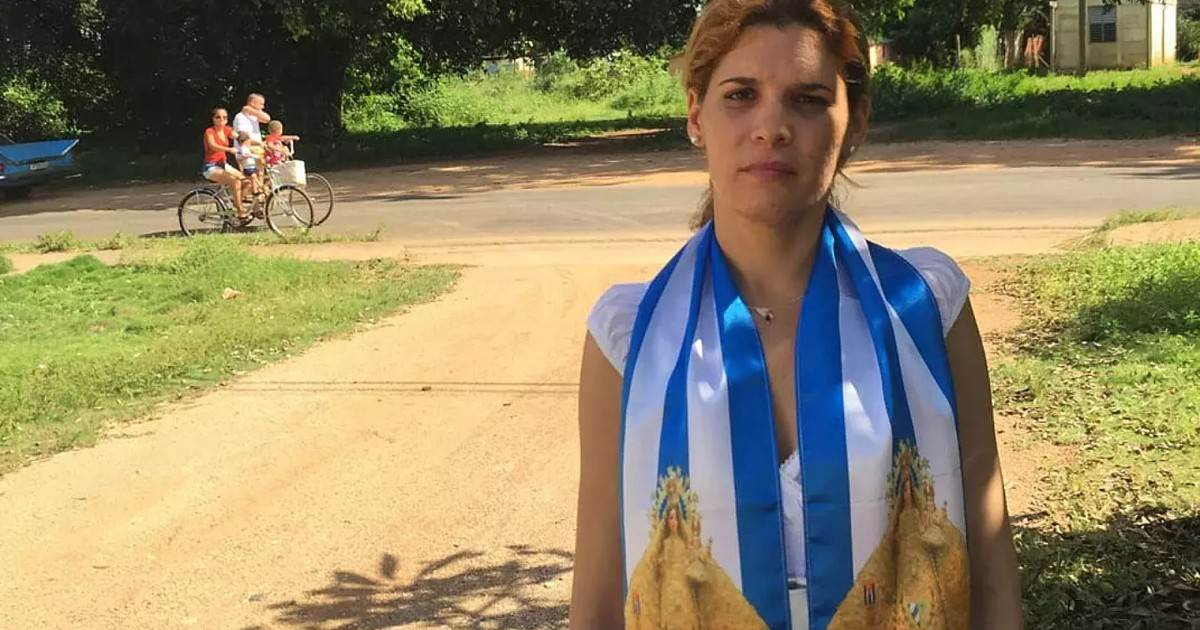
Amnesty International once again demanded on Tuesday the immediate and unconditional release of Sayli Navarro Álvarez, a Cuban activist and member of the Damas de Blanco, whom the organization classifies as a prisoner of conscience, according to Infobae, based on a post published on Monday by the Amnesty International Americas account under the campaign #CubaSinRepresión.
The claim is framed within a statement issued by Amnesty in October, marking exactly two years since the organization designated Sayli, her father Félix Navarro Rodríguez, and the activist Roberto Pérez Fonseca as prisoners of conscience on October 23, 2024.
"Two years after being declared prisoners of conscience, Félix Navarro, Sayli Navarro, and Roberto Pérez Fonseca continue to be unjustly deprived of their freedom. This means two more years separated from their families, subjected to the harsh conditions of the Cuban prison system, and punished solely for exercising their human rights. Cuban authorities must release them immediately and unconditionally," stated Ana Piquer, director for the Americas at Amnesty International.
Sayli Navarro was arrested on July 12, 2021, in Perico, Matanzas, when she approached a police station to inquire about protesters detained following the demonstrations on July 11. In March 2022, the dictatorship sentenced her to eight years in prison on charges of assault, public disorder, and contempt. She is serving her sentence in the La Bellotex women's prison in Matanzas.
Her connection with the Ladies in White began in 2003, when her father was one of the 75 opponents, journalists, and activists detained during the Black Spring. Sayli joined the movement by visiting him in prison and maintained her activism for over a decade.
The conditions of confinement have worsened in 2026. In May, she was sanctioned disciplinarily at La Bellotex —having her conduct benefit reduced from 60 to 30 days— after her mother, Sonia Álvarez Campillo, publicly reported that she had revealed the beating inflicted on Félix Navarro by Major Yoslén Pedroso Sotolongo, head of Internal Order at the Agüica prison, on April 8.
Amnesty International also points out that Sayli remains in a prison without regular access to safe drinking water and that authorities have repeatedly denied him prison benefits under the criteria of "rehabilitation." For 137 consecutive days, the regime prevented him from visiting his father, despite the fact that such visits were supposed to occur every 45 days.
The former political prisoner Sissi Abascal, who shared a cell with Sayli in La Bellotex before being exiled in May 2026, denounced the conditions of the prison in August with a phrase that encapsulates the situation: "I survived those walls. Sayli is still behind them."
The case falls within a broader repressive pattern. Cubalex reported 677 political prisoners verified in Cuba as of November 1, while Prisoners Defenders counted 1,351 by the end of September. The #CubaSinRepresión campaign also called for the release of Donaida Pérez Paseiro and Loreto Hernández García a few days ago, Yoruba leaders who were also imprisoned due to the 11J protests.
"Félix, Sayli, and Roberto represent many others in Cuba who have been imprisoned for protesting, dissenting, or defending human rights. Their sentences illustrate how authorities continue to use the criminal justice system to silence critical voices. Expressing an opinion, participating in a protest, or demanding respect for human rights should never result in years of imprisonment," concluded Ana Piquer.
Related videos:
Filed under: