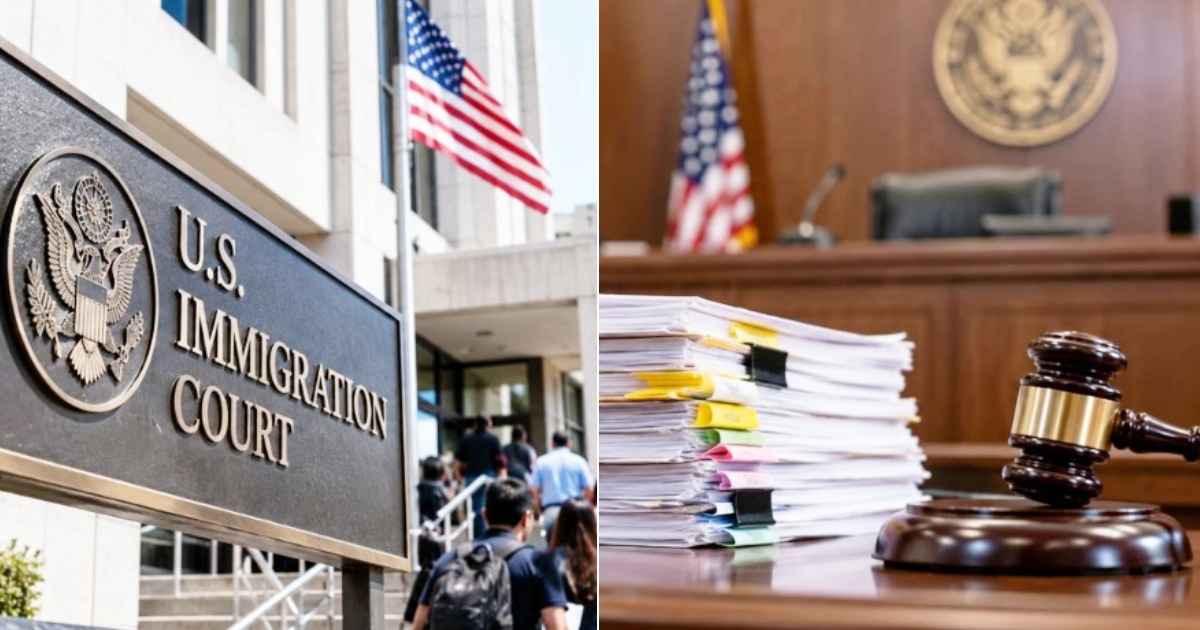
If you are Cuban and have received a Notice to Appear (Aviso de Comparecencia, NTA), it is important to understand what defenses you can present before a U.S. immigration judge.
Receiving this document does not mean that a final deportation order has been issued.
Among the legal options are asylum, withholding of removal, protection under the Convention Against Torture, adjustment of status, cancellation of removal, and, under certain circumstances, voluntary departure.
Each procedure has different requirements, deadlines, and consequences.
The appropriate defense depends on how you entered the country, how long you have been in the United States, your immigration history, and the available evidence.
How does a case work in immigration court?
Deportation processes are handled by the immigration courts of the Executive Office for Immigration Review (EOIR), which is part of the Department of Justice.
There are generally two types of audience.
The first is the general calendar hearing (master calendar hearing). In this hearing, the judge reviews the immigration charges, informs about the right to have legal representation at no cost to the Government, and sets forth the steps of the procedure.
During this hearing, issues such as the following can be addressed:
- Admit or deny the facts and charges included in the Notice of Appearance.
- To designate or refuse to designate a country for deportation.
- Identify the requests for protection or immigration relief that are intended to be submitted.
- Establish deadlines for submitting forms and tests.
The second is the individual hearing (individual calendar hearing), where defense applications are reviewed.
The immigrant can testify under oath, present witnesses, and provide documentation. The attorney from the Department of Homeland Security (DHS) may also intervene and question the witnesses.
Failing to attend a hearing can result in an order of deportation in absentia. There are mechanisms to request the reopening of certain cases, but they are subject to legal requirements and deadlines.
Asylum, expulsion restriction, and protection against torture
These three forms of protection can be requested using Form I-589, although their requirements and consequences differ.
Asylum: allows individuals to seek protection if they have suffered persecution or have a well-founded fear of persecution due to race, religion, nationality, membership in a particular social group, or political opinion.
As a general rule, the application must be submitted within the first year after arrival in the United States. The law provides for exceptions related to changes in circumstances or extraordinary situations that justify the delay.
Withholding of removal: requires demonstrating that it is more likely than not that the person would face persecution for one of the protected grounds if sent back to the relevant country.
This protection prevents deportation to that country, but it does not automatically grant permanent residency nor does it necessarily prevent expulsion to a third country.
Protection under the Convention against Torture (CAT): requires demonstrating that it is more likely than not that the person would be subjected to torture in the country to which they are to be deported, in accordance with the applicable legal requirements.
It can be granted through a restriction or postponement of the expulsion, depending on the circumstances of the case.
For Cubans claiming political persecution, evidence may include police summons, detention documents, fines, documented threats, testimonies, and other elements that establish the risk.
The existence of these documents does not guarantee that protection will be granted. The judge must assess the evidence and determine if the legal requirements are met.
Status adjustment before the judge: the Cuban Adjustment Act
The Cuban Adjustment Act allows certain Cuban citizens and their eligible family members to apply for permanent residency in the United States.
Among the general requirements are being a natural-born or citizen of Cuba, having been inspected and admitted or received through a parole that meets legal conditions, accumulating at least one year of physical presence in the United States, and fulfilling the applicable admissibility requirements, except for the exceptions provided by law.
Having been in the country for more than a year and possessing a immigration document does not guarantee residency on its own.
Additionally, the competent authority to resolve an adjustment request may vary depending on the procedural situation and the method of entry.
An important obstacle affects many Cubans who received the I-220A form.
In September 2023, the Board of Immigration Appeals (BIA) determined, in Matter of Cabrera-Fernández, that release on parole under section 236 of immigration law does not equate to the parole required to apply for the Cuban Adjustment Act.
Therefore, having an I-220A does not automatically mean meeting the parole requirement.
Those in that situation should consult with a lawyer to determine if there is any path for adjustment or other applicable defenses based on their circumstances.
Cancellation of deportation: very stringent requirements
The cancellation of deportation allows certain individuals to request the judge to annul their expulsion and, if they meet the requirements, grant them permanent residency.
There are two main modalities.
For individuals who are not permanent residents, the law generally requires:
- Having accumulated at least ten years of continuous physical presence in the United States, calculated according to legal regulations.
- To have maintained good moral character during the required period.
- Not having been convicted of certain crimes that prevent access to this protection.
- Demonstrate that deportation would cause exceptional and extremely unusual difficulties for a spouse, parent, or child who is a U.S. citizen or a permanent resident.
The continuous physical presence is subject to the so-called time interruption rule (stop-time rule).
Under certain circumstances, the notification of a Notice to Appear may stop the countdown. However, the effect depends on whether the legal requirements and applicable jurisprudence are met. It should not be assumed that any appearance document automatically interrupts that period.
The legislation also establishes an annual limit of 4,000 concessions for this cancellation modality, with legally provided exceptions.
For permanent residents, the general requirements include:
- Have been a legal permanent resident for at least five years.
- To have accumulated seven years of continuous residence following a valid admission in any status, in accordance with the applicable calculation rules.
- Not having been convicted of an aggravated felony in accordance with immigration law.
Meeting these requirements does not guarantee approval. Cancellation is a discretionary measure, and the judge examines individual circumstances.
Voluntary departure: a decision with consequences
Voluntary departure allows certain individuals to leave the United States on their own accord rather than facing a formal deportation order.
It may be granted before the procedure is concluded, usually for a maximum period of 120 days, or upon its completion, for a maximum of 60 days.
The voluntary departure granted at the end of the procedure requires additional requirements, including physical presence during the period established by law, good moral character, financial means to leave the country, and the intention to do so.
In this mode, the judge must set a bail amount of at least 500 dollars, which typically must be deposited within the following five business days.
Failing to meet the deadline for voluntary departure can lead to serious immigration consequences, including financial penalties and the inability to access certain forms of immigration relief for ten years, as stipulated by the law.
Before accepting this option, it is important to understand its effects on your ability to remain legally in the United States or return in the future.
How much does it cost to file each application with the court?
Migration procedures may involve filing fees, payments for biometric services, and expenses for legal representation.
The EOIR publishes the applicable amounts on its official forms and fees page.
Among the procedures that may incur costs are:
- Asylum (I-589): the submission of an asylum application is subject to an initial fee of 100 dollars, with no possibility of exemption or reduction of this amount. There are differences when the form is used solely to request withholding of removal or protection under the Convention Against Torture.
- Annual asylum fee: pending applications during the periods established by law may be subject to an additional annual payment, the amount of which should be referenced in the current table.
- Cancellation for non-residents (EOIR-42B): requires a filing fee and, when applicable, biometric payments.
- Cancellation for permanent residents (EOIR-42A): it also has filing fees and biometric services.
- Appeal before the BIA (EOIR-26): generally requires payment of the applicable fee, although there are exceptions and waiver mechanisms for certain cases.
Rates may change due to regulatory updates. Before making a payment, you should check the official EOIR forms and fees chart.
Starting February 23, 2026, the EOIR requires that its immigration fees be paid electronically through the official payment portal, rather than using checks or money orders.
How to appeal an immigration judge's decision
If the judge issues an unfavorable decision, in many cases there is the possibility of filing an appeal with the Board of Immigration Appeals (BIA).
The general deadline is 30 calendar days from the moment the judge orally delivers his decision or from the notification of the written decision, as applicable.
The appeal must be submitted using the EOIR-26 form and received by the BIA within the applicable deadline. It is not enough to mail it before the deadline.
It is also important not to waive the right to appeal without understanding the consequences. Certain decisions and procedures have special rules.
The EOIR explains the requirements in its official guide on appeals of immigration judges' decisions.
What to do if you have a deportation process?
- Check the status of your case. Utiliza tu número de extranjero o número A para revisar la información disponible en el official EOIR case system.
- Seek legal representation as soon as possible. La EOIR mantiene una list of providers of free legal services. La inclusión en esa lista no constituye una recomendación o garantía del Gobierno.
- Meets all deadlines. Record the set dates for hearings, requests, appeals, and submission of evidence.
- Gather your immigration documents. Keep copies of the I-94, parole, I-220A, Notice to Appear, resolutions, and any other relevant documentation.
- Organize the evidence for your defense. If you are seeking protection from persecution or torture, keep documents, testimonies, and any evidence that supports your situation.
- Do not sign documents that you do not understand. A waiver of appeal, an acceptance of voluntary departure, or any other procedural decision can have significant consequences.
- Keep your address updated with the court. Changes must be communicated through the appropriate procedure to receive official notifications.
This article provides general information and does not constitute individual legal advice. To assess a specific case, consult with an authorized immigration attorney or a representative accredited by the United States Department of Justice.
Related videos:
Filed under: