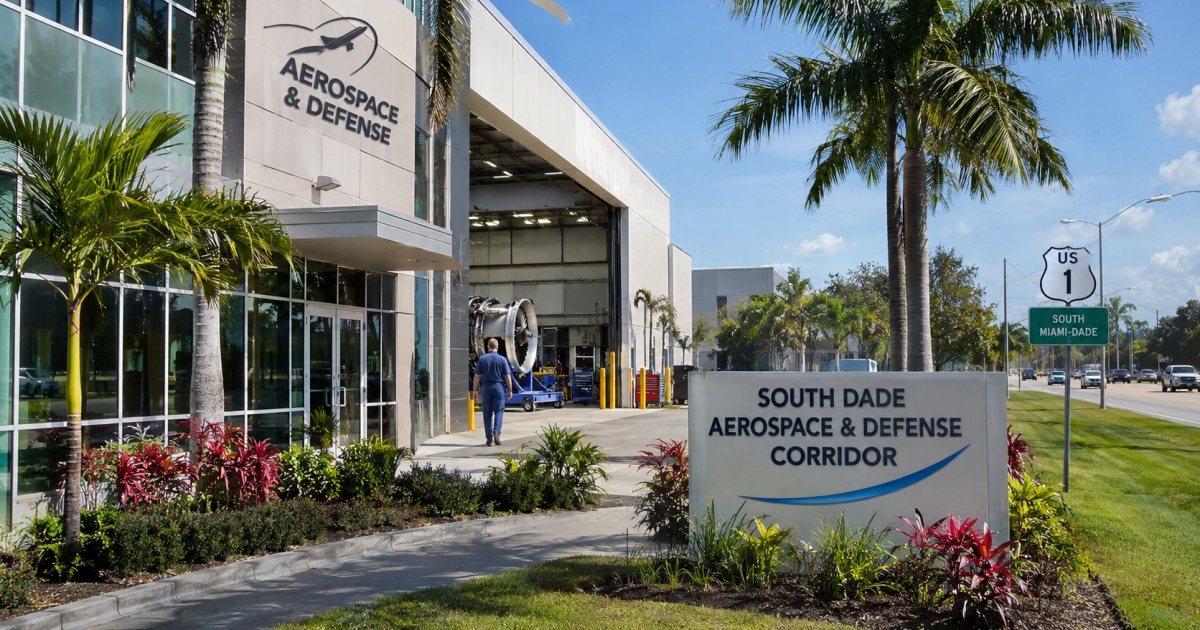
The Economic Development Council of South Miami-Dade (EDC) works to identify land along US-1 where aerospace and defense companies can be established. The initiative aims to attract investments and create job opportunities near the communities in the southern part of Miami-Dade County, as reported this Wednesday by Miami Today.
The project, called South Dade Aerospace and Defense Corridor, emerged when a company interested in occupying a vacant 100,000 square foot warehouse in Cutler Bay found that the municipality's commercial zoning did not allow for the proposed aerospace activity to be developed there.
Local authorities then explored the possibility of establishing a special zoning regulation that would allow such activities. The proposal ultimately became a regional initiative supported by several municipalities in southern Miami-Dade.
The EDC is a nonprofit organization dedicated to promoting investment and business development in the southern part of the county.
According to its institutional data, the region has over 600,000 inhabitants, approximately 140,000 workers, and around 20,000 companies.
The aerospace, aviation, and defense industries are among the strategic sectors that it aims to promote.
Municipalities support the corridor, but there are still lands to be designated
The participating municipalities along US-1 have approved resolutions in support of the aerospace corridor. Pinecrest was the last to join, with a favorable vote on October 13.
However, the project still needs to overcome a fundamental step: to identify and formally designate the parcels where the companies could be established.
Peter England, director of strategy for the Economic Development Council of South Miami-Dade, explained that he requested the municipal administrator of Cutler Bay to convene the planning officials from the six participating communities to move forward with the selection of the sites.
According to England, authorities will need to approve new resolutions that identify the specific plots included in the corridor, as general support for the initiative is not enough to provide concrete locations for interested companies.
The project also aims to reduce the long commutes that many residents of the southern county undertake for work. According to England, almost 80% of the South Dade workforce works outside the region.
The intention is to attract industrial and technological activities that allow more people to find employment close to their homes, without having to commute daily to other areas of Miami-Dade.
Homestead aims to establish itself as an aerospace hub
The regional corridor is supported by the designation of certain lands of Homestead Air Reserve Base and the former Air Force base as spaceport territory, a state measure that took effect on July 1, 2024, to promote the growth of the aerospace industry.
This designation does not imply the construction of a space launch facility; rather, it aims to facilitate the attraction of companies related to manufacturing, technology, and other services in the sector.
The initiative is related to the proposal South Dade Aerospace Zone, an industrial and technological park planned on former military grounds near Homestead Air Reserve Base.
According to county records cited by Miami Today, the Air Force agreed in 2004 to transfer approximately 601 acres of land from the former base to Miami-Dade for economic development, following the damage caused by Hurricane Andrew.
Homestead is already recording business activities related to the sector. The company AST SpaceMobile has expanded its satellite manufacturing operations in the city, while Global Engine Stands, specializing in equipment for transporting and storing aviation engines, signed a ten-year lease to occupy 35,000 square feet in the local industrial park.
The mayor of Homestead, Steven Losner, explained in a previous report from Miami Today that the city receives frequent inquiries from aerospace and defense companies interested in establishing themselves in the area.
Some companies have proposed projects that could create hundreds of jobs, although these possibilities are still in preliminary phases and do not represent hiring commitments.
The shortage of industrial land limits the project
One of the main obstacles to developing the corridor is the availability of suitable land.
The urban development boundary of the county, established to restrict expansion into environmentally sensitive areas, reduces the opportunities to create new industrial sites.
For this reason, the Economic Development Council is focusing its efforts on attracting light industries related to the aerospace sector, rather than large heavy manufacturing facilities near residential areas.
Municipalities like Pinecrest and Palmetto Bay are participating in the regional initiative, although their land limitations make it unlikely that they will host large manufacturing facilities.
England also invited Edward "Ned" Murray, associate director of the Metropolitan Center at Florida International University (FIU), to participate in the planning discussions.
That university center had previously collaborated on the strategic economic development plan of the council.
The selection of plots and the approval of the corresponding resolutions will be the next steps to turn the aerospace corridor into a concrete proposal for interested companies.
Related videos:
Filed under: