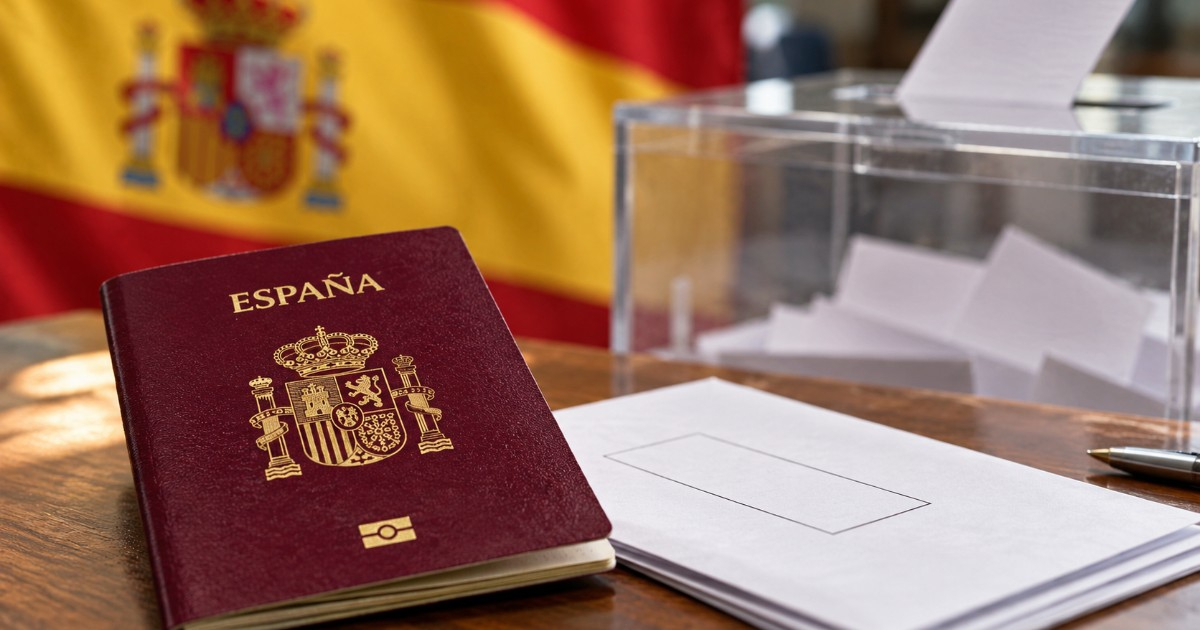
The State Attorney submitted its arguments this Tuesday before the Contentious-Administrative Chamber of the Supreme Court to oppose the extension of the precautionary suspension of voting rights for the adult children of those nationalized under the Grandchildren's Law, warning that this measure could affect the development and counting of votes in the elections on November 29.
The petition, presented by Iustitia Europa and Vox, seeks to extend the precautionary suspension of voting to adult children of individuals naturalized under the historical and democratic memory laws who are registered in the Electoral Census of Absentee Residents (CERA).
According to the data provided for the judicial proceedings, by July 31, 2026, there were 189,678 nationality registrations corresponding to Annex III. However, this figure does not allow us to determine how many of those citizens are actually listed in the external electoral roll and could be affected by the measure.
The request aims to extend the suspension to those registered in the CERA who obtained nationality through Annex III. As of July 31, 2026, there were 189,678 nationality registrations through this route.
The State Attorney emphasizes that the beneficiaries of Annex III do not form a homogeneous group, as it includes both adult children of individuals who were naturalized under the Democratic Memory Law of 2022 and descendants of those who obtained nationality under the Historical Memory Law of 2007. The latter originate from files unrelated to the judicial process that led to the suspension of the vote.
The Government also warns that there is no breakdown available to determine how many citizens correspond to each of the two pathways, which hinders the identification of those potentially affected by an expansion of the precautionary measures.
The rejection is based on the technical infeasibility of implementing such screening less than four weeks before the elections. The census has already been formally closed, the final lists have been distributed to the provincial boards, and the consulates have begun sending the voting documentation abroad.
According to the state's legal services, acting now would cause a "serious logistical disruption and a procedural collapse" in the consular offices and at the counting tables, where the segregation of envelopes or votes in transit would trigger an overwhelming cascade of challenges.
The Bar Association also deems the task of individually identifying those affected, locating their parents' files, and reconstructing the naturalization process as "impossible to fulfill." Identifying the 163,355 files examined to apply the initial suspension required a month and a half of continuous work. This timeframe is incompatible with the approaching date of November 29th.
On the constitutional level, the Executive warns that temporarily depriving citizens who hold valid Spanish nationality of their right to vote, without a final ruling on the substance of their cases, would constitute an "irreparable violation of Article 23 of the Constitution."
The legal battle has been escalating for months. The Supreme Court suspended the electoral effects of certain registrations in the CERA related to the Grandchildren's Law in September, and on October 12th, it confirmed that suspension by rejecting the appeal from the State's legal service.
On October 30, the high court rejected the urgent adoption of the new suspension without previously hearing from the parties, and initiated the process that is now concluding.
By the first half of 2025, the General Consulate of Spain in Havana had received 107,338 nationality applications, and it is estimated that more than 350,000 Cubans initiated the process since October 2022.
However, there is no verified breakdown of how many Cubans are part of the 189,678 registrations in Annex III that are currently in dispute.
It is important to clarify that the precautionary suspension does not nullify Spanish nationality or revoke passports: it exclusively affects the right to vote from abroad through the CERA. Cubans with Spanish nationality who reside and are registered in Spain can vote on November 29 without any restrictions.
The Supreme Court must decide whether to extend the temporary suspension of voting rights to adult children of those naturalized under the memory laws, a decision that could impact the conduct of the general elections on November 29 and the subsequent tallying of votes.
Related videos:
Filed under: