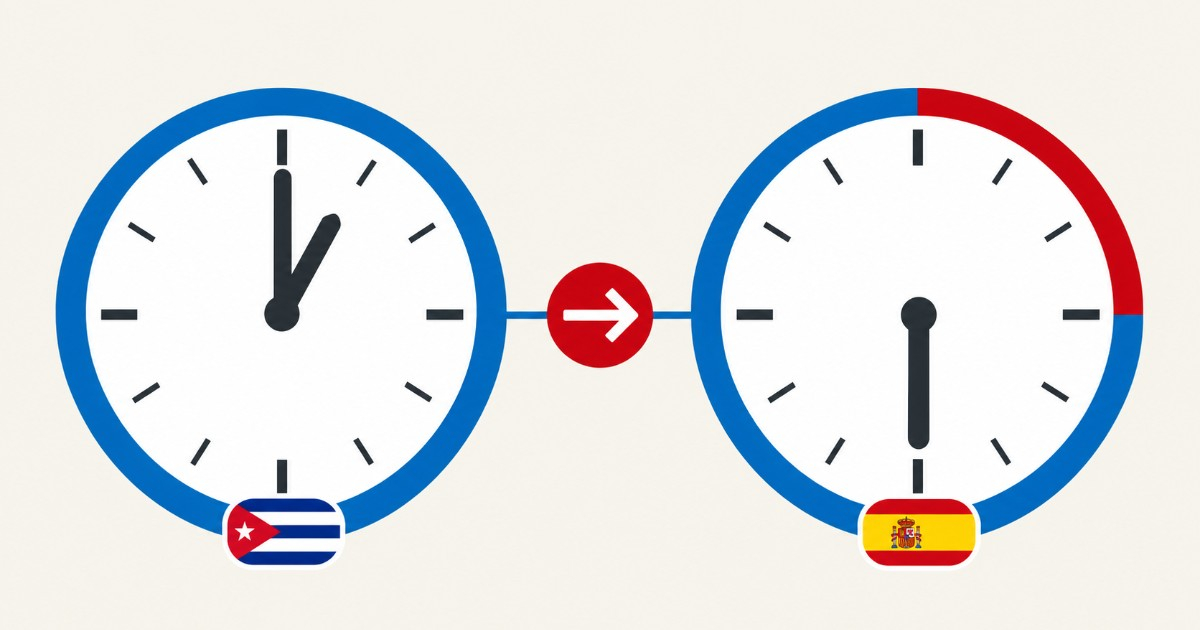
The time difference between Spain and Cuba is five hours starting from October 25, 2026. Madrid and the rest of mainland Spain are ahead of Havana by that amount: when it is 6:00 PM in Madrid, it is 1:00 PM in Cuba.
The time difference is due to Spain ending its daylight saving time and turning the clocks back, while Cuba decided to keep its time. Madrid moved to UTC+1, while the island remains at UTC−4. The difference will not be the same throughout 2027, as the scheduling for time changes in both countries is different.
To check the time difference on a specific date, CiberCuba offers a that allows you to select the date and time of a call, an appointment, or a trip and see the corresponding time in the other country.
Why does Madrid have five more hours than Havana?
In Spain, the official calendar published in the Official State Bulletin set the end of daylight saving time for 2026 to Sunday, October 25. At 3:00 AM, the clocks in mainland Spain were turned back to 2:00 AM, causing Madrid to change from UTC+2 to UTC+1.
In Cuba, it was planned to set the clocks back on November 1, 2026. However, the island's authorities suspended that change and announced they would maintain daylight saving time until November 7, 2027, amid the electrical crisis. As a result, Havana remains on UTC−4 during the winter of 2026-2027.
The five-hour difference also applies to Barcelona, Valencia, Seville, and the rest of the Peninsula, as well as the Balearic Islands. The Canary Islands are an exception: their clocks are set one hour behind Madrid, which means that during this period, they are four hours ahead of Cuba.
How long will there be a five-hour difference between Spain and Cuba?
With the current rules, the five-hour difference between Madrid and Havana will remain until March 28, 2027. On that Sunday, Spain will move the clocks forward by one hour, and Madrid will transition to UTC+2; Cuba, if it maintains the announced decision, will remain at UTC−4. The difference will then increase to six hours.
The European Commission's calendar for 2027 establishes another change in Spain for October 31, when daylight saving time will end and Madrid will revert to UTC+1. From that day on, there will again be a five-hour difference, at least until the anticipated Cuban adjustment on November 7, 2027, which will shift Cuba to UTC−5 and increase the gap back to six hours. These forecasts may change if either country modifies its regulations.
How to calculate the time of a call between Spain and Cuba?
For a call made between November 2026 and the change of time in March 2027, simply subtract five hours from Madrid's time to find out the time in Havana. If it is 10:00 in the morning in Madrid, it is 5:00 in Cuba; if it is 8:00 in the evening in the Spanish capital, it is 3:00 in the afternoon in Havana.
The calculation changes when Spain moves the clock forward in March. Therefore, if the call is scheduled for a future date, it is advisable to use the converter instead of always applying the current time difference. It is also necessary to check if the conversion causes the date to change when moving from one country to another.
Those who only need to know the time in the Spanish capital can check the , along with the clock of mainland Spain and its difference compared to Cuba.
Is the time in Havana the same throughout Cuba?
Yes. Havana, Santiago de Cuba, Holguín, Camagüey, and the rest of Cuban territory share the same official time. To compare any Cuban city with Madrid or Barcelona, the same time difference is used; in Spain, it is necessary to distinguish between the Peninsula and Balearic Islands and the Canary Islands.
Related videos:
Filed under: