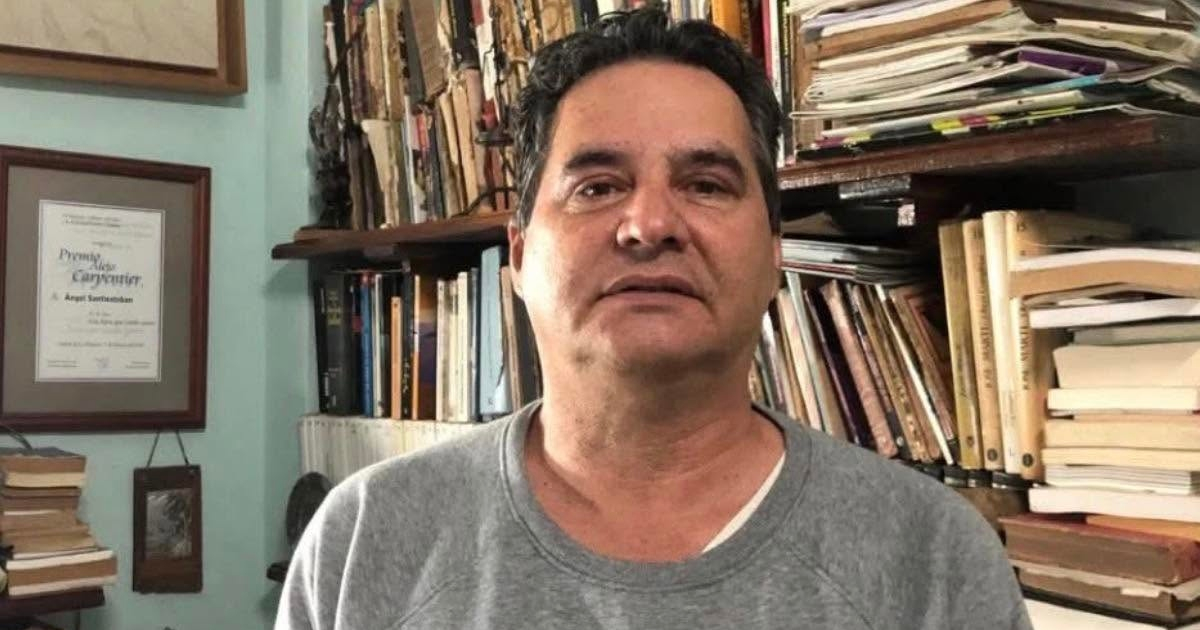
A Havana court sentenced four members of the Cuban Freemasonry this Thursday for alleged illegal currency trafficking, in a process that legal organizations describe as a political persecution disguised as a criminal case. Among those convicted is the writer and former political prisoner, Ángel Santiesteban Prats, who is currently Sovereign Grand Commander of the Supreme Council of the 33rd Degree.
The Criminal Section of the People's Municipal Court of Diez de Octubre issued a ruling in Case 26E of 2026 and imposed penalties of between two and four years of restriction of freedom on José Ramón Viñas Alonso, Fernando Marcos García, Ángel Lázaro Santiesteban Prats, and Osvaldo Ernesto Villegas Digat.
Viñas Alonso, who held the position of Most Powerful Sovereign Grand Commander of the Supreme Council of Degree 33 for the Republic of Cuba and presided over the Board of the National Masonic Asylum "Llansó", received the harshest sentence: four years of freedom restriction and a fine of 500 installments of 50 pesos each.
The accountant of the asylum, Fernando Marcos García, was sentenced to three years of restricted freedom and a fine of 500 installments of 40 pesos.
Santiesteban Prats and Villegas Digat each received two years of restricted freedom and the same fine of 500 installments of 40 pesos.
As additional sanctions, the court imposed on the four convicted individuals the deprivation of rights, the prohibition from leaving the national territory, and the disqualification from holding their positions or offices.
"Everything that threatened State Security has been fulfilled," said Santiesteban Prats to the independent media CubaNet. "They said, either you step aside or we will remove you," he added. The writer also denied acknowledging the crime: "I have not acknowledged the crime." According to that source, the officers offered to let them leave the country if they stepped back. Otherwise, they warned: "We will take you to trial, and you know that we will sanction you."
"I said it there, that I did not understand why, during all those hours that they had us there, it had not been possible to prove in the trial that I had committed a crime. The investigator lied, said things that were not in my statement," added the former political prisoner.
The facts that led to the accusation involve two currency exchange operations carried out with asylum funds: in September 2023, Viñas Alonso authorized Santiesteban Prats to exchange 49,600 Cuban pesos for 200 dollars belonging to the institution; in June 2025, he authorized Villegas Digat to exchange 37,500 pesos for another 100 dollars from the asylum. The total amount under investigation was 300 dollars over nearly two years, at the informal market rate used by the majority of the Cuban population.
According to the defense, the exchange of 200 dollars allowed for the purchase of powdered milk for the elderly in the nursing home, while the 100-dollar transaction enabled Villegas Digat to obtain medication for his son and allowed the institution to have Cuban pesos for emergencies. The nursing home, founded in 1918, currently cares for around 90 elderly individuals.
The legal organization Cubalex questioned the process in an analysis published the day before the trial, noting that both operations were formally recorded in the accounting books of the shelter, which eliminates any notion of clandestinity. "The internal conversion of 300 USD over two years for the maintenance of a non-profit elderly shelter does not constitute a disturbance to the socio-economic or monetary order of the State," it pointed out.
Cubalex also warned that the case was initiated by the Specialized Body for Criminal Investigation of Crimes Against State Security of MININT, and characterized that decision as evidence of political motivation: "Assigning the investigation of a 300 USD accounting adjustment in a charitable organization to the State's Intelligence and Security apparatus clearly demonstrates political persecution and government interference in the autonomy of Cuban Masonry."
According to Cubalex, the most revealing aspect of the process is the treatment that the Prosecutor's Office gave to Santiesteban Prats, an independent writer and journalist with decades of documented repression. The indictment included that the accused "openly expresses opposition to the revolutionary process that prevails in Cuba" and "does not engage in any socially useful activity," assessments that Cubalex deemed a violation of the principle of equality before the law.
Santiesteban Prats was elected Sovereign Grand Commander of the Supreme Council of the 33rd Degree on September 26, 2026, just weeks before the trial, replacing Viñas Alonso in the position.
This case falls within a broader state offensive against Cuban Freemasonry that intensified since 2024, involving freezing of bank accounts, annulment of internal decisions of the organization, and the imposition of leaders aligned with the regime.
Against the ruling, both the convicted individuals and the prosecutor have the right to file an appeal once they are notified in writing. This appeal must be resolved by the corresponding chamber of the Provincial People's Court of Havana.
Related videos:
Filed under: