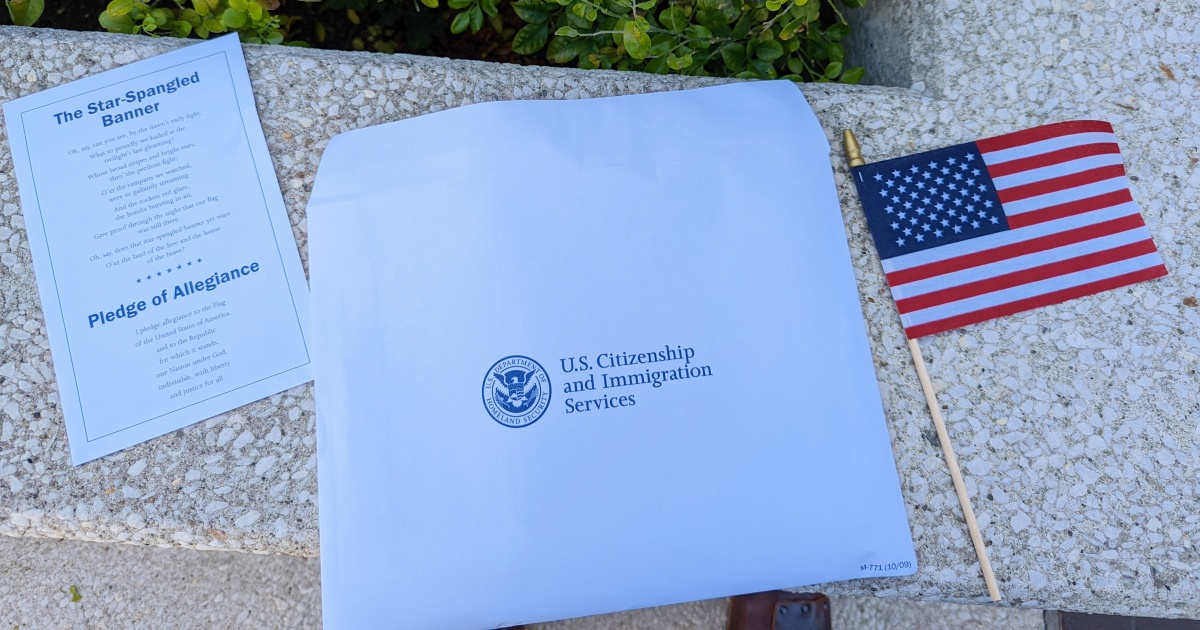
The U.S. Citizenship and Immigration Services (USCIS) issued this Wednesday the policy memorandum PM-602-0201, which expands scrutiny on the financial and family history of those applying for naturalization, with direct implications for thousands of Cubans in Florida.
The document is immediately applicable —including pending cases— and instructs officials to evaluate three behaviors: whether the applicant received public assistance in a manner that average citizens would consider intentional evasion of self-sufficiency, whether they ceased to financially support their dependents, or whether they failed to comply with the obligations incurred by signing an Affidavit of Support (forms I-864, I-864EZ, or I-864A).
The memo clarifies that legally receiving Medicaid, food stamps (SNAP), or cash assistance (TANF) is not in itself a barrier to citizenship.
However, if an officer concludes that the applicant deliberately reduced their income or stopped working to remain eligible, such behavior may weigh negatively in the assessment of good moral character, even if it was technically legal.
Fraud in obtaining benefits—such as declaring false income, using multiple identities, or failing to report changes that affect eligibility—can indeed serve as a conditional barrier to naturalization, even without a formal conviction.
Este memorando de USCIS puede afectar a miles de personas en proceso de naturalización. Sigue todos los cambios en las políticas migratorias en nuestra sección de
The most immediate risk: child support in Cuba
The most sensitive issue for the Cuban community is the obligation to support dependents. Voluntary noncompliance is a conditional barrier to good moral character even in the absence of a court order and even if the dependent lives outside the United States, as is the case with children who remain on the island.
The memo also states that if a dependent receives public benefits, that fact may be interpreted as an indication that the applicant is not fulfilling their obligation of support.
This point directly addresses a structural practice of the Cuban diaspora: remittances sent without bank receipts —via travelers or informal intermediaries— are difficult to document for USCIS. The case of a resident with 26 years in the United States who was denied citizenship for not being able to prove that the money was going directly to his son illustrates this risk.
The immigration attorney Willy Allen III had warned in August 2025 that "the maintenance of children is one of the two main reasons why men do not receive American citizenship immediately when they apply."
Due to the lack of receipts, Allen suggested alternatives: "There are still support letters, photos, anything else that can show that the person is receiving the money," and noted that the person who physically delivered the money can write a letter certifying the delivery.
Sponsors of parole: what risks do they face?
Those who signed an I-864 to bring a relative as a permanent resident and that relative received public assistance while the commitment was in effect may have that violation assessed negatively when applying for their own citizenship.
The I-134 and I-134A forms —used in the humanitarian parole program that brought tens of thousands of Cubans between 2022 and 2025— do not create the same legal obligation for reimbursement as the I-864, but the memo warns that failure to meet those commitments can also reflect negatively on the sponsor's moral character.
This scenario adds to the alarm generated at the end of 2025, when the Department of Health and Human Services began to send letters to sponsors demanding reimbursement for the aid received by their beneficiaries.
A tightening that has lasted for more than a year
The PM-602-0201 is the latest link in a chain of measures. In August 2025, USCIS expanded the assessment of good moral character to a holistic analysis that requires affirmative demonstration of positive contributions to the community. In August 2026, a policy alert removed the obligation to issue prior notices before denying an application, and another authorized officers to interview neighbors and employers of the applicants.
USCIS also announced that it will review the N-400 Form to gather additional information regarding the use of benefits and dependent support, with no specific date set for that change. In light of this situation, experts recommend consulting an immigration attorney before submitting the application.
Related videos:
Filed under: