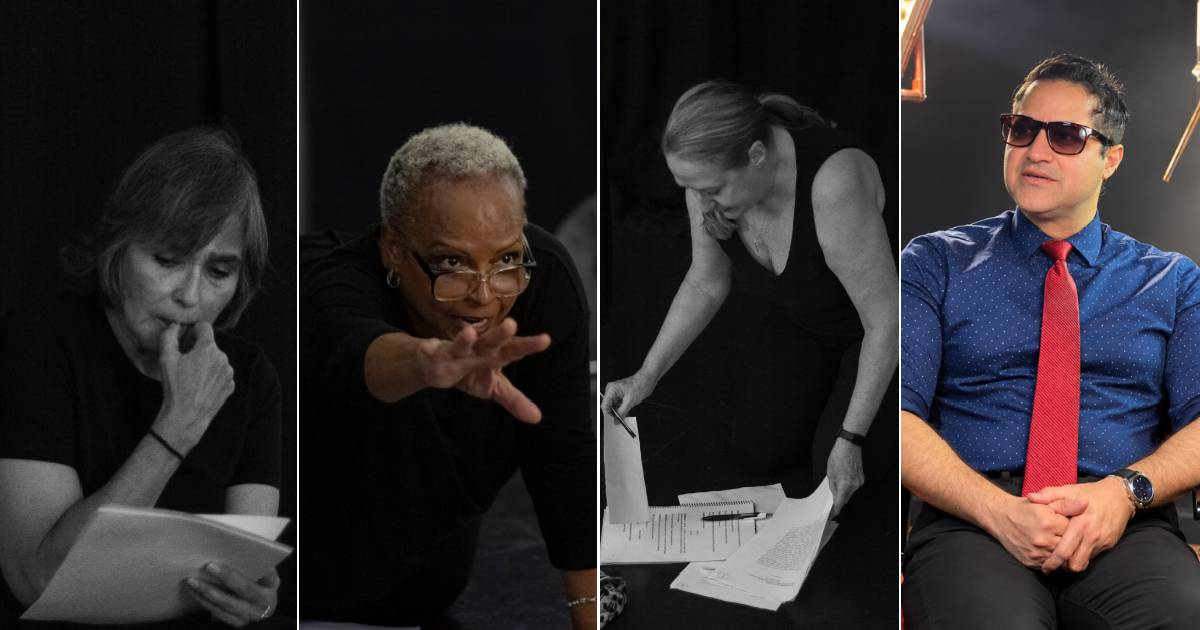
The theater is not only observed: it is endured, celebrated, and inhabited. In the current landscape of independent drama in South Florida, the Cuban director Erom Jimmy Cuesta has established himself as a craftsman of insular memory, a creator who uses the stage to dissect the deepest pains of a dispersed nation.
His latest project, Mare Nostrum, is an act of aesthetic audacity and a miracle of generational convergence, bringing to life this harrowing journey on a raft across the Sargasso Sea.
Cuesta has managed to assemble an interpretive Olympus that will shake the stage: Katia Caso, Ileana Wilson, and the iconic María Isabel Díaz Lago —the unforgettable star of Una novia para David and the "Almodóvar girl"—, three extraordinary actresses who defined an era in Cuba and today lend their bodies and voices to embody the contradictions of the Island.
I talk with the director about the hidden beauty in tragedy and the power of theater as the ultimate voice of resistance.
Erom, Mare Nostrum places the viewer in front of the immobility of three women stranded in the vastness of the ocean, a “confinement within confinement.” How is it possible for a pain so intimate to Cubans, such as the exodus on rafts, to transcend mere political lament and transform into a universal artistic experience?
I believe the first challenge is to understand that theater is not there to reproduce pain, but to transform it into an experience that allows us to reflect on our own human condition.
Mare Nostrum is part of a deeply Cuban reality, a historical wound that still remains open, but our intention is not to reconstruct the drama of the exodus or to turn the stage into a space for political denunciation.
I am interested in what happens to a human being when they are stripped of everything: their territory, their certainties, their identity, and even the possibility of deciding their own fate. These three women are trapped in an immensity that, paradoxically, becomes their prison. And that contradiction has a tremendous theatrical power: being surrounded by an infinite horizon and having nowhere to go.
From the direction, we have precisely worked on that paradox. We seek a beauty that does not hide horror, but rather makes it more disturbing. The body, silence, stillness, and time take on a poetic dimension. We do not need to literally represent suffering; we are interested in having the viewer discover it in what is left unsaid, in the small gestures, in the fragility of those bodies suspended between life and death. And I believe that is where the universal emerges.
Because, although the work directly engages with the experience of Cuban exile, it also speaks of uprooting, of loneliness, of memory, of fear, and of that deeply human need to find a place to belong.
Bringing together on the same stage figures of the caliber of María Isabel Díaz, Katia Caso, and Ileana Wilson is a historic event for Cuban theater in the diaspora. Each carries with them an immense acting legacy and a shared emotional memory that the audience immediately recognizes. Why are they precisely Faith, Hope, and Charity?
I believe that there are artistic encounters that transcend any casting decisions. Bringing together Ileana Wilson, Katia Caso, and María Isabel Díaz on the same stage means much more than having three great actresses. It represents the gathering of three journeys, three sensitivities, and, above all, three ways of understanding and experiencing theater.
Each one belongs to an artistic story that is also part of our cultural memory. Faith, Hope, and Charity are three women who carry with them much more than their individual stories. They are bearers of a collective memory, of a fractured identity, and of a desperate need to find a place in the world. And I believe that these three actresses possess something essential for building that universe: an artistic maturity that allows them to navigate the deepest emotions without needing to explain them.
There is something that particularly interests me in directing actors, and it is that area where technique ceases to be visible and the truth of the performer emerges. I didn't want three similar interpretations, but rather three different human universes forced to coexist in a minimal space, where any gesture, any silence, or any word can ignite a conflict.
The richness of that encounter lies precisely in its differences. There is another dimension that I consider important. In a work that speaks of exile, bringing together these three actresses also represents, in a way, an act of recovering our theatrical memory. Exile not only disperses people; it also fragments generations, artistic traditions, and cultural ties. The stage offers us the possibility to symbolically reunite what history has separated.
Your theater is characterized by a pronounced visual aesthetic, often dark and rich in symbolism, where you play with intertextuality and rewriting. In this work, you choose to fragment, appropriate, and reconstruct the dramatic universe of Alberto Pedro, while paying tribute to Miriam Lezcano. Technically, how does your avant-garde and conceptual style engage with the legacy of Cuban theater from the 90s, and how is that blend translated into the sacred space of the stage?
My relationship with Cuban theater from the 90s is, above all, a relationship with memory. It was a period of immense social, political, and aesthetic tensions, but also of extraordinary creative vitality.
A generation of playwrights and directors found ways to address a deeply contradictory reality, using metaphor, absurdity, irony, and a theatricality that often exceeded the boundaries of the dramatic text.
Alberto Pedro belongs to that universe of creators who understood that Cuban reality could not be explained solely through realism. His dramaturgy possesses a poetic dimension, an emotional violence, and a capacity to transform the everyday into an almost metaphysical situation that resonates particularly with me. My intention has not been to reconstruct an aesthetic of the time or to create an archaeological representation of his dramaturgy. I am interested in establishing a dialogue with that legacy through the concerns and languages of contemporary theater.
In this regard, fragmentation is not merely a formal procedure. It has a direct relationship with the very nature of exile. The memory of the emigrant is rarely linear: it is constructed from absences, unfinished memories, images that return obsessively, and events that time transforms.
That is why I am interested in a dramaturgy that does not rely solely on narrative progression, but rather on the accumulation of states, tensions, and associations. From a scenic perspective, we work with a conception of space that is very close to the idea of theater as an essential territory, where elements gain value through their relationship with the actor's body.
The ocean does not need to be represented in a naturalistic way. It can exist through light, sound, breathing, stillness, and the perception of time. Darkness, for example, does not function solely as an atmospheric resource, but as a dramatic material that hides, reveals, and alters our perception of the characters.
There is also a significant influence from anthropological theater and certain post-dramatic conceptions, particularly in the construction of stage presence. The tribute to Miriam Lezcano emerges from this very intention to preserve artistic memory, but without turning it into an untouchable object.
Designing and producing a staging where the physical space is so limited, yet the emotional and symbolic weight is infinite, presents an immense challenge. What visual, auditory, and spatial tools have you utilized in the production?
I believe that the greatest challenge of this staging has been precisely to create a sense of vastness from an extremely limited space. There is a contradiction that fascinates me: the sea represents, in our imagination, freedom, the open horizon, the possibility of escape.
However, for these three women, it becomes a prison without walls, a territory where freedom is merely an illusion. From the beginning, I decided to avoid a naturalistic representation of the ocean. I was not interested in reproducing the movement of the waves or constructing a set that literally illustrated the place where the action takes place.
I was interested in exploring the perception of space, specifically how light, sound, and bodies can alter dimensions and transform an almost empty stage into an oppressive universe. Lighting plays an essential role in this construction. Beams of light delineate very small territories, isolate bodies, and create a kind of visual confinement. Paradoxically, the less space we can see, the more immense and unsettling what remains hidden becomes. Sound also plays a part in this dramaturgy. It’s not just about emotionally supporting the scenes; it’s about creating an invisible presence. The sea can exist through a vibration, an amplified breath, or an extended silence. I am particularly interested in that boundary where sound stops describing a landscape and begins to provoke a physical sensation in the viewer.
But perhaps the most important tool is the actresses' own bodies. Stillness, for example, can become an action of immense dramatic intensity. Three bodies forced to remain together, with no possibility of escape, create relationships of tension, dependency, and rejection. Physical proximity ultimately becomes a form of violence. And time, when it seems to stand still, begins to weigh heavily on those bodies.
In Mare Nostrum, we don't want the audience to see the sea. We want them to experience the impossibility of escaping it. To feel how that seemingly infinite horizon ultimately closes in on the characters.
And there is a final contradiction that seems fundamental to me: the very sea that separates Cubans from their land is also what connects them to it. It is a border, a path, a memory, and a tomb. Therefore, we do not conceive of it solely as a geographical space, but as a symbolic presence that permeates the entire work.
Ultimately, our intention is for the viewer not to witness the shipwreck from the safety of their seat, but rather, at times, to share with these women the uncertainty of being suspended in a place where returning is no longer possible and where there is still no certainty of arrival.
In the current context of Cuba, where independent art suffers under the weight of censorship and the social reality continues to push thousands towards exile, what ethical and aesthetic responsibilities does theater have?
The theater has an undeniable ethical responsibility towards the reality of its time, but I also believe that this responsibility cannot be reduced solely to denunciation. Theater is not a tribunal, nor a political manifesto, nor a platform from which we must impose a truth.
Its true strength lies in the ability to question, to challenge, and to reveal the contradictions of the human condition. In the Cuban context, this responsibility takes on a particularly complex dimension. Our recent history is marked by ideological fractures, emigration, family separation, censorship, and a profound crisis of belonging. These are experiences that have shaped several generations and that inevitably are part of our artistic creation.
To pretend that theater remains unaffected by them would be to ignore its very nature. However, there is one thing that particularly concerns me: the danger that political discourse may end up replacing artistic discourse. When that happens, the character ceases to be a human being and becomes a spokesperson for an idea, and the stage loses its ability to generate questions, limiting itself to offering answers.
I am precisely interested in the opposite. I am interested in a theater where contradictions can coexist, where characters are neither completely innocent nor absolutely guilty, where the audience must confront their own prejudices and construct their interpretation of what they are seeing. From that perspective, I believe that the ethical responsibility of the creator begins with defending their freedom.
In Mare Nostrum, for example, the Cuban exodus is an evident historical and emotional reference, but our intention is not to turn these three women into symbols of an ideological stance. We want to restore their human complexity. Their fears, their contradictions, their small miseries, and their moments of greatness.
I also believe that the Cuban theater of the diaspora bears a particular responsibility to memory. It is not only about preserving what we have lost, but also about critically reexamining it.
To me, the ethical responsibility of theater is to not remain silent in the face of human suffering; its aesthetic responsibility is to prevent that suffering from becoming mere discourse. And I would like to add something: I do not believe that theater should speak for those who have no voice. I think it should create the conditions for those voices to exist, even when they are uncomfortable or contradict our own convictions.
Ultimately, I continue to advocate for a theater that does not renounce its political dimension, but also does not sacrifice its poetic freedom in the name of any cause. A theater that does not aim to tell us what to think, but rather compels us to question why we think in a certain way. Because the true commitment of the artist lies not only in denouncing an unjust reality, but also in finding a language capable of revealing what that very reality prevents us from seeing.
Mare Nostrum will be showcased in three unique performances on Friday, November 13, and Saturday, November 14, at 8 PM, and on Sunday, November 15, at 6 PM. The venue: 280 Miracle Mile, Coral Gables, FL 33134.
The certainty that Mare Nostrum will leave no one indifferent lingers in the air. Erom Jimmy Cuesta reminds us that independent theater not only survives in the distance but flourishes where the wound remains open.
Related videos:
Filed under: