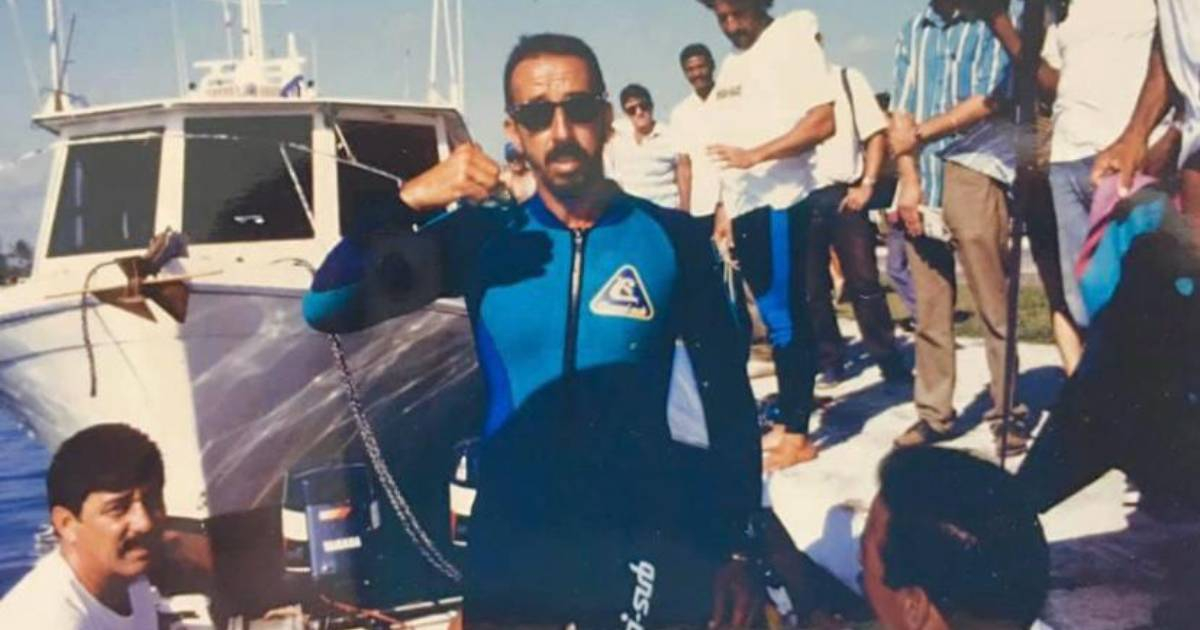
Although I admired him for his underwater feats, I never had the chance to interview him. Years have passed, and who would have thought that I would meet King Triton, Jorge Mario García, the same one with the nine world records that amazed the world of diving in Miami.
Now face to face, a little older but conversational and kind, Jorge Mario allows me to come closer to his life.
What are you doing, and how long have you been in the U.S.? I know you have a connection with the sea, spearfishing, and diving.
I have been living in Miami for 21 years now; I left Cuba for personal reasons that had nothing to do with politics or my life there. I came in search of my son, and fortunately, I achieved my goal, and we reunited.
Since I arrived, I started fishing and selling fish, something I had been doing in Cuba since I was a boy. And although it's hard work, I did quite well; I fished with friends who had commercial licenses and earned a good amount of money.
Then I did what I had planned, which was to buy my boat and start taking people fishing, offering charters, giving courses, and teaching people how to fish. Since I have a name in this sport, it went quite well for me right away.
And you achieved what you wanted… to be with your child!
Well, yes. I have a wonderful 28-year-old son, Jorge Mario, studying medicine in Puerto Rico. If he had been in Cuba, I don't know how his life would have been. Additionally, I have a five-year-old daughter, who is a beautiful and intelligent girl, Antonella. She is wonderful as well.
Everything is going well for me here in this regard. I live in a beautiful place by the sea. I have my boat, my own business. When people search for me online and see they're going to fish with a world champion, they immediately choose me. Hahaha.
Sometimes, my classes seem expensive to them, and that's when I compare myself to the NBA… hahaha... Isn't it costly to attend a game at that level? Well, I'm the NBA of spearfishing. And well, I've been doing this for many years now, and it's going well.
You were indeed a champion of spearfishing and set nine world records in freediving, but how did Jorge Mario start out, those early nautical steps, at what age?
I started fishing when I was very young, at the age of nine, ten, or eleven... I don't remember the exact date, but I began fishing and from that moment on, I fell in love with it and dreamed of one day becoming a champion in underwater fishing, a world champion.
You know, I wasn't thinking about setting any diving records or anything like that, but I became completely dedicated to it, to the point that I would skip school to go spearfishing, even while I was in high school. I even repeated a year because I would sneak out; I would say I was going to school and then head out to spearfish... and I loved it!
Supported by a friend who was older than me, Reinaldo Morán, who had been a great deep-sea fisherman, I learned what it means to be a "deep" fisherman, that is, one who fishes at a depth where others do not fish.
Thus, I had more catches, and by the age of 14 or 15, I was selling fish and had money. By 17, I bought myself a motorcycle, just to give you an example. Making a living doing something you enjoy is very positive; in addition to being very athletic and fun, underwater fishing gives you a tremendous thrill when you catch a lot of fish... haha.
And I was doing well at such a young age; however, time passed and, incredibly! they banned sport fishing on the island, and that was something Fidel Castro loved... Of course, he reserved it just for himself! The regulations and prohibitions were so strict that, simply put, fishing was not allowed.
They only allowed fishing on weekends, and I had to do what everyone else did: fish secretly, which was difficult. That was a terrible story. They put inspectors in place who would stop people, fine them for underwater fishing, and seize their equipment. Then those same inspectors, who were corrupt, would sell the confiscated gear to others who wanted to fish. It was unbelievable. The things that happened in Cuba... phew! Well, the things that are happening, which seem impossible but are actually even worse.
What happened to underwater fishing and sports diving in Cuba? Why do you think an activity in which the country had prominent athletes has ended up disappearing?
Underwater fishing in Cuba was eradicated because it was not an Olympic sport and the government had no interest in it. What mattered to Cuba was winning, and I believe it still is—winning Olympic medals, medals in the Pan American and Central American Games—but they had no interest in underwater fishing because it did not yield any tangible results.
The fishing was so, so, so controlled that it was difficult to practice spearfishing. Of course, for Fidel Castro, nothing was prohibited.
As I mentioned, spearfishing was the favorite sport of the "man of stone". And he in Playa Girón, had an area that was exclusively his. In other words, no one else could fish there. It was monitored and it was like an aquarium due to the number of fish that were there. There were crazy people who sometimes sneaked in to fish there. Woe to those who got caught: in the best-case scenario, their catch was taken away and they were expelled; in other cases, they were imprisoned.
Castro did not like others to fish, which is why he banned underwater fishing in Cuba; it simply bothered him. You, who are fond of anecdotes, here's one for you:
In 1984 or 1985, I don’t remember the exact year, they attempted to hold a national spearfishing championship in pairs in Baracoa, a news that surprised us. Since I was the national champion at that time, I chose my partner and we traveled there by bus from Havana to Baracoa. Upon arrival, we jumped in to scout the area.
A beautiful place, Baracoa. I had never been there before. We spent five or six days waiting for the order to start, but… It had been announced: newspapers, radio, television had all picked up the news. A grave mistake! You know who saw what was reported in the media and ordered the competition to be suspended: it didn't matter the effort we competitors put in, the expenses incurred, the lost hopes...
The competition did not take place, and we took the bus back to Havana. That was the last attempt at an underwater fishing competition in Cuba. The "gentleman," the "comrade," the "commander" removed it from the agenda.
I imagine that with the ban on spearfishing, you ventured into other horizons. Was scuba diving an option for you?
I have been diabetic since I was young, since I was about 26; the doctors told me to forget about spearfishing and diving; they even prohibited me from riding motorcycles... hahaha.
I did the exact opposite, although having lived here in Miami for 14 years, I had a heart attack because, unbeknownst to me, I had many clogged arteries and a peripheral circulation around my heart that replaced the large arteries, and I genuinely didn't realize it... until I had the heart attack and had to undergo surgery.
I have been banned from spearfishing again, but I’m not paying attention to it. The company Merck has invited me on two occasions to give talks about motivating those who have been struggling and are returning to life; motivational speeches, just think about how far I’ve come.
And now I answer your question: Yes, scuba diving became an escape after I was not allowed to do what I loved most, which was spearfishing.
In all high-performance sports, there must be sacrifice. My case was no exception; the sacrifice was not just in training, it was in everything. I faced many obstacles, and in Cuba, no one cared, which is why I had to turn to sponsors.
INDER helped me, Cubanacán helped me, and I had sponsors in Italy who paid me not a lot of money, but enough, and in that way, I was able to help several friends who were always there for me.
Your career was also defined by the rivalry with Francisco "Pipín" Ferreras. What was that competition really like between two Cubans who ended up becoming global leaders in diving?
A Pipín I've known practically since he was a kid; I taught him how to fish, although he might deny it now. When we were friends, we used to go out together, fish together, but… one day, after he had already set world records, I came along and broke one of his records. What do you think happened? He got into a fight with me.
So, one would break the record for the other… hahaha… Yes, it was like that. Until we became friends again. He invited me to come to Miami in 2001, which was the first time I visited the City of Sun.
At this moment, he is in Cuba. I respect and admire him; he was a very accomplished athlete in this field, a great one; no one doubts that.
After the records, the challenges, the illness, the emigration, and a whole life connected to the sea, what do you think today of your status in Cuba?
I don't know if I'm still remembered in Cuba. Perhaps older people recall me from when I set world records. I remember that in Cuba, more importance was given to sports than to other things.
I have been to Cuba a few times, and sometimes in nightclubs that I’ve visited with my wife, they have recognized me and announced it over the microphone. There he is, so-and-so, who was a world champion. That gives me tremendous joy, as is only natural. But I don't think the younger generation knows who I am; a lot of time has passed.
As someone who experienced Cuban sports in a different era and now observes the reality from Miami, please share your perspective on sports in Cuba, in general.
You know? I would have never left Cuba; my son brought me here; his maternal grandmother brought him without telling me anything, and I couldn’t live without him. I had the chance to live in Italy; in fact, I married an Italian woman.
"Child, but your life is a novel!"
Not a novel, Julita... Reality! The thing is, I was invited to break a record there, and the INDER thought I was going to stay, so they prevented me from leaving. Well... I got married! I went, broke the record in Italy, did well, got a sponsor... In short, when no one was counting on Jorge Mario, I returned to the Island and proved all those envious bastards wrong who said that if I went to Italy, I would stay.
And speaking of novels, I have written a book, Profundamente... mi vida. It is available for sale on Amazon. It consists of 35 anecdotes from my life; it is a quick read, especially. Unfortunately, people have lost the habit of reading. What people do is watch television, get absorbed in social media; nonetheless, the book has been well received.
Why do you think the book was liked?
Why do I think it’s so appealing? Because the book is told in a lively manner. It shares entertaining stories, although some are sad; others are tough, but readers don’t know what the next anecdote will be about, and they get immersed in the reading.
I've even been told by Netflix that they might do something with the book. But they haven't given me any answers yet. So hopefully they'll do something soon.
Pleasant moments you experienced in your career in Cuba
Look, I told you that I lived in Italy, where I found sponsors who paid me. They didn't pay me a fortune, but it was enough, and the cost of living was much cheaper than it is now. But I felt a pang of sadness because it was my Cuba.
So I came back, and it was really great moments. I didn't like the government, but I did like the country, and I decided to return. I was very well taken care of by the then president of INDER, Conrado Martínez Corona.
Additionally, I had Cubanacán as a sponsor, providing me with boats for training and for setting world records. Cubanacán sponsored me, gave me a hotel with a boat, and a small boat for training there.
INDER, especially Cerro Pelado, attended to me. It's true that I had many friends, study companions, and in that way, they took care of me. I tell you that I started setting records at the age of 37.
Years and decades have passed, and I believe that many factors came together to help me do what I did, especially considering that my sport was of no interest to the government at all. I wasn’t practicing an Olympic sport; it didn’t bring medals to the country... It didn’t matter! The convergence of factors that led to success was just coincidence, along with friendships and goodwill from some.
How is Cuban sports viewed through the lens of Jorge Mario?
Cuban sports were magnificent at one point, but little by little, athletes began to leave; they were fleeing, so to speak, in search of opportunities that would allow them to live and thrive in their respective disciplines.
World and Olympic champions, forgotten, set aside, with no recognition whatsoever. Some privileged individuals were given a Lada or a used car, without spare parts, tires, batteries, or fuel; others received an apartment. This was for athletes who were the best in the world! That is not motivation; that's why they stayed and continue to stay…
That, not to mention the phenomenon in baseball, with teenagers fleeing to the Dominican Republic with their sights set on MLB.
They should have been smarter, paid them, or allowed them to be professionals and give a portion of the money to the State. They needed to take better care of them, but in reality, they never did it properly.
For example, let me share a personal experience. In the 90s, I went fishing in Pinar del Río and at a party, I ran into the Olympic champion from Barcelona '92, Héctor Milián, of all people, asking for a ride! It was truly embarrassing, the best in the world hitchhiking in the middle of a highway. And he was not alone; the majority are like him. This was 30 years ago; just imagine how much worse it is now... They have to flee in droves!
Jorge Mario García set his first world record in 1989, when he was 37 years old, an age at which many athletes are already considering retirement. From there, he went on to achieve a series of nine world records, won the national championship in Underwater Hunting five times, and was the National Champion in Fin Swimming in 1974.
She pours all that experience into her daily work, for those who want to fish in the depths of the sea and, at the same time, “play in the NBA of Spearfishing.”
Related videos:
Filed under: