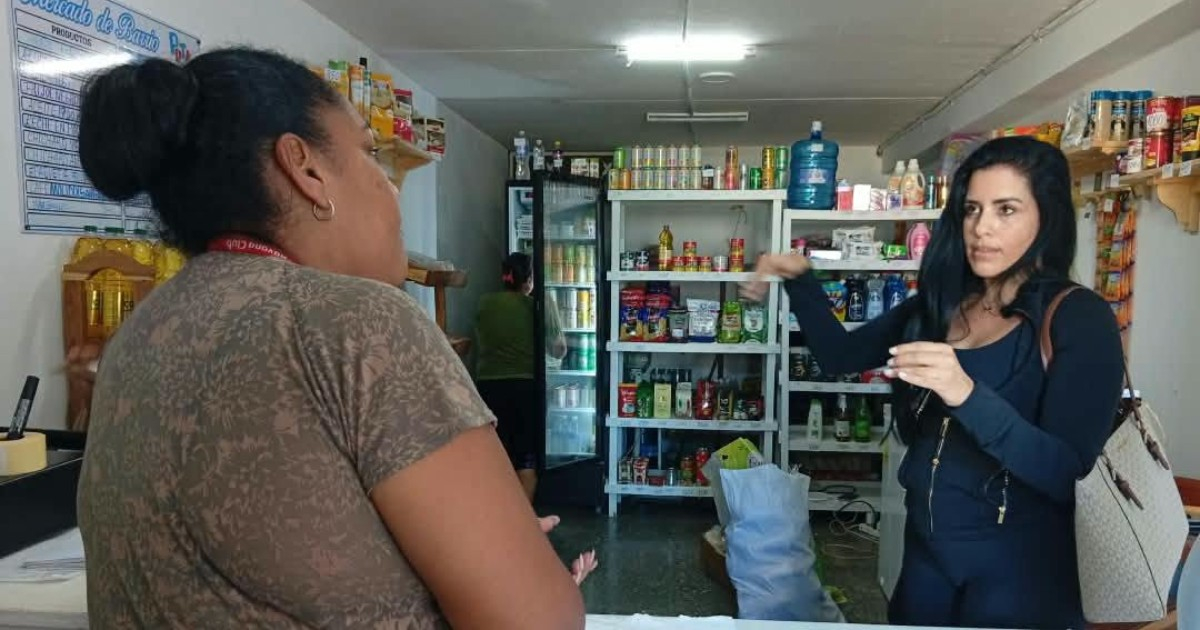
The Ministry of Domestic Trade (MINCIN) posted a note on its social media on Thursday celebrating the progress of the Neighborhood Market located at 1ra and 10, in the Plaza de la Revolución municipality, Havana, managed by the small and medium-sized enterprise Café Carmesí. The response from Cubans was immediate and overwhelming.
The state agency highlighted as achievements the use of electronic payments, the information board with neighborhood and reference prices, the offering of rice and sugar in packages smaller than one kilogram, and the salary improvement for former store clerks. However, the publication triggered an avalanche of comments that dismantled the official narrative point by point.
"This is the other biggest lie for the population," wrote one user. Another was more graphic: "They should change the name of the neighborhood market to the market for the wealthy."
The sign at the establishment 'Cárnicos del Mercado de Barrio' reveals the gap between official rhetoric and reality: five pounds of processed chicken costs 4,250 Cuban pesos (CUP) compared to a reference price of 4,500 CUP; bath soap, 530 CUP compared to 600 CUP; toothpaste, 450 CUP compared to 608 CUP; Ridal detergent, 1,100 CUP compared to 1,200 CUP. The actual discounts range from 7% to 12%, well below the official promise of between 15% and 30% made when the program was launched in July.
“The prices have a minimal difference compared to the small and medium enterprises, what a tremendous achievement,” another Cuban quipped. Several users reported even worse situations: oil, which has an average price in other stores of around 2,600 CUP per liter, is sold in some Neighborhood Markets for 3,000 CUP, which is 30% more expensive.
"At Ayestarán and 19 de Mayo, it started off very well, but after a few weeks, prices began to rise like rice, cans of tomato puree, and other things. We need to be inspecting weekly," wrote another user.
"A retiree with 3,206 pesos can only afford to buy a liter of oil and a pound of rice, and that’s all they have to make it through the month. Pure math," stated a Cuban. The minimum wage in Cuba is 3,210 CUP per month and the minimum pension for the lowest level retirees is 3,056 CUP, figures that turn any basic shopping list into an impossible exercise.
The program Neighborhood Markets was launched as a pilot in Plaza de la Revolución on July 23, 2026, with the promise of bringing essential products at affordable prices through the management of small and medium-sized enterprises and cooperatives in converted state-owned premises. By the end of October, 62 establishments were already operating in 12 provinces.
However, MINCIN itself acknowledged in October that the markets still had not achieved noticeable price reductions for the population. Even a state journalist criticized the prices that same month, suggesting renaming them "Wealthy Neighborhood Markets" and pointing out that some products were available at lower prices from self-employed workers.
Related videos:
Filed under: