A journalist from the Cuban state press criticized the new Neighborhood Markets of the regime in an article published on Saturday in the Matanzas broadcaster Radio 26.
The conclusion of the piece—titled "Neighborhood Markets: Which Neighborhood?"—addresses with unprecedented bluntness in the state-sponsored press the growing inequality fostered by the measures adopted by the Cuban regime, arguing that these establishments do not deserve that name because their prices are unattainable for most Cubans.
José Miguel Solís, correspondent for Radio Rebelde in Matanzas for 28 years, wrote that if the name were honest, those places would be called "Upper Neighborhood Markets, Exclusive Zone Markets, Private Development Markets, or simply, Affluent Neighborhood Markets."
"A business whose prices the local community cannot afford does not belong to the neighborhood: it belongs to another stratum, to another social geography, to that parallel country where inflation is not measured in distress, but in comfort," added the veteran communicator of the regime.
The Neighborhood Markets were born under the auspices of the from the Ministry of Domestic Trade, effective since August 11, as part of a mixed model that allows small and medium-sized enterprises, cooperatives, and self-employed workers to manage locations within the state network — many of which are former storage facilities — with the promise of offering around 20 basic products at prices 10% to 15% cheaper than private stores.
The reality, according to Solís, contradicts that promise: «However, reality crashes against the pockets of retirees and workers».
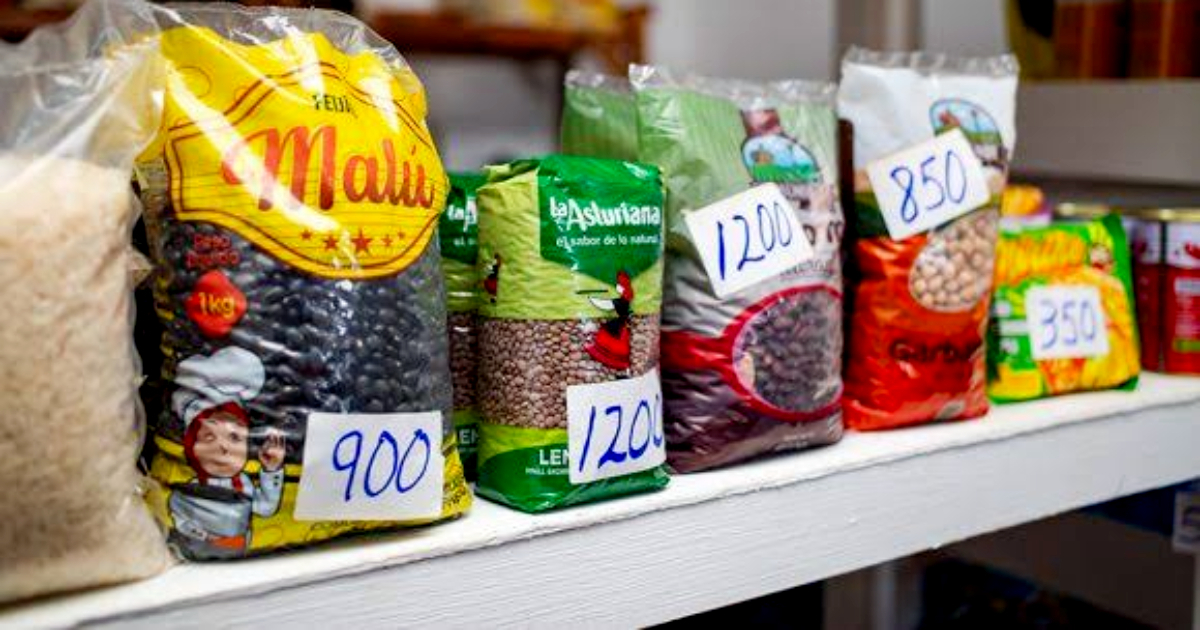
In the Neighborhood Market on Ermita Street, in the Havana municipality of Plaza de la Revolución —inaugurated last weekend at the location of the former Bodega 043 and managed by the mipyme El Titán de Tulipán—, a kilogram of rice costs 900 pesos, black beans 950 pesos, a 250-gram package of coffee 2,600 pesos, and a carton of eggs 4,200 pesos, according to an investigation by 14ymedio.
The available appliances include rice cookers for 24,000 pesos, blenders for 32,000 pesos, and air conditioning units for 220,000 pesos.
A list of 22 products published for a neighborhood market in Granma totaled 12,740 pesos, almost four times the minimum monthly salary of 3,210 pesos that has been in effect since July 2026.
Solís also pointed out that the promised reduction is not only insufficient, but in some cases doesn't even exist: powdered milk, rice, and wheat flour “are sometimes found cheaper among self-employed workers than in the so-called Neighborhood Markets.”
The journalist also pointed out a tax paradox: managers of these markets receive bonuses of 5% on sales tax, exemptions for those who operate wholesale with the Domestic Trade system, and even up to two years of free lease for state-owned premises.
The state forgoes revenue, but that forgoing does not reach the consumer's pocket. The alleged reduction gets lost along the way.
The backdrop of all this is the gradual dismantling of the rationing system, established in 1963, which the regime has wrapped in slogans such as "subsidize people, not products" and "eliminate undue gratuities."
On June 18, Díaz-Canel promised before the National Assembly that the measure would not mean “leaving anyone alone in the market.” The MINCIN announced that only 1,913 bodegas —16% of the network— would continue to serve vulnerable individuals with regulated products.
Solís, who has a history of specific criticisms from within the official system —including reports on blackouts and challenges to statements made by officials— concludes in his article that what is happening "is merely the replacement of a scarcity managed by a commercialized inequality."
The criticism is particularly significant because it comes from a journalist awarded by the system itself: Solís received the Provincial Journalism Award Bonifacio Byrne "For a Lifelong Work" in 2026.
Related videos:
Filed under: