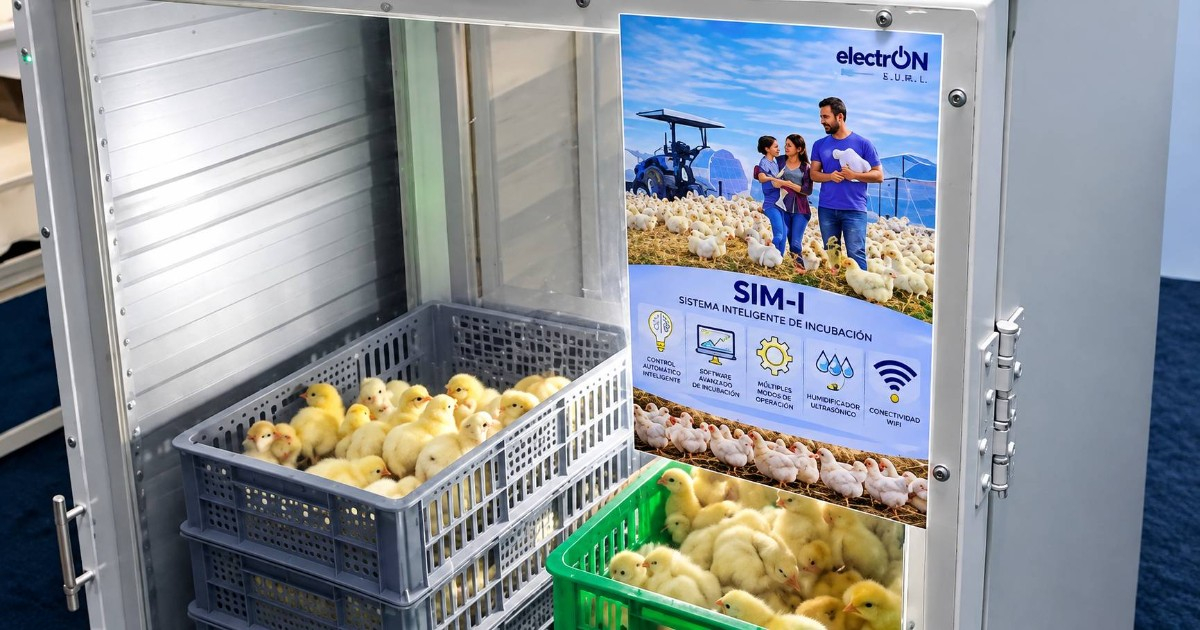
A group of engineers from Sancti Spíritus has developed a "smart incubator" capable of operating on solar energy and achieving a hatching rate of 93% for fertile eggs, according to a report this Saturday by the official media Cubadebate.
The initiative comes from the private micro, small, and medium-sized enterprise electrON S.U.R.L. and aims to provide a technological alternative for small poultry producers trying to survive amid a structural crisis exacerbated by power outages.
The project originated from two master's theses: one in Automation and Computational Systems, developed by Aslian Rodríguez Caballero at the Central University Marta Abreu of Las Villas, and the other in Applied Computer Science, led by Ángel Ramón Valdivia Hernández at the José Martí Pérez University of Sancti Spíritus.
The incubator has the capacity for 420 chicken eggs or 1,260 quail eggs, featuring intelligent automatic control, an ultrasonic humidifier, and wireless connectivity that allows monitoring from anywhere in the world.
The system operates using a client-server architecture with distributed sensors that record temperature, humidity, ventilation, gas levels, and egg rotation in real time.
"The system allows for the design of different profiles for hens, quails, turkeys, and other birds; each species has specific requirements, and the software program automatically controls all the variables of the incubation process," explained Valdivia Hernández.
One of the most important features of the equipment is its low energy consumption: 106 watts/hour on average, which significantly reduces the cost of the photovoltaic system required to keep it running continuously, even during prolonged power outages.
"One of the strengths of the developed system is its high energy efficiency, as it is an incubator that consumes an average of 106 watts per hour. Additionally, it can operate with a solar system, which reduces the costs of the photovoltaic energy support system necessary for the continuous operation of the plant," noted Rodríguez Caballero.
This ability to operate with solar panels is especially critical in the current context: in the first week of November 2026, the national electricity deficit hovered around 1,800-1,950 megawatts, with blackouts exceeding 20 hours in urban areas and 30 hours in rural areas.
The creators of the team also emphasize the project's technological autonomy. "We are independent, we have our own hardware and software, we use open hardware and open software, we are the designers of the program and the electronics for the entire incubator," stated Rodríguez Caballero.
The mipyme also developed the application Mi Granja, which allows producers to monitor the incubation process and share experiences within the community.
The project has been in development for four years and was conceived in a house on Ampliación Brigadier Reeves street, in the city of Sancti Spíritus, with the support of professors from the Central University Marta Abreu of Las Villas, as well as mechanical engineers, welders, and technicians.
The initiative arises at a time of collapse in the Cuban poultry sector. The egg production in Cuba fell from 2.717 billion units in 1991 to approximately 385 million in 2024, a reduction of 86%. In that same year, over 1.3 million laying hens died due to a lack of feed, and daily production plummeted from between four and five million units to just 1.2 million.
To compensate for this deficit, the regime imports around 16.5 million eggs monthly from the Dominican Republic, Brazil, and the United States, primarily intended for hospitals, schools, and maternal and child programs.
The national production target for 2026 is 690.7 million eggs, less than a quarter of the volume produced in 1991, highlighting the magnitude of the regression accumulated after decades of state management of the sector.
“If a producer brings 100 fertile quail eggs, they get 93 first-class chicks; and if they bring 100 fertile chicken eggs, they end up with more than 85 first-class hatchlings,” summarized Rodríguez Caballero, distilling the value proposition of a technology that, originating from a home in Sancti Spíritus, aims to expand across the entire island.
Related videos:
Filed under: