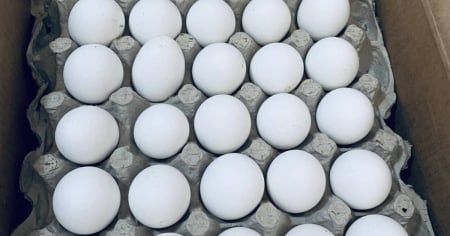
Ciego de Ávila set a production record of 120 million eggs in 2016, but eight years later, at the end of 2024, that figure plummeted to just 16 million, confirmed Rogelio García García, director of the provincial Poultry Company, during a recent presidential visit to the municipality of Majagua.
The decline represents a drop of 87%, in a context of widespread food shortages and unmet demand.
To meet the basic family basket needs in the area, at least 21 million eggs are required annually; however, there is a deficit of five million layers, reported the provincial newspaper Invasor.
Against this backdrop, the government is attempting to reactivate production through "cooperative production agreements," like the one implemented at the Mártires del Moncada unit, which is part of the Avícola de Ciego de Ávila company, located in Guayacanes, Majagua. The farm was revived in November 2024, after eight months of inactivity due to a lack of food for the birds, the source noted.
The agreement states that the private producer receives the feed from the Cuban Tobacco Business Group (Tabacuba). After collecting the eggs, 36% goes to the poultry company and the remainder to the private producer, who pays Tabacuba "in both egg and meat production as well as in freely convertible currency (MLC)," García explained.
According to the official, there are currently only seven active agreements of this kind in the province: four for layers, two for fattening, and one for replacement hens. The authorities plan to incorporate three more before the end of the year.
For his part, José Ignacio Iglesias Ceija, head of the Mártires del Moncada unit, highlighted the salary benefits for its 24 workers, which range from 14,000 to 23,000 pesos per month, as well as the profits that exceed three million pesos.
The Cuban leader Miguel Díaz-Canel asked how the poultry company would recover from its financial losses, “to which they explained that, in addition to the current one, other alternatives are being sought, such as the fattening of chickens and the sale of quail eggs,” emphasized Invasor.
Díaz-Canel and his entourage of party and government officials toured other entities in Majagua on Wednesday, where he reiterated his interest in "discovering and generalizing positive experiences."
The ruling leader visited the Canned Goods Factory in the municipality, which, to sustain its productions, partnered with a private micro, small, and medium-sized enterprise (mipyme) "and several productive entities." The partnership agreement aims to process this year “tomatoes from 106.5 hectares, with a yield of 15 tons per hectare.”
During the current tomato harvest, over 7,000 tons have been processed there, "in addition to the diversification of production into other assortments," the source stated without further details.
The Cuban government has been unable in recent years to produce the amount of eggs needed to supply the population, amid a deep economic crisis in which the country has experienced a significant decline in overall protein production.
In October 2024, the Minister of Agriculture, Ydael Pérez Brito, revealed that, from producing between four and five million eggs per day, only 1,200,000 are achieved, when they manage to feed the livestock.
The regime authorities attribute the collapse of the agricultural sector to the lack of supplies, fuel shortages, and climatic conditions. However, the latter do not seem to affect neighboring Dominican Republic, from where approximately 16.5 million eggs monthly are imported.
Cuba also imports eggs from countries such as Colombia and the United States. In fact, the latter are sold in state-owned hard currency stores as well as by micro, small, and medium enterprises (mipymes).
Online stores on the island also sell eggs from the U.S., although the regime claims that the U.S. embargo prevents it from purchasing basic food products.
Due to the lack of a historically essential food in the diet of Cubans, a carton of eggs has reached astronomical prices in the informal market, which far exceed the minimum wage or pension.
In 2024, Cubans reported the exorbitant cost of a “file” of hen's chicks: 5,000 pesos on the black market, a price that a low-wage worker or a retiree, with their minimal pension, cannot afford.
Frequently asked questions about the egg production crisis in Ciego de Ávila
Why has egg production fallen in Ciego de Ávila?
The production of eggs in Ciego de Ávila has fallen by 87% in the last eight years due to a shortage of feed for the birds, along with a series of economic and logistical issues affecting the agricultural sector in Cuba. The lack of supplies and fuel, as well as adverse weather conditions, have contributed to this significant decline.
What measures is the Cuban government taking to reactivate egg production?
The Cuban government is implementing "cooperative production agreements", such as the one at the Mártires del Moncada unit, where the private producer receives feed from the Cuban Tobacco Business Group (Tabacuba). Part of the production is allocated to the poultry company, and the rest goes to the private producer, who pays Tabacuba with eggs, meat, or freely convertible currency (MLC).
How does the egg shortage affect the Cuban population?
The shortage of eggs in Cuba has led to a significant increase in prices in the informal market, where a carton of eggs can reach astronomical prices that exceed the basic salary or the minimum pension for retirees. This situation exacerbates food insecurity in the country, making it difficult to access an essential food item in the Cuban diet.
Where does Cuba import eggs from to meet domestic demand?
Cuba imports eggs mainly from the Dominican Republic, averaging 16.5 million units per month, as well as from countries like Colombia and the United States. These imports aim to compensate for the lack of domestic production, although they do not fully meet domestic demand.
Filed under: