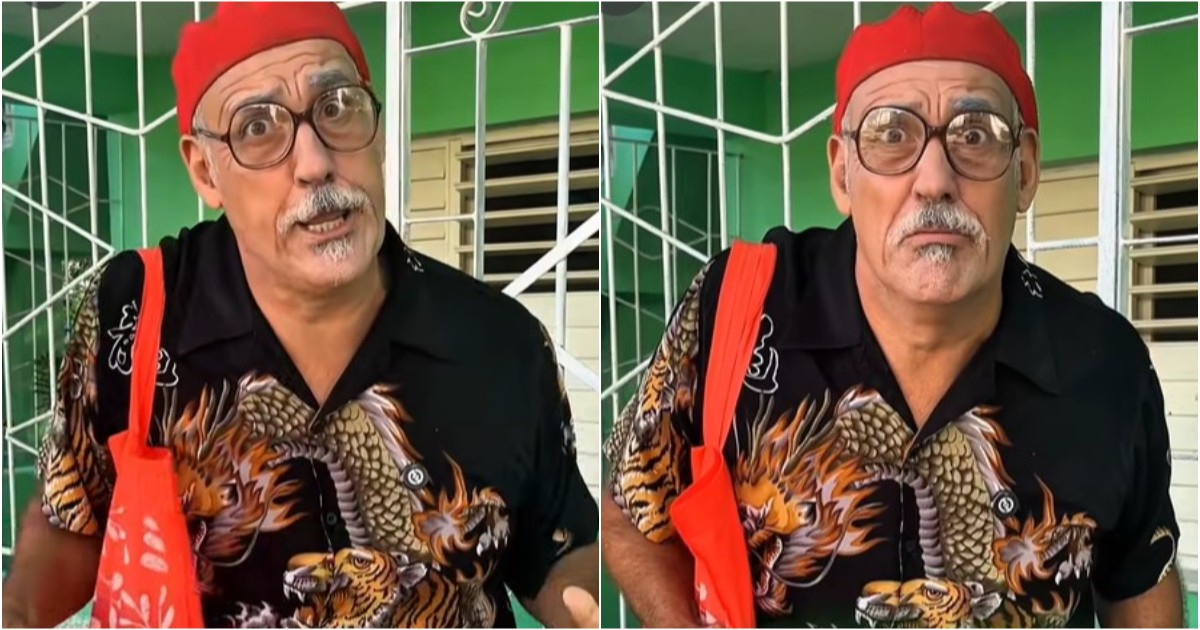
The popular Cuban actor Mario Sardiñas, known for his character Chequera from the show "Vivir del cuento," once again struck a chord with the Cuban reality by sharing a new 45-second reel published on Facebook in which he satirizes the intermittent blackouts in Cuba as if they were a contagious disease.
In the sketch posted on social media this Friday, Chequera confesses to his niece that he has "gotten tangled up with that virus from the electric company, that bad one that’s going around." The diagnosis leaves no room for doubt: it’s the "quitaypón virus," that constant flickering of the power which, according to the patient, "lasts an hour, two hours, and can even last up to three hours." The description is so accurate that any Cuban would recognize it immediately: "Then you stabilize, but the next day you catch it again."
The niece, playing the role of a skeptical interlocutor, asks if there is any cure. Chequera responds with the solemnity of an on-call doctor: "Yes, niece, you need to go [...] to the bathroom and splash some fresh water on your face." The punchline comes when the niece, relieved, tells him she has already started the treatment. "Niece, I'm waiting... for the water to come," Chequera replies, with that calm that only resignation brings.
The term "quitaypón" is not new to Sardiñas' vocabulary. It was coined in August 2026 in a 42-second song that described the cycles of "four hours of quita y pon, ten minutes of current", and it surpassed 20,000 views on Facebook. The new reel updates that concept with a medical metaphor that is as precise as it is devastating: blackouts behave exactly like a virus, with recurrent symptoms, no definitive cure, and impossible treatment.
The joke has a reality that isn't funny. This Friday, the Electric Union forecasted a shortfall of 1,838 MW during peak hours, with only 1,072 MW available against a demand of 2,880 MW. So far in 2026, Cuba has experienced at least eight total disconnections from the National Electric System.
The ending of the absent water adds a second layer of dark humor that is, in fact, pure drama. According to recent data from the National Institute of Hydraulic Resources, over 2.6 million Cubans experience interruptions in their drinking water supply, and more than 50% of these interruptions are directly due to a lack of electricity to operate the pumping stations.
Government officials have acknowledged that the water situation is serious and complex. Residents of some communities in Havana, Santiago de Cuba, and Pinar del Río, to name just a few areas, have reported going for months without receiving water through the pipelines.
The popular Chequera, by Mario Sardiñas, has long served as a comedic barometer of the Cuban crisis. Last month, he described his neighborhood of Arroyo Arenas as "a tribe" without electricity, internet, and cooking with wood, in a video that garnered tens of thousands of views. By the end of that same month, he satirized the price of a Halloween pumpkin: 1,700 pesos, over half of the monthly minimum wage.
In September, Cheque adapted "40 y 20" by José José, to denounce "40 hours without electricity and 20 days without water", a video that gathered over 220,000 views. Among the comments on the new reel, followers quickly recognized themselves in the character: many pointed out that they also have that virus and that the water treatment is not working for them either, for obvious reasons.
The video of the "quitaypón virus" accumulated over 11,000 views and 800 reactions in just a few hours—figures that, in the context of Cuba in 2026, serve almost as an epidemiological indicator: the more Cubans are affected by the Electric Company virus, the more views Chequera gains.
Related videos:
Filed under: