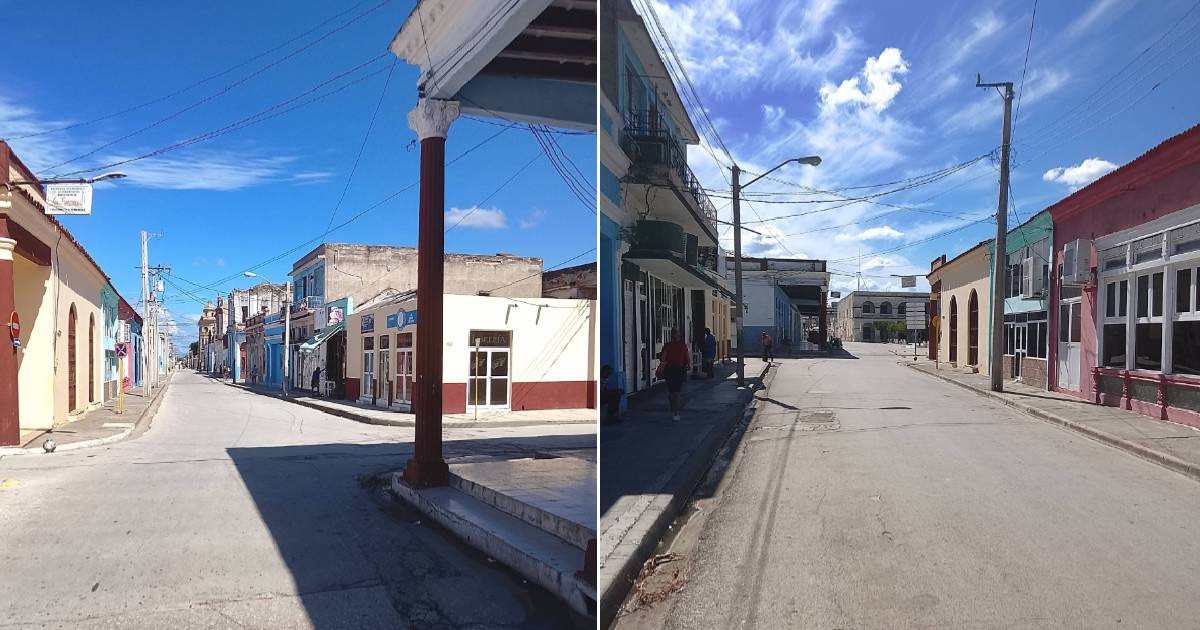
Photos shared on social media depict the streets of Manzanillo, in the province of Granma, virtually deserted at any hour of the day, a stark contrast to the hustle and bustle that once characterized this city and which is raising concerns among its residents once again.
"Before, it was a great hustle and bustle of people at all hours, but now all the streets are empty at any time," wrote the author of the post, shared on the profile on Facebook "vivencias," after being away from his homeland for two years, as he confessed in previous posts.
The images show avenues with colonial architecture, minimal pedestrian presence, deteriorated buildings, and poorly maintained pavement.
The contrast was also documented in June by a Cuban identified as Claudia Manzanillo, who traveled through the city for her series "Walking My Land" and found streets with no cars or pedestrians, debris, accumulated trash, and a leak of dirty water.
"There was a time when this area was known for different things: movement, family, the life that existed at every corner... And today, what stands out the most is the silence," he said in a video that sparked reactions among Cubans both on and off the island.
In recent months, similar scenes have emerged in Limonar, Matanzas; Trinidad, Sancti Spíritus; El Vedado, in Havana, and Gibara, Holguín.
Behind this phenomenon is a demographic crisis of enormous proportions. Cuba closed 2025 with 9,434,593 effective inhabitants, according to the National Office of Statistics and Information (ONEI), compared to the 11,113,215 recorded in 2022. The difference exceeds 1.67 million people in just three years.
The external migration balance for 2025 was -245,264 people, with 317,320 recorded departures. Between 70% and 80% of those who emigrate are under 40 years old, while 26.7% of the population remaining in the country is already over 60 years old.
Manzanillo has also lost residents. The city had about 123,610 inhabitants in 2021, and projections based on the ONEI yearbooks indicate that its population will be around 105,610 in 2026, reflecting an approximate reduction of 14.6% over five years.
Emigration is exacerbated by living conditions that hinder daily activities. In October, some areas of Manzanillo had gone up to 22 months without a regular water supply.
In September 2025, residents of the Gutiérrez neighborhood confronted the Vice President of the Government, Inés María Chapman, during an official visit to report service interruptions that were also affecting the local hospital.
Daily power outages of 20 hours or more, along with gasoline prices reaching 4,000 pesos per liter, create a situation that restricts mobility and exacerbates the challenges faced by families.
"These images resonate deeply with those who grew up here, because they are not just looking at a street, they are comparing a memory with a reality," summarized Claudia Manzanillo during her tour in June.
Related videos:
Filed under: