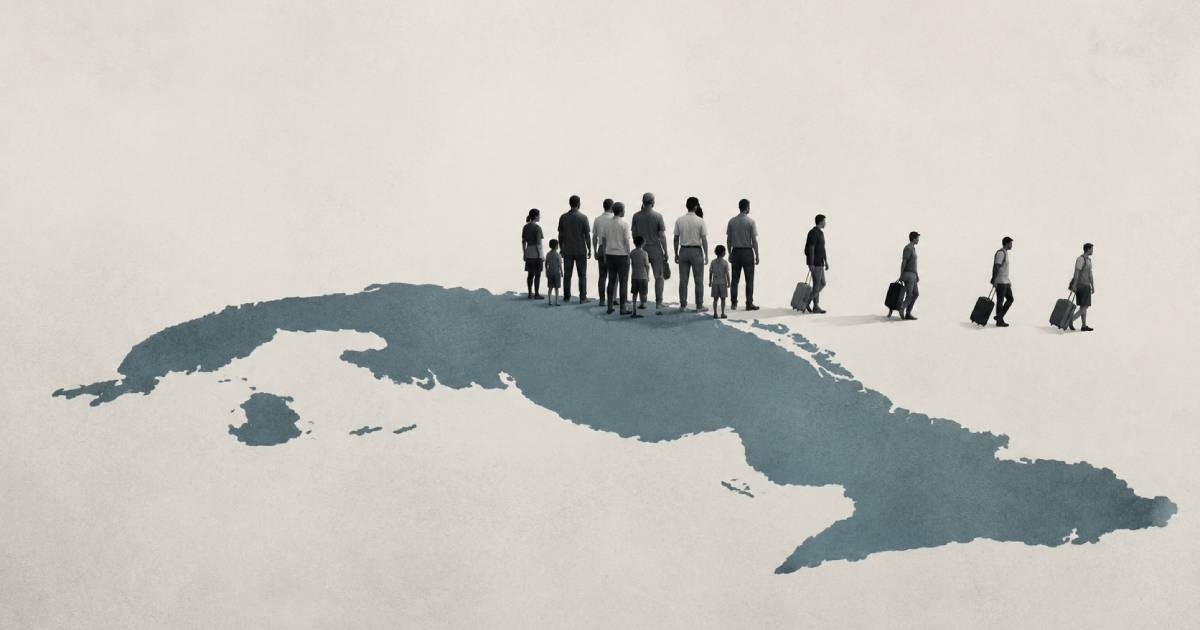
Cuba ended 2025 with only 9,434,593 inhabitants, according to official data presented this Tuesday by the National Office of Statistics and Information (ONEI) at a press conference.
The figure, published by ONEI on its social media, places the island's population below 9.5 million residents and confirms an unprecedented demographic contraction in the modern history of the country.
Juan Carlos Alfonso Fraga, Deputy Head of ONEI, and Diego Enrique González Galbán, Director of the Population and Development Studies Center, presented the data to the press.
Regarding 2024, when the effective population was 9,748,007 people, the island lost 313,414 inhabitants in just one year.
Birth rate indicators have been the most critical for over a century. In 2025, only 68,064 Cubans were born, the lowest figure in recent decades and even lower than the number recorded in 1899, when the island was emerging from the War of Independence.
At the same time, the deaths rose to 136,214, almost double the number of births, which resulted in a natural growth rate of -7.1 per 1,000 inhabitants.
The global fertility rate remained at 1.29 children per woman for the second consecutive year, marking the lowest historical rate since records began in 1958, well below the generational replacement level of 2.1.
Emigration further exacerbates the situation. The negative net migration in 2025 was -245,264 people, which means that the island is losing population even before accounting for deaths.
In just five years, Cuba's population declined from over 11 million at the end of 2020 to the current 9.4 million, a drop of more than 1.6 million people during that period.
The aging population has also reached a new record: 26.7% of Cubans are 60 years or older, keeping Cuba as the oldest country in Latin America and the Caribbean. In five years, the island has also lost 1,259,894 people of working age, a direct blow to the already weakened productive capacity of the country.
The official figures, despite their significance, could even underestimate the magnitude of the problem. Demographer Juan Carlos Albizu-Campos estimated in a 2025 study, to which the EFE agency had access, that by the end of 2024, only 8,025,624 people were living in Cuba, 24% less than in 2020.
Albizu-Campos argues that the regime's statistics omit tens of thousands of emigrants who are not heading to the United States, and describes the phenomenon as a "demographic hollowing out" typical of wartime contexts.
Alfonso Fraga himself acknowledged to the United Nations Population Fund (UNFPA) during a meeting held in Havana on June 29 that "there is no similar experience" in any country of the Global South outside of a war scenario.
The international organization reiterated its warning that if current trends continue, Cuba could end the 21st century with just 5.6 million inhabitants.
Meanwhile, Díaz-Canel downplayed the exodus on June 25 by describing emigration as "a global problem" and attributing the departure of professionals to the appeal of capitalist economies, avoiding any responsibility of the regime in the crisis that is emptying the island.
Cuba has not conducted a national census since 2012. The census operation that began in 2026 will not yield results until 2027, so current projections are obtained through the so-called compensatory equation, which combines births, deaths, and migration flows to estimate the population without the need for a direct count.
Related videos:
Filed under: