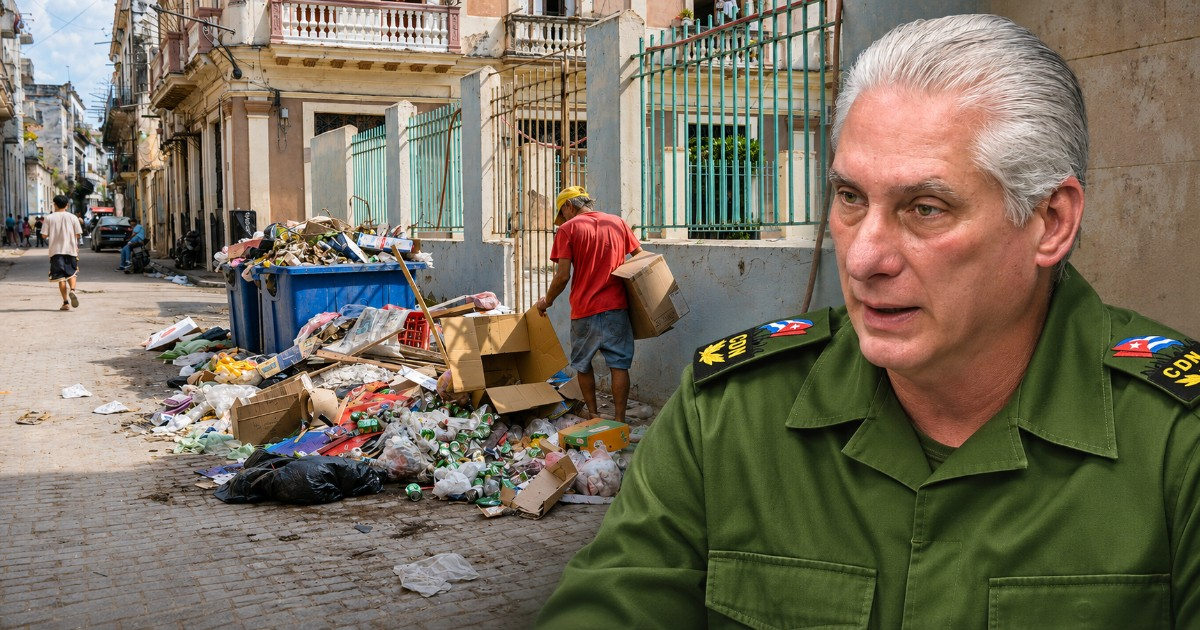
A message from Miguel Díaz-Canel in which he stated that "the future of Cuba will never be decided in the north" triggered a wave of critical responses from Cubans who turned his own arguments against the government, demanding free elections and highlighting the crisis they face daily.
The leader published the text in response to statements made by President Donald Trump —who labeled Cuba a "failed nation" and predicted that the island will "fall quite soon"— and Secretary of State Marco Rubio, who, during the G7 ministers meeting in Paris, asserted that promoting political and economic changes in Cuba is a "priority" for Washington. Díaz-Canel described U.S. energy restrictions as a "criminal blockade of fuels" and "collective punishment" against the Cuban people, and accused the U.S. of justifying its policy towards the island with "ridiculous lies."
The response from Cubans in the comments was emphatic. The most frequently mentioned demand was for free elections, with multiple parties and direct voting for the president, a figure that is not provided for in the Cuban Constitution.
"The future should be decided by Cubans at the ballot box, with opposition and clean elections, exercising their rights without pressure, in freedom," wrote a commentator.
Another was more direct: "What future? You have left no future!"
Several Cubans used Díaz-Canel's own words against his government. "Two very real phrases from the writing: 'It is perverse not to assume responsibility' and 'The lies are becoming more and more ridiculous,'" noted one of them, applying these to the regime's management.
The contradiction between the discourse of sovereignty and external dependence was also a target of criticism: "We depend on the United States for our food, on Venezuela for our electricity, on Chinese charity to keep our equipment running, and on the Russians for just about anything. I don’t know, Limoncín, but I don’t see sovereignty in that."
The energy crisis that the island is experiencing served as the backdrop for many reactions. The Cuban Electric Utility was only meeting 38% of the national demand in the early days of November, with circuits in Havana experiencing over 52 consecutive hours without electricity.
"To be without electricity for 21 hours a day is perverse," responded a user.
Another person sarcastically remarked: "Poor thing, he's also been without electricity for 24 hours and is waiting to see if the water comes in today, as it hasn't flowed for six days."
Material shortages surfaced in dozens of comments: lack of medicines in pharmacies, food spoiled due to power outages, and skyrocketing prices. "Stop looking so much to the north and look down here, because soap is already 700 pesos, we're going to die," wrote a Cuban.
The gap between rulers and the ruled was another recurring theme: "Let the leaders live like the people, and then tell me if they 'bend' or not. If I lived as you do, I would be willing to 'resist' for a hundred years."
Some questioned the historical legitimacy that Díaz-Canel invoked by mentioning January 1, 1959: "I did not know that there were general elections in Cuba on January 1, 1959."
The pattern repeats itself: throughout 2026, every anti-imperialist rhetoric message from the leader has been met with similar criticisms, ranging from posts about sanctions and salary increases to National Defense Day, when Cubans summarized their discontent with one phrase: "The war is not of the whole people. The war is yours."
"The people of the United States are not going hungry, but those in Cuba are; that's the main difference. Keep resisting, and you will be left without a people," concluded one of the most cited commentators in the thread.
Related videos:
Filed under: